







Iran accelerates massive 2 bcm desalination project to tackle severe drought
Iran’s Energy Minister Abbas Aliabadi said the government is accelerating work on a large-scale seawater desalination program with a capacity of two billion cubic meters, describing the effort as essential to coping with one of the country’s harshest multi-year droughts.
Aliabadi said current plans target more than 2 billion cubic meters of desalination capacity, a volume that would place Iran “in the first rank of the region,” IRNA reported.
Speaking Thursday evening at an administrative council of five southern counties in Kerman Province, Aliabadi said the government is determined to complete the initiative.
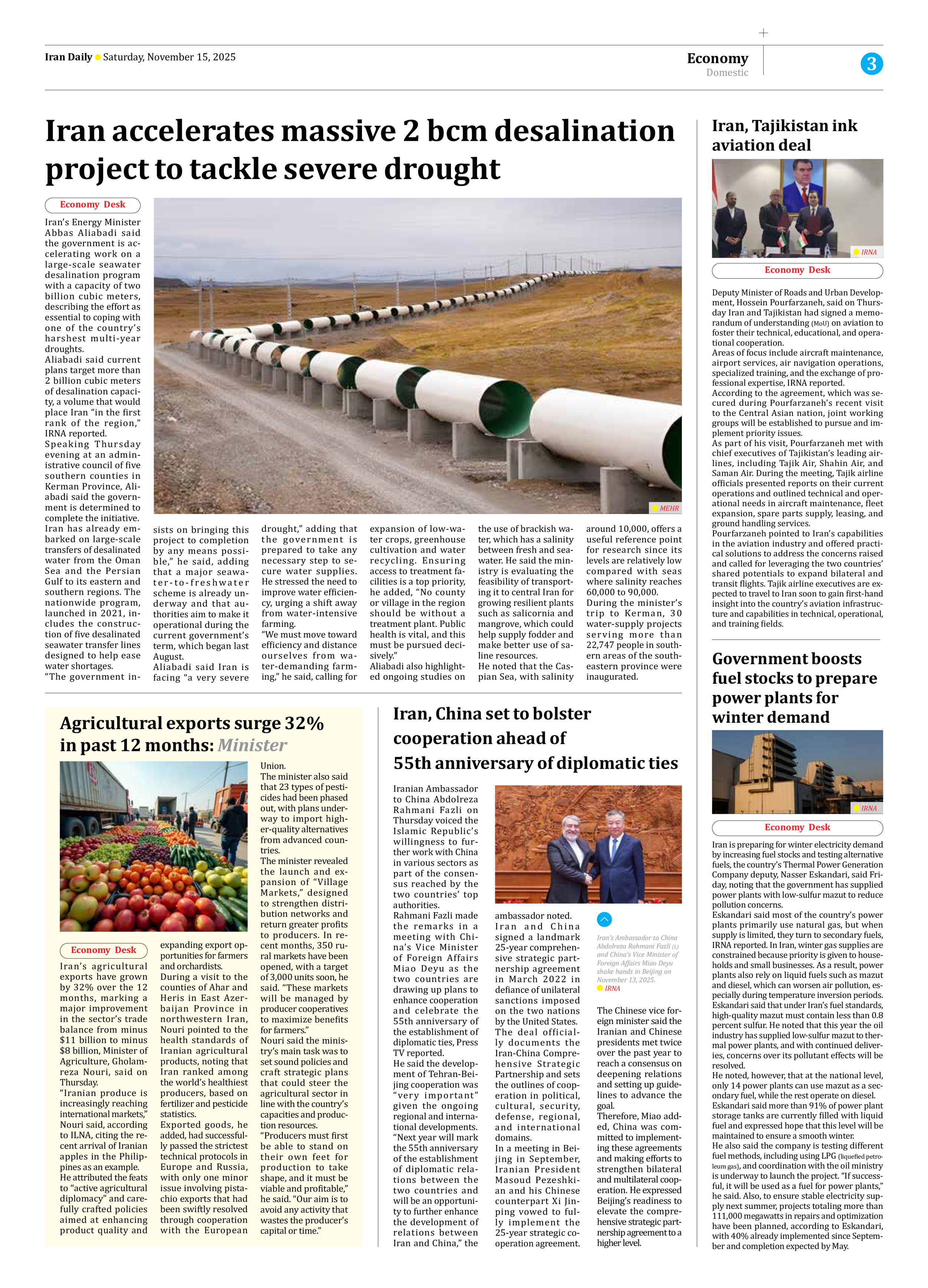
Iran has already embarked on large-scale transfers of desalinated water from the Oman Sea and the Persian Gulf to its eastern and southern regions. The nationwide program, launched in 2021, includes the construction of five desalinated seawater transfer lines designed to help ease water shortages.
“The government insists on bringing this project to completion by any means possible,” he said, adding that a major seawater-to-freshwater scheme is already underway and that authorities aim to make it operational during the current government’s term, which began last August.
Aliabadi said Iran is facing “a very severe drought,” adding that the government is prepared to take any necessary step to secure water supplies. He stressed the need to improve water efficiency, urging a shift away from water-intensive farming.
“We must move toward efficiency and distance ourselves from water-demanding farming,” he said, calling for expansion of low-water crops, greenhouse cultivation and water recycling. Ensuring access to treatment facilities is a top priority, he added, “No county or village in the region should be without a treatment plant. Public health is vital, and this must be pursued decisively.”
Aliabadi also highlighted ongoing studies on the use of brackish water, which has a salinity between fresh and seawater. He said the ministry is evaluating the feasibility of transporting it to central Iran for growing resilient plants such as salicornia and mangrove, which could help supply fodder and make better use of saline resources.
He noted that the Caspian Sea, with salinity around 10,000, offers a useful reference point for research since its levels are relatively low compared with seas where salinity reaches 60,000 to 90,000.
During the minister’s trip to Kerman, 30 water-supply projects serving more than 22,747 people in southern areas of the southeastern province were inaugurated.