





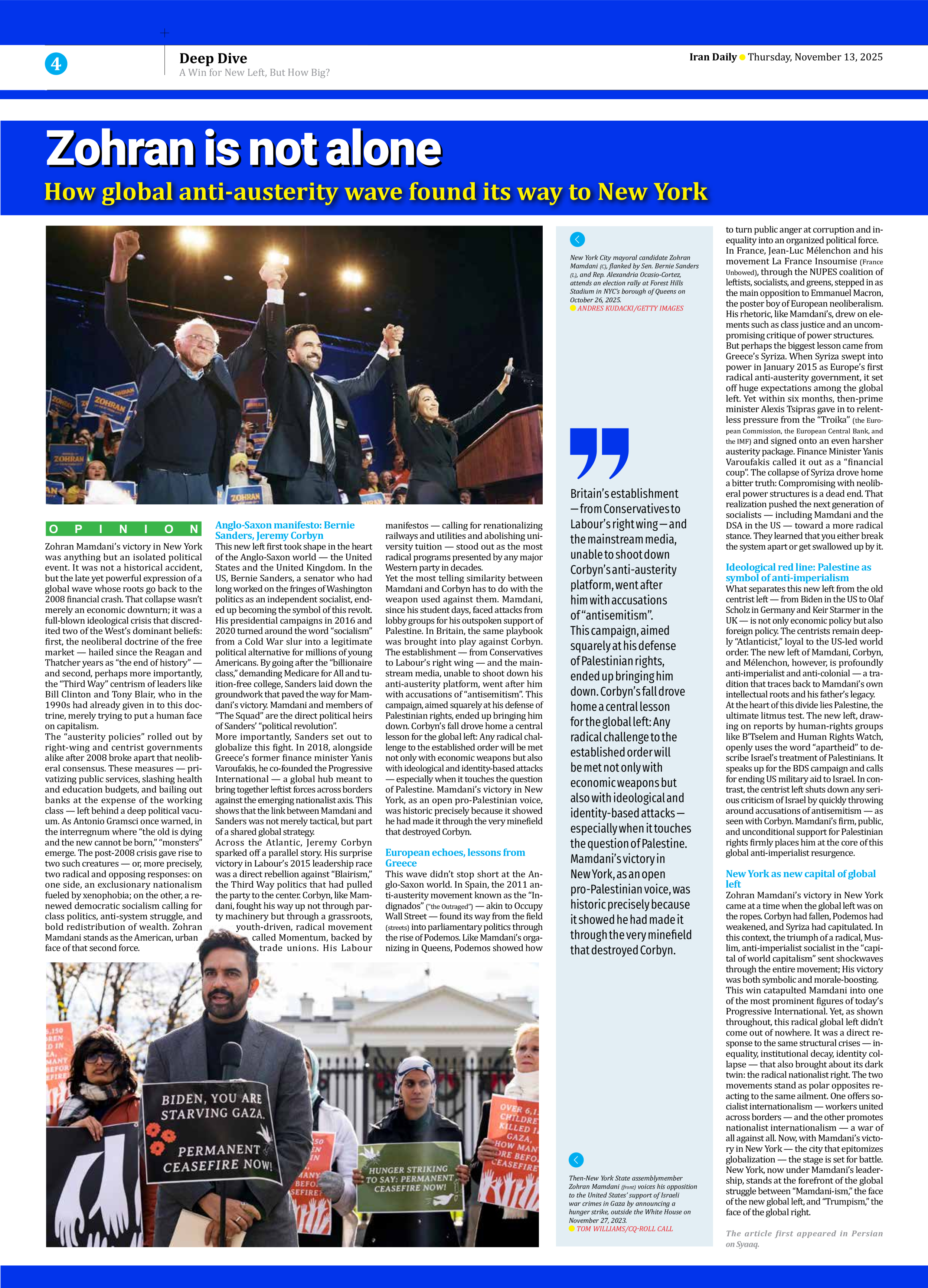


Zohran is not alone
How global anti-austerity wave found its way to New York
Zohran Mamdani’s victory in New York was anything but an isolated political event. It was not a historical accident, but the late yet powerful expression of a global wave whose roots go back to the 2008 financial crash. That collapse wasn’t merely an economic downturn; it was a full-blown ideological crisis that discredited two of the West’s dominant beliefs: first, the neoliberal doctrine of the free market — hailed since the Reagan and Thatcher years as “the end of history” — and second, perhaps more importantly, the “Third Way” centrism of leaders like Bill Clinton and Tony Blair, who in the 1990s had already given in to this doctrine, merely trying to put a human face on capitalism.
The “austerity policies” rolled out by right-wing and centrist governments alike after 2008 broke apart that neoliberal consensus. These measures — privatizing public services, slashing health and education budgets, and bailing out banks at the expense of the working class — left behind a deep political vacuum. As Antonio Gramsci once warned, in the interregnum where “the old is dying and the new cannot be born,” “monsters” emerge. The post‑2008 crisis gave rise to two such creatures — or, more precisely, two radical and opposing responses: on one side, an exclusionary nationalism fueled by xenophobia; on the other, a renewed democratic socialism calling for class politics, anti‑system struggle, and bold redistribution of wealth. Zohran Mamdani stands as the American, urban face of that second force.
Anglo‑Saxon manifesto: Bernie Sanders, Jeremy Corbyn
This new left first took shape in the heart of the Anglo‑Saxon world — the United States and the United Kingdom. In the US, Bernie Sanders, a senator who had long worked on the fringes of Washington politics as an independent socialist, ended up becoming the symbol of this revolt. His presidential campaigns in 2016 and 2020 turned around the word “socialism” from a Cold War slur into a legitimate political alternative for millions of young Americans. By going after the “billionaire class,” demanding Medicare for All and tuition‑free college, Sanders laid down the groundwork that paved the way for Mamdani’s victory. Mamdani and members of “The Squad” are the direct political heirs of Sanders’ “political revolution”.
More importantly, Sanders set out to globalize this fight. In 2018, alongside Greece’s former finance minister Yanis Varoufakis, he co‑founded the Progressive International — a global hub meant to bring together leftist forces across borders against the emerging nationalist axis. This shows that the link between Mamdani and Sanders was not merely tactical, but part of a shared global strategy.
Across the Atlantic, Jeremy Corbyn sparked off a parallel story. His surprise victory in Labour’s 2015 leadership race was a direct rebellion against “Blairism,” the Third Way politics that had pulled the party to the center. Corbyn, like Mamdani, fought his way up not through party machinery but through a grassroots, youth‑driven, radical movement called Momentum, backed by trade unions. His Labour manifestos — calling for renationalizing railways and utilities and abolishing university tuition — stood out as the most radical programs presented by any major Western party in decades.
Yet the most telling similarity between Mamdani and Corbyn has to do with the weapon used against them. Mamdani, since his student days, faced attacks from lobby groups for his outspoken support of Palestine. In Britain, the same playbook was brought into play against Corbyn. The establishment — from Conservatives to Labour’s right wing — and the mainstream media, unable to shoot down his anti‑austerity platform, went after him with accusations of “antisemitism”. This campaign, aimed squarely at his defense of Palestinian rights, ended up bringing him down. Corbyn’s fall drove home a central lesson for the global left: Any radical challenge to the established order will be met not only with economic weapons but also with ideological and identity‑based attacks — especially when it touches the question of Palestine. Mamdani’s victory in New York, as an open pro‑Palestinian voice, was historic precisely because it showed he had made it through the very minefield that destroyed Corbyn.
European echoes, lessons from Greece
This wave didn’t stop short at the Anglo‑Saxon world. In Spain, the 2011 anti‑austerity movement known as the “Indignados” (“the Outraged”) — akin to Occupy Wall Street — found its way from the field (streets) into parliamentary politics through the rise of Podemos. Like Mamdani’s organizing in Queens, Podemos showed how to turn public anger at corruption and inequality into an organized political force.
In France, Jean‑Luc Mélenchon and his movement La France Insoumise (France Unbowed), through the NUPES coalition of leftists, socialists, and greens, stepped in as the main opposition to Emmanuel Macron, the poster boy of European neoliberalism. His rhetoric, like Mamdani’s, drew on elements such as class justice and an uncompromising critique of power structures.
But perhaps the biggest lesson came from Greece’s Syriza. When Syriza swept into power in January 2015 as Europe’s first radical anti‑austerity government, it set off huge expectations among the global left. Yet within six months, then-prime minister Alexis Tsipras gave in to relentless pressure from the “Troika” (the European Commission, the European Central Bank, and the IMF) and signed onto an even harsher austerity package. Finance Minister Yanis Varoufakis called it out as a “financial coup”. The collapse of Syriza drove home a bitter truth: Compromising with neoliberal power structures is a dead end. That realization pushed the next generation of socialists — including Mamdani and the DSA in the US — toward a more radical stance. They learned that you either break the system apart or get swallowed up by it.
Ideological red line: Palestine as symbol of anti‑imperialism
What separates this new left from the old centrist left — from Biden in the US to Olaf Scholz in Germany and Keir Starmer in the UK — is not only economic policy but also foreign policy. The centrists remain deeply “Atlanticist,” loyal to the US‑led world order. The new left of Mamdani, Corbyn, and Mélenchon, however, is profoundly anti‑imperialist and anti‑colonial — a tradition that traces back to Mamdani’s own intellectual roots and his father’s legacy.
At the heart of this divide lies Palestine, the ultimate litmus test. The new left, drawing on reports by human‑rights groups like B’Tselem and Human Rights Watch, openly uses the word “apartheid” to describe Israel’s treatment of Palestinians. It speaks up for the BDS campaign and calls for ending US military aid to Israel. In contrast, the centrist left shuts down any serious criticism of Israel by quickly throwing around accusations of antisemitism — as seen with Corbyn. Mamdani’s firm, public, and unconditional support for Palestinian rights firmly places him at the core of this global anti‑imperialist resurgence.
New York as new capital of global left
Zohran Mamdani’s victory in New York came at a time when the global left was on the ropes. Corbyn had fallen, Podemos had weakened, and Syriza had capitulated. In this context, the triumph of a radical, Muslim, anti‑imperialist socialist in the “capital of world capitalism” sent shockwaves through the entire movement; His victory was both symbolic and morale‑boosting.
This win catapulted Mamdani into one of the most prominent figures of today’s Progressive International. Yet, as shown throughout, this radical global left didn’t come out of nowhere. It was a direct response to the same structural crises — inequality, institutional decay, identity collapse — that also brought about its dark twin: the radical nationalist right. The two movements stand as polar opposites reacting to the same ailment. One offers socialist internationalism — workers united across borders — and the other promotes nationalist internationalism — a war of all against all. Now, with Mamdani’s victory in New York — the city that epitomizes globalization — the stage is set for battle. New York, now under Mamdani’s leadership, stands at the forefront of the global struggle between “Mamdani‑ism,” the face of the new global left, and “Trumpism,” the face of the global right.
The article first appeared in Persian
on Syaaq.