







India’s Chabahar waiver shows Washington’s effort to preserve strategic ties
By Sadeq Dehqan
Staff writer
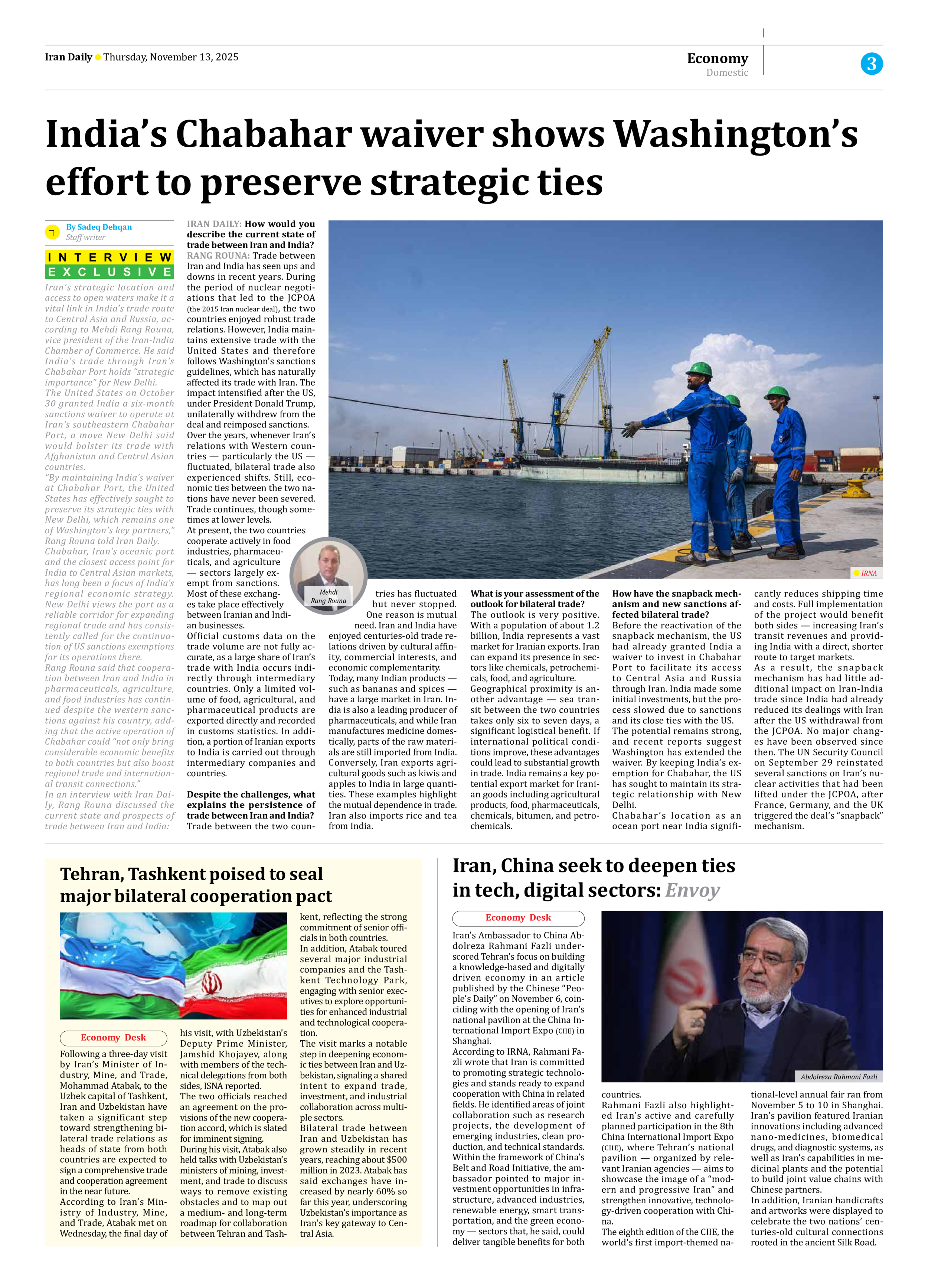
Iran’s strategic location and access to open waters make it a vital link in India’s trade route to Central Asia and Russia, according to Mehdi Rang Rouna, vice president of the Iran-India Chamber of Commerce. He said India’s trade through Iran’s Chabahar Port holds “strategic importance” for New Delhi.
The United States on October 30 granted India a six-month sanctions waiver to operate at Iran’s southeastern Chabahar Port, a move New Delhi said would bolster its trade with Afghanistan and Central Asian countries.
“By maintaining India’s waiver at Chabahar Port, the United States has effectively sought to preserve its strategic ties with New Delhi, which remains one of Washington’s key partners,” Rang Rouna told Iran Daily.
Chabahar, Iran’s oceanic port and the closest access point for India to Central Asian markets, has long been a focus of India’s regional economic strategy. New Delhi views the port as a reliable corridor for expanding regional trade and has consistently called for the continuation of US sanctions exemptions for its operations there.
Rang Rouna said that cooperation between Iran and India in pharmaceuticals, agriculture, and food industries has continued despite the western sanctions against his country, adding that the active operation of Chabahar could “not only bring considerable economic benefits to both countries but also boost regional trade and international transit connections.”
In an interview with Iran Daily, Rang Rouna discussed the current state and prospects of trade between Iran and India:
IRAN DAILY: How would you describe the current state of trade between Iran and India?
Rang Rouna: Trade between Iran and India has seen ups and downs in recent years. During the period of nuclear negotiations that led to the JCPOA (the 2015 Iran nuclear deal), the two countries enjoyed robust trade relations. However, India maintains extensive trade with the United States and therefore follows Washington’s sanctions guidelines, which has naturally affected its trade with Iran. The impact intensified after the US, under President Donald Trump, unilaterally withdrew from the deal and reimposed sanctions.
Over the years, whenever Iran’s relations with Western countries — particularly the US — fluctuated, bilateral trade also experienced shifts. Still, economic ties between the two nations have never been severed. Trade continues, though sometimes at lower levels.
At present, the two countries cooperate actively in food industries, pharmaceuticals, and agriculture — sectors largely exempt from sanctions. Most of these exchanges take place effectively between Iranian and Indian businesses.
Official customs data on the trade volume are not fully accurate, as a large share of Iran’s trade with India occurs indirectly through intermediary countries. Only a limited volume of food, agricultural, and pharmaceutical products are exported directly and recorded in customs statistics. In addition, a portion of Iranian exports to India is carried out through intermediary companies and countries.
Despite the challenges, what explains the persistence of trade between Iran and India?
Trade between the two countries has fluctuated but never stopped. One reason is mutual need. Iran and India have enjoyed centuries-old trade relations driven by cultural affinity, commercial interests, and economic complementarity.
Today, many Indian products — such as bananas and spices — have a large market in Iran. India is also a leading producer of pharmaceuticals, and while Iran manufactures medicine domestically, parts of the raw materials are still imported from India.
Conversely, Iran exports agricultural goods such as kiwis and apples to India in large quantities. These examples highlight the mutual dependence in trade. Iran also imports rice and tea from India.
What is your assessment of the outlook for bilateral trade?
The outlook is very positive. With a population of about 1.2 billion, India represents a vast market for Iranian exports. Iran can expand its presence in sectors like chemicals, petrochemicals, food, and agriculture.
Geographical proximity is another advantage — sea transit between the two countries takes only six to seven days, a significant logistical benefit. If international political conditions improve, these advantages could lead to substantial growth in trade. India remains a key potential export market for Iranian goods including agricultural products, food, pharmaceuticals, chemicals, bitumen, and petrochemicals.
How have the snapback mechanism and new sanctions affected bilateral trade?
Before the reactivation of the snapback mechanism, the US had already granted India a waiver to invest in Chabahar Port to facilitate its access to Central Asia and Russia through Iran. India made some initial investments, but the process slowed due to sanctions and its close ties with the US.
The potential remains strong, and recent reports suggest Washington has extended the waiver. By keeping India’s exemption for Chabahar, the US has sought to maintain its strategic relationship with New Delhi.
Chabahar’s location as an ocean port near India significantly reduces shipping time and costs. Full implementation of the project would benefit both sides — increasing Iran’s transit revenues and providing India with a direct, shorter route to target markets.
As a result, the snapback mechanism has had little additional impact on Iran-India trade since India had already reduced its dealings with Iran after the US withdrawal from the JCPOA. No major changes have been observed since then. The UN Security Council on September 29 reinstated several sanctions on Iran’s nuclear activities that had been lifted under the JCPOA, after France, Germany, and the UK triggered the deal’s “snapback” mechanism.