





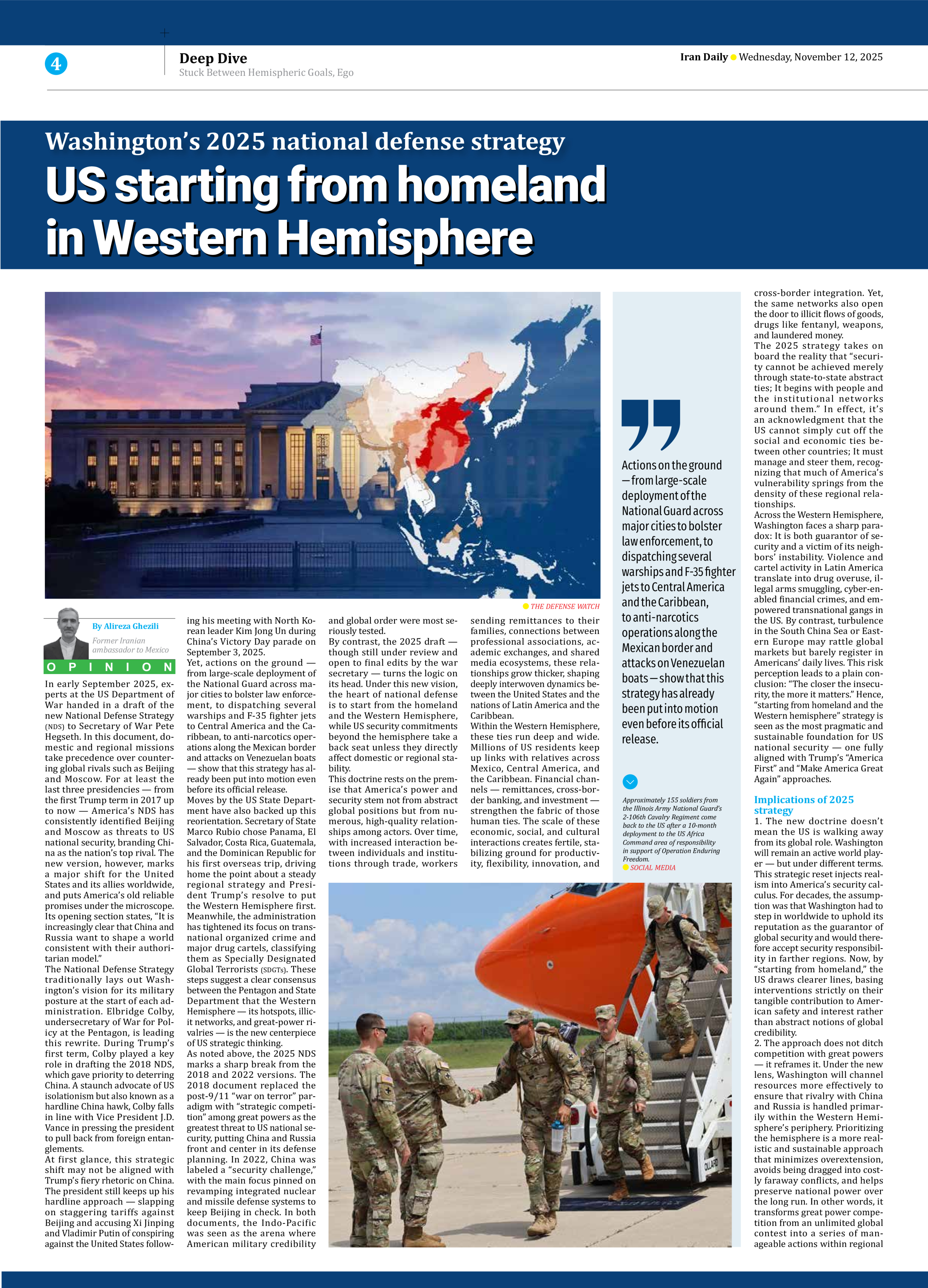


Washington’s 2025 national defense strategy
US starting from homeland in Western Hemisphere
By Alireza Ghezili
Former Iranian ambassador to Mexico
In early September 2025, experts at the US Department of War handed in a draft of the new National Defense Strategy (NDS) to Secretary of War Pete Hegseth. In this document, domestic and regional missions take precedence over countering global rivals such as Beijing and Moscow. For at least the last three presidencies — from the first Trump term in 2017 up to now — America’s NDS has consistently identified Beijing and Moscow as threats to US national security, branding China as the nation’s top rival. The new version, however, marks a major shift for the United States and its allies worldwide, and puts America’s old reliable promises under the microscope. Its opening section states, “It is increasingly clear that China and Russia want to shape a world consistent with their authoritarian model.”
The National Defense Strategy traditionally lays out Washington’s vision for its military posture at the start of each administration. Elbridge Colby, undersecretary of War for Policy at the Pentagon, is leading this rewrite. During Trump’s first term, Colby played a key role in drafting the 2018 NDS, which gave priority to deterring China. A staunch advocate of US isolationism but also known as a hardline China hawk, Colby falls in line with Vice President J.D. Vance in pressing the president to pull back from foreign entanglements.
At first glance, this strategic shift may not be aligned with Trump’s fiery rhetoric on China. The president still keeps up his hardline approach — slapping on staggering tariffs against Beijing and accusing Xi Jinping and Vladimir Putin of conspiring against the United States following his meeting with North Korean leader Kim Jong Un during China’s Victory Day parade on September 3, 2025.
Yet, actions on the ground — from large-scale deployment of the National Guard across major cities to bolster law enforcement, to dispatching several warships and F-35 fighter jets to Central America and the Caribbean, to anti-narcotics operations along the Mexican border and attacks on Venezuelan boats — show that this strategy has already been put into motion even before its official release.
Moves by the US State Department have also backed up this reorientation. Secretary of State Marco Rubio chose Panama, El Salvador, Costa Rica, Guatemala, and the Dominican Republic for his first overseas trip, driving home the point about a steady regional strategy and President Trump’s resolve to put the Western Hemisphere first. Meanwhile, the administration has tightened its focus on transnational organized crime and major drug cartels, classifying them as Specially Designated Global Terrorists (SDGTs). These steps suggest a clear consensus between the Pentagon and State Department that the Western Hemisphere — its hotspots, illicit networks, and great-power rivalries — is the new centerpiece of US strategic thinking.
As noted above, the 2025 NDS marks a sharp break from the 2018 and 2022 versions. The 2018 document replaced the post-9/11 “war on terror” paradigm with “strategic competition” among great powers as the greatest threat to US national security, putting China and Russia front and center in its defense planning. In 2022, China was labeled a “security challenge,” with the main focus pinned on revamping integrated nuclear and missile defense systems to keep Beijing in check. In both documents, the Indo-Pacific was seen as the arena where American military credibility and global order were most seriously tested.
By contrast, the 2025 draft — though still under review and open to final edits by the war secretary — turns the logic on its head. Under this new vision, the heart of national defense is to start from the homeland and the Western Hemisphere, while US security commitments beyond the hemisphere take a back seat unless they directly affect domestic or regional stability.
This doctrine rests on the premise that America’s power and security stem not from abstract global positions but from numerous, high-quality relationships among actors. Over time, with increased interaction between individuals and institutions through trade, workers sending remittances to their families, connections between professional associations, academic exchanges, and shared media ecosystems, these relationships grow thicker, shaping deeply interwoven dynamics between the United States and the nations of Latin America and the Caribbean.
Within the Western Hemisphere, these ties run deep and wide. Millions of US residents keep up links with relatives across Mexico, Central America, and the Caribbean. Financial channels — remittances, cross-border banking, and investment — strengthen the fabric of those human ties. The scale of these economic, social, and cultural interactions creates fertile, stabilizing ground for productivity, flexibility, innovation, and cross-border integration. Yet, the same networks also open the door to illicit flows of goods, drugs like fentanyl, weapons, and laundered money.
The 2025 strategy takes on board the reality that “security cannot be achieved merely through state-to-state abstract ties; It begins with people and the institutional networks around them.” In effect, it’s an acknowledgment that the US cannot simply cut off the social and economic ties between other countries; It must manage and steer them, recognizing that much of America’s vulnerability springs from the density of these regional relationships.
Across the Western Hemisphere, Washington faces a sharp paradox: It is both guarantor of security and a victim of its neighbors’ instability. Violence and cartel activity in Latin America translate into drug overuse, illegal arms smuggling, cyber-enabled financial crimes, and empowered transnational gangs in the US. By contrast, turbulence in the South China Sea or Eastern Europe may rattle global markets but barely register in Americans’ daily lives. This risk perception leads to a plain conclusion: “The closer the insecurity, the more it matters.” Hence, “starting from homeland and the Western hemisphere” strategy is seen as the most pragmatic and sustainable foundation for US national security — one fully aligned with Trump’s “America First” and “Make America Great Again” approaches.
Implications of 2025 strategy
1. The new doctrine doesn’t mean the US is walking away from its global role. Washington will remain an active world player — but under different terms. This strategic reset injects realism into America’s security calculus. For decades, the assumption was that Washington had to step in worldwide to uphold its reputation as the guarantor of global security and would therefore accept security responsibility in farther regions. Now, by “starting from homeland,” the US draws clearer lines, basing interventions strictly on their tangible contribution to American safety and interest rather than abstract notions of global credibility.
2. The approach does not ditch competition with great powers — it reframes it. Under the new lens, Washington will channel resources more effectively to ensure that rivalry with China and Russia is handled primarily within the Western Hemisphere’s periphery. Prioritizing the hemisphere is a more realistic and sustainable approach that minimizes overextension, avoids being dragged into costly faraway conflicts, and helps preserve national power over the long run. In other words, it transforms great power competition from an unlimited global contest into a series of manageable actions within regional spaces where US interests are at stake.
3. The “starting from homeland” model signals that Washington will now pick and choose its overseas commitments with greater care. The Trump administration has made clear that its foreign interactions boil down to two principles: “America’s interests first” and “cost-benefit calculation” — not shared interests with European, Asian, or Middle Eastern allies.
4. America’s partners in Europe, the Middle East, and the Indo-Pacific should expect that some security guarantees or assurances long taken for granted will no longer be automatically implemented. Instead, they will be reassessed against the benchmark of effectiveness in protecting the homeland. The permanent security umbrella, established post-World War II through alliance agreements aimed at preserving the status quo — often irrespective of a direct link to US security — can no longer be considered absolute. There are indications that Washington has already taken steps in line with this strategy. A Pentagon official and a European diplomat confirmed that the Pentagon will cut funding this year for the Baltic Security Initiative, which annually provides hundreds of millions of dollars to Latvia, Lithuania, and Estonia to help build their defense and military infrastructure. Moreover, NATO allies increasingly anticipate that a portion of the approximately 80,000 US troops stationed in Europe will be withdrawn in the coming years.
The article first appeared on the Institute for Political and International Studies website.