





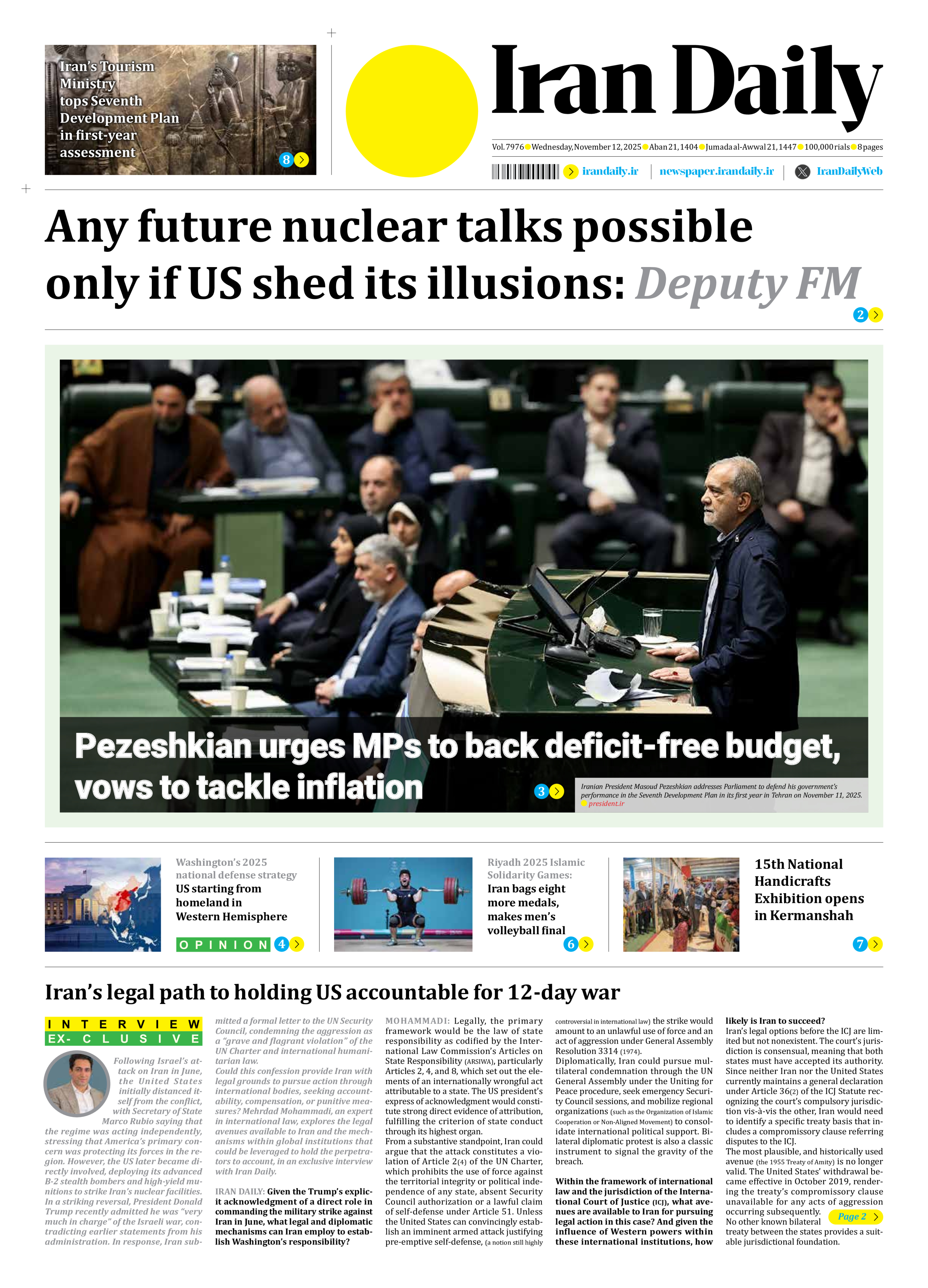


Iran’s legal path to holding US accountable for 12-day war
Following Israel’s attack on Iran in June, the United States initially distanced itself from the conflict, with Secretary of State Marco Rubio saying that the regime was acting independently, stressing that America’s primary concern was protecting its forces in the region. However, the US later became directly involved, deploying its advanced B-2 stealth bombers and high-yield munitions to strike Iran’s nuclear facilities.
In a striking reversal, President Donald Trump recently admitted he was “very much in charge” of the Israeli war, contradicting earlier statements from his administration. In response, Iran submitted a formal letter to the UN Security Council, condemning the aggression as a “grave and flagrant violation” of the UN Charter and international humanitarian law.
Could this confession provide Iran with legal grounds to pursue action through international bodies, seeking accountability, compensation, or punitive measures? Mehrdad Mohammadi, an expert in international law, explores the legal avenues available to Iran and the mechanisms within global institutions that could be leveraged to hold the perpetrators to account, in an exclusive interview with Iran Daily.
IRAN DAILY: Given the Trump’s explicit acknowledgment of a direct role in commanding the military strike against Iran in June, what legal and diplomatic mechanisms can Iran employ to establish Washington’s responsibility?
MOHAMMADI: Legally, the primary framework would be the law of state responsibility as codified by the International Law Commission’s Articles on State Responsibility (ARSIWA), particularly Articles 2, 4, and 8, which set out the elements of an internationally wrongful act attributable to a state. The US president’s express of acknowledgment would constitute strong direct evidence of attribution, fulfilling the criterion of state conduct through its highest organ.
From a substantive standpoint, Iran could argue that the attack constitutes a violation of Article 2(4) of the UN Charter, which prohibits the use of force against the territorial integrity or political independence of any state, absent Security Council authorization or a lawful claim of self-defense under Article 51. Unless the United States can convincingly establish an imminent armed attack justifying pre-emptive self-defense, (a notion still highly controversial in international law) the strike would amount to an unlawful use of force and an act of aggression under General Assembly Resolution 3314 (1974).
Diplomatically, Iran could pursue multilateral condemnation through the UN General Assembly under the Uniting for Peace procedure, seek emergency Security Council sessions, and mobilize regional organizations (such as the Organization of Islamic Cooperation or Non-Aligned Movement) to consolidate international political support. Bilateral diplomatic protest is also a classic instrument to signal the gravity of the breach.
Within the framework of international law and the jurisdiction of the International Court of Justice (ICJ), what avenues are available to Iran for pursuing legal action in this case? And given the influence of Western powers within these international institutions, how likely is Iran to succeed?
Iran’s legal options before the ICJ are limited but not nonexistent. The court’s jurisdiction is consensual, meaning that both states must have accepted its authority. Since neither Iran nor the United States currently maintains a general declaration under Article 36(2) of the ICJ Statute recognizing the court’s compulsory jurisdiction vis-à-vis the other, Iran would need to identify a specific treaty basis that includes a compromissory clause referring disputes to the ICJ.
The most plausible, and historically used avenue (the 1955 Treaty of Amity) is no longer valid. The United States’ withdrawal became effective in October 2019, rendering the treaty’s compromissory clause unavailable for any acts of aggression occurring subsequently. No other known bilateral treaty between the states provides a suitable jurisdictional foundation
Page 2.