







Explore cradle of civilization in Dehloran’s ancient plains
With its ancient heritage and a landscape dotted with archaeological mounds and prehistoric sites, Ilam Province stands as one of the most significant centers of early civilization in Iran.
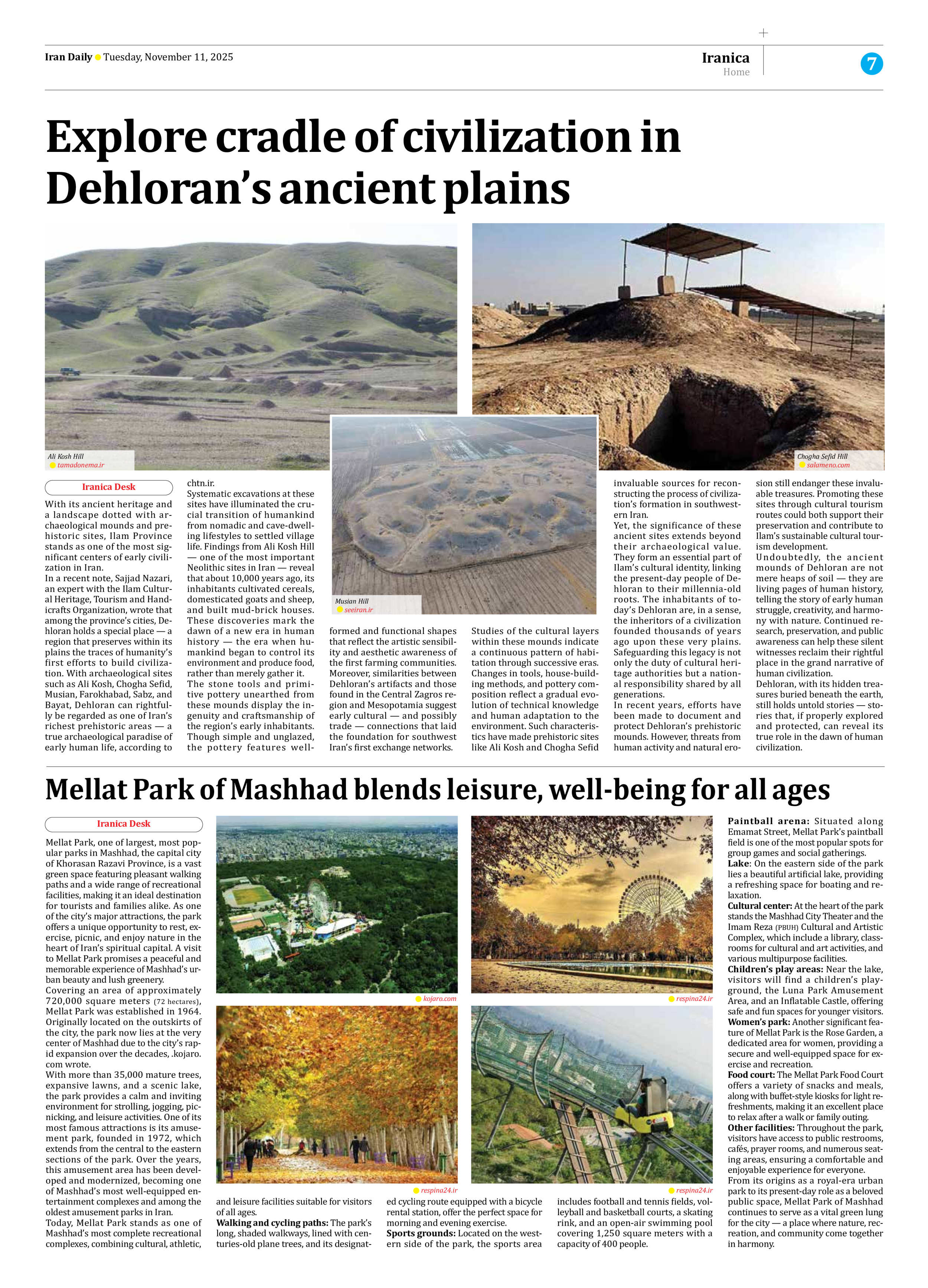
In a recent note, Sajjad Nazari, an expert with the Ilam Cultural Heritage, Tourism and Handicrafts Organization, wrote that among the province’s cities, Dehloran holds a special place — a region that preserves within its plains the traces of humanity’s first efforts to build civilization. With archaeological sites such as Ali Kosh, Chogha Sefid, Musian, Farokhabad, Sabz, and Bayat, Dehloran can rightfully be regarded as one of Iran’s richest prehistoric areas — a true archaeological paradise of early human life, according to chtn.ir.
Systematic excavations at these sites have illuminated the crucial transition of humankind from nomadic and cave-dwelling lifestyles to settled village life. Findings from Ali Kosh Hill — one of the most important Neolithic sites in Iran — reveal that about 10,000 years ago, its inhabitants cultivated cereals, domesticated goats and sheep, and built mud-brick houses. These discoveries mark the dawn of a new era in human history — the era when humankind began to control its environment and produce food, rather than merely gather it.
The stone tools and primitive pottery unearthed from these mounds display the ingenuity and craftsmanship of the region’s early inhabitants. Though simple and unglazed, the pottery features well-formed and functional shapes that reflect the artistic sensibility and aesthetic awareness of the first farming communities. Moreover, similarities between Dehloran’s artifacts and those found in the Central Zagros region and Mesopotamia suggest early cultural — and possibly trade — connections that laid the foundation for southwest Iran’s first exchange networks.
Studies of the cultural layers within these mounds indicate a continuous pattern of habitation through successive eras. Changes in tools, house-building methods, and pottery composition reflect a gradual evolution of technical knowledge and human adaptation to the environment. Such characteristics have made prehistoric sites like Ali Kosh and Chogha Sefid invaluable sources for reconstructing the process of civilization’s formation in southwestern Iran.
Yet, the significance of these ancient sites extends beyond their archaeological value. They form an essential part of Ilam’s cultural identity, linking the present-day people of Dehloran to their millennia-old roots. The inhabitants of today’s Dehloran are, in a sense, the inheritors of a civilization founded thousands of years ago upon these very plains. Safeguarding this legacy is not only the duty of cultural heritage authorities but a national responsibility shared by all generations.
In recent years, efforts have been made to document and protect Dehloran’s prehistoric mounds. However, threats from human activity and natural erosion still endanger these invaluable treasures. Promoting these sites through cultural tourism routes could both support their preservation and contribute to Ilam’s sustainable cultural tourism development.
Undoubtedly, the ancient mounds of Dehloran are not mere heaps of soil — they are living pages of human history, telling the story of early human struggle, creativity, and harmony with nature. Continued research, preservation, and public awareness can help these silent witnesses reclaim their rightful place in the grand narrative of human civilization.
Dehloran, with its hidden treasures buried beneath the earth, still holds untold stories — stories that, if properly explored and protected, can reveal its true role in the dawn of human civilization.