





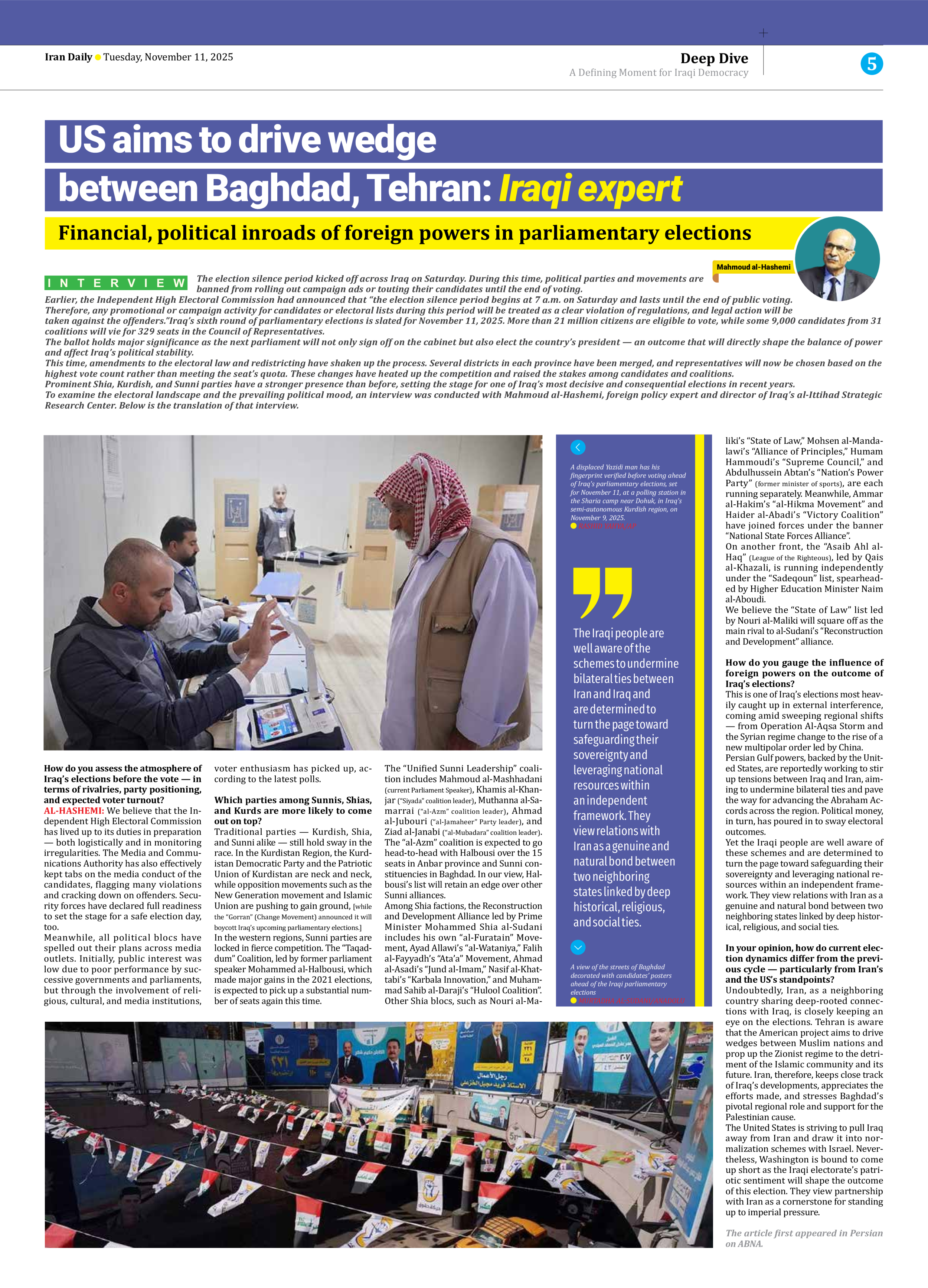


US aims to drive wedge between Baghdad, Tehran: Iraqi expert
Financial, political inroads of foreign powers in parliamentary elections
The election silence period kicked off across Iraq on Saturday. During this time, political parties and movements are banned from rolling out campaign ads or touting their candidates until the end of voting. Earlier, the Independent High Electoral Commission had announced that “the election silence period begins at 7 a.m. on Saturday and lasts until the end of public voting. Therefore, any promotional or campaign activity for candidates or electoral lists during this period will be treated as a clear violation of regulations, and legal action will be taken against the offenders.”Iraq’s sixth round of parliamentary elections is slated for November 11, 2025. More than 21 million citizens are eligible to vote, while some 9,000 candidates from 31 coalitions will vie for 329 seats in the Council of Representatives. The ballot holds major significance as the next parliament will not only sign off on the cabinet but also elect the country’s president — an outcome that will directly shape the balance of power and affect Iraq’s political stability. This time, amendments to the electoral law and redistricting have shaken up the process. Several districts in each province have been merged, and representatives will now be chosen based on the highest vote count rather than meeting the seat’s quota. These changes have heated up the competition and raised the stakes among candidates and coalitions. Prominent Shia, Kurdish, and Sunni parties have a stronger presence than before, setting the stage for one of Iraq’s most decisive and consequential elections in recent years. To examine the electoral landscape and the prevailing political mood, an interview was conducted with Mahmoud al-Hashemi, foreign policy expert and director of Iraq’s al-Ittihad Strategic Research Center. Below is the translation of that interview.
How do you assess the atmosphere of Iraq’s elections before the vote — in terms of rivalries, party positioning, and expected voter turnout?
AL-HASHEMI: We believe that the Independent High Electoral Commission has lived up to its duties in preparation — both logistically and in monitoring irregularities. The Media and Communications Authority has also effectively kept tabs on the media conduct of the candidates, flagging many violations and cracking down on offenders. Security forces have declared full readiness to set the stage for a safe election day, too.
Meanwhile, all political blocs have spelled out their plans across media outlets. Initially, public interest was low due to poor performance by successive governments and parliaments, but through the involvement of religious, cultural, and media institutions, voter enthusiasm has picked up, according to the latest polls.
Which parties among Sunnis, Shias, and Kurds are more likely to come out on top?
Traditional parties — Kurdish, Shia, and Sunni alike — still hold sway in the race. In the Kurdistan Region, the Kurdistan Democratic Party and the Patriotic Union of Kurdistan are neck and neck, while opposition movements such as the New Generation movement and Islamic Union are pushing to gain ground, [while the “Gorran” (Change Movement) announced it will boycott Iraq’s upcoming parliamentary elections.]
In the western regions, Sunni parties are locked in fierce competition. The “Taqaddum” Coalition, led by former parliament speaker Mohammed al-Halbousi, which made major gains in the 2021 elections, is expected to pick up a substantial number of seats again this time.
The “Unified Sunni Leadership” coalition includes Mahmoud al-Mashhadani (current Parliament Speaker), Khamis al-Khanjar (“Siyada” coalition leader), Muthanna al-Samarrai (“al-Azm” coalition leader), Ahmad al-Jubouri (“al-Jamaheer” Party leader), and Ziad al-Janabi (“al-Mubadara” coalition leader). The “al-Azm” coalition is expected to go head-to-head with Halbousi over the 15 seats in Anbar province and Sunni constituencies in Baghdad. In our view, Halbousi’s list will retain an edge over other Sunni alliances.
Among Shia factions, the Reconstruction and Development Alliance led by Prime Minister Mohammed Shia al-Sudani includes his own “al-Furatain” Movement, Ayad Allawi’s “al-Wataniya,” Falih al-Fayyadh’s “Ata’a” Movement, Ahmad al-Asadi’s “Jund al-Imam,” Nasif al-Khattabi’s “Karbala Innovation,” and Muhammad Sahib al-Daraji’s “Hulool Coalition”.
Other Shia blocs, such as Nouri al-Maliki’s “State of Law,” Mohsen al-Mandalawi’s “Alliance of Principles,” Humam Hammoudi’s “Supreme Council,” and Abdulhussein Abtan’s “Nation’s Power Party” (former minister of sports), are each running separately. Meanwhile, Ammar al-Hakim’s “al-Hikma Movement” and Haider al-Abadi’s “Victory Coalition” have joined forces under the banner “National State Forces Alliance”.
On another front, the “Asaib Ahl al-Haq” (League of the Righteous), led by Qais al-Khazali, is running independently under the “Sadeqoun” list, spearheaded by Higher Education Minister Naim al-Aboudi.
We believe the “State of Law” list led by Nouri al-Maliki will square off as the main rival to al-Sudani’s “Reconstruction and Development” alliance.
How do you gauge the influence of foreign powers on the outcome of Iraq’s elections?
This is one of Iraq’s elections most heavily caught up in external interference, coming amid sweeping regional shifts — from Operation Al-Aqsa Storm and the Syrian regime change to the rise of a new multipolar order led by China.
Persian Gulf powers, backed by the United States, are reportedly working to stir up tensions between Iraq and Iran, aiming to undermine bilateral ties and pave the way for advancing the Abraham Accords across the region. Political money, in turn, has poured in to sway electoral outcomes.
Yet the Iraqi people are well aware of these schemes and are determined to turn the page toward safeguarding their sovereignty and leveraging national resources within an independent framework. They view relations with Iran as a genuine and natural bond between two neighboring states linked by deep historical, religious, and social ties.
In your opinion, how do current election dynamics differ from the previous cycle — particularly from Iran’s and the US’s standpoints?
Undoubtedly, Iran, as a neighboring country sharing deep-rooted connections with Iraq, is closely keeping an eye on the elections. Tehran is aware that the American project aims to drive wedges between Muslim nations and prop up the Zionist regime to the detriment of the Islamic community and its future. Iran, therefore, keeps close track of Iraq’s developments, appreciates the efforts made, and stresses Baghdad’s pivotal regional role and support for the Palestinian cause.
The United States is striving to pull Iraq away from Iran and draw it into normalization schemes with Israel. Nevertheless, Washington is bound to come up short as the Iraqi electorate’s patriotic sentiment will shape the outcome of this election. They view partnership with Iran as a cornerstone for standing up to imperial pressure.
The article first appeared in Persian on ABNA.