





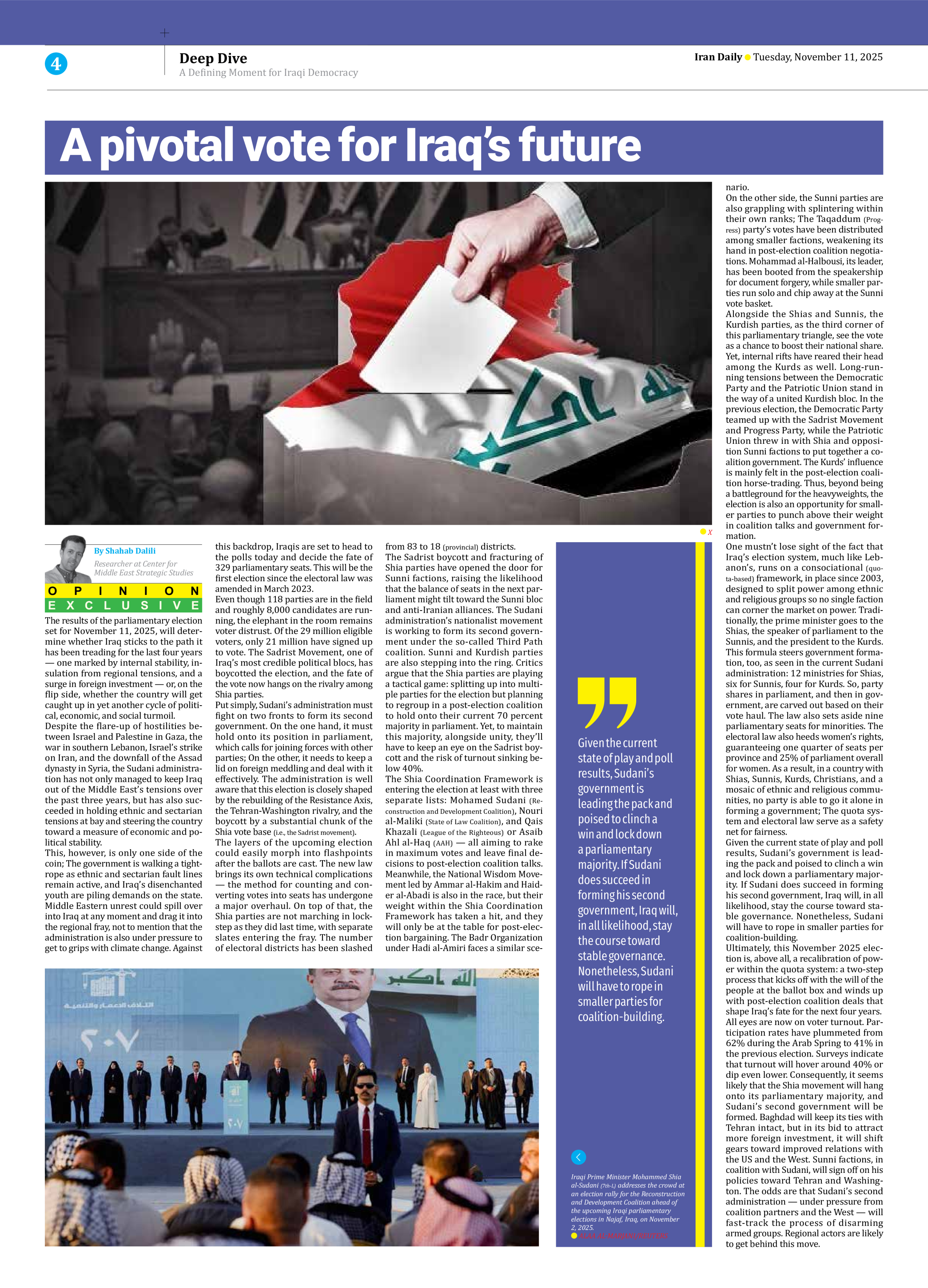


A pivotal vote for Iraq’s future
By Shahab Dalili
Researcher at Center for
Middle East Strategic Studies
The results of the parliamentary election set for November 11, 2025, will determine whether Iraq sticks to the path it has been treading for the last four years — one marked by internal stability, insulation from regional tensions, and a surge in foreign investment — or, on the flip side, whether the country will get caught up in yet another cycle of political, economic, and social turmoil.
Despite the flare-up of hostilities between Israel and Palestine in Gaza, the war in southern Lebanon, Israel’s strike on Iran, and the downfall of the Assad dynasty in Syria, the Sudani administration has not only managed to keep Iraq out of the Middle East’s tensions over the past three years, but has also succeeded in holding ethnic and sectarian tensions at bay and steering the country toward a measure of economic and political stability.
This, however, is only one side of the coin; The government is walking a tightrope as ethnic and sectarian fault lines remain active, and Iraq’s disenchanted youth are piling demands on the state. Middle Eastern unrest could spill over into Iraq at any moment and drag it into the regional fray, not to mention that the administration is also under pressure to get to grips with climate change. Against this backdrop, Iraqis are set to head to the polls today and decide the fate of 329 parliamentary seats. This will be the first election since the electoral law was amended in March 2023.
Even though 118 parties are in the field and roughly 8,000 candidates are running, the elephant in the room remains voter distrust. Of the 29 million eligible voters, only 21 million have signed up to vote. The Sadrist Movement, one of Iraq’s most credible political blocs, has boycotted the election, and the fate of the vote now hangs on the rivalry among Shia parties.
Put simply, Sudani’s administration must fight on two fronts to form its second government. On the one hand, it must hold onto its position in parliament, which calls for joining forces with other parties; On the other, it needs to keep a lid on foreign meddling and deal with it effectively. The administration is well aware that this election is closely shaped by the rebuilding of the Resistance Axis, the Tehran-Washington rivalry, and the boycott by a substantial chunk of the Shia vote base (i.e., the Sadrist movement).
The layers of the upcoming election could easily morph into flashpoints after the ballots are cast. The new law brings its own technical complications — the method for counting and converting votes into seats has undergone a major overhaul. On top of that, the Shia parties are not marching in lockstep as they did last time, with separate slates entering the fray. The number of electoral districts has been slashed from 83 to 18 (provincial) districts.
The Sadrist boycott and fracturing of Shia parties have opened the door for Sunni factions, raising the likelihood that the balance of seats in the next parliament might tilt toward the Sunni bloc and anti-Iranian alliances. The Sudani administration’s nationalist movement is working to form its second government under the so-called Third Path coalition. Sunni and Kurdish parties are also stepping into the ring. Critics argue that the Shia parties are playing a tactical game: splitting up into multiple parties for the election but planning to regroup in a post-election coalition to hold onto their current 70 percent majority in parliament. Yet, to maintain this majority, alongside unity, they’ll have to keep an eye on the Sadrist boycott and the risk of turnout sinking below 40%.
The Shia Coordination Framework is entering the election at least with three separate lists: Mohamed Sudani (Reconstruction and Development Coalition), Nouri al-Maliki (State of Law Coalition), and Qais Khazali (League of the Righteous) or Asaib Ahl al-Haq (AAH) — all aiming to rake in maximum votes and leave final decisions to post-election coalition talks. Meanwhile, the National Wisdom Movement led by Ammar al-Hakim and Haider al-Abadi is also in the race, but their weight within the Shia Coordination Framework has taken a hit, and they will only be at the table for post-election bargaining. The Badr Organization under Hadi al-Amiri faces a similar scenario.
On the other side, the Sunni parties are also grappling with splintering within their own ranks; The Taqaddum (Progress) party’s votes have been distributed among smaller factions, weakening its hand in post-election coalition negotiations. Mohammad al-Halbousi, its leader, has been booted from the speakership for document forgery, while smaller parties run solo and chip away at the Sunni vote basket.
Alongside the Shias and Sunnis, the Kurdish parties, as the third corner of this parliamentary triangle, see the vote as a chance to boost their national share. Yet, internal rifts have reared their head among the Kurds as well. Long-running tensions between the Democratic Party and the Patriotic Union stand in the way of a united Kurdish bloc. In the previous election, the Democratic Party teamed up with the Sadrist Movement and Progress Party, while the Patriotic Union threw in with Shia and opposition Sunni factions to put together a coalition government. The Kurds’ influence is mainly felt in the post-election coalition horse-trading. Thus, beyond being a battleground for the heavyweights, the election is also an opportunity for smaller parties to punch above their weight in coalition talks and government formation.
One mustn’t lose sight of the fact that Iraq’s election system, much like Lebanon’s, runs on a consociational (quota-based) framework, in place since 2003, designed to split power among ethnic and religious groups so no single faction can corner the market on power. Traditionally, the prime minister goes to the Shias, the speaker of parliament to the Sunnis, and the president to the Kurds. This formula steers government formation, too, as seen in the current Sudani administration: 12 ministries for Shias, six for Sunnis, four for Kurds. So, party shares in parliament, and then in government, are carved out based on their vote haul. The law also sets aside nine parliamentary seats for minorities. The electoral law also heeds women’s rights, guaranteeing one quarter of seats per province and 25% of parliament overall for women. As a result, in a country with Shias, Sunnis, Kurds, Christians, and a mosaic of ethnic and religious communities, no party is able to go it alone in forming a government; The quota system and electoral law serve as a safety net for fairness.
Given the current state of play and poll results, Sudani’s government is leading the pack and poised to clinch a win and lock down a parliamentary majority. If Sudani does succeed in forming his second government, Iraq will, in all likelihood, stay the course toward stable governance. Nonetheless, Sudani will have to rope in smaller parties for coalition-building.
Ultimately, this November 2025 election is, above all, a recalibration of power within the quota system: a two-step process that kicks off with the will of the people at the ballot box and winds up with post-election coalition deals that shape Iraq’s fate for the next four years.
All eyes are now on voter turnout. Participation rates have plummeted from 62% during the Arab Spring to 41% in the previous election. Surveys indicate that turnout will hover around 40% or dip even lower. Consequently, it seems likely that the Shia movement will hang onto its parliamentary majority, and Sudani’s second government will be formed. Baghdad will keep its ties with Tehran intact, but in its bid to attract more foreign investment, it will shift gears toward improved relations with the US and the West. Sunni factions, in coalition with Sudani, will sign off on his policies toward Tehran and Washington. The odds are that Sudani’s second administration — under pressure from coalition partners and the West — will fast-track the process of disarming armed groups. Regional actors are likely to get behind this move.