







Copy in clipboard...
UNESCO recognizes Cyrus Cylinder as early global human-rights document
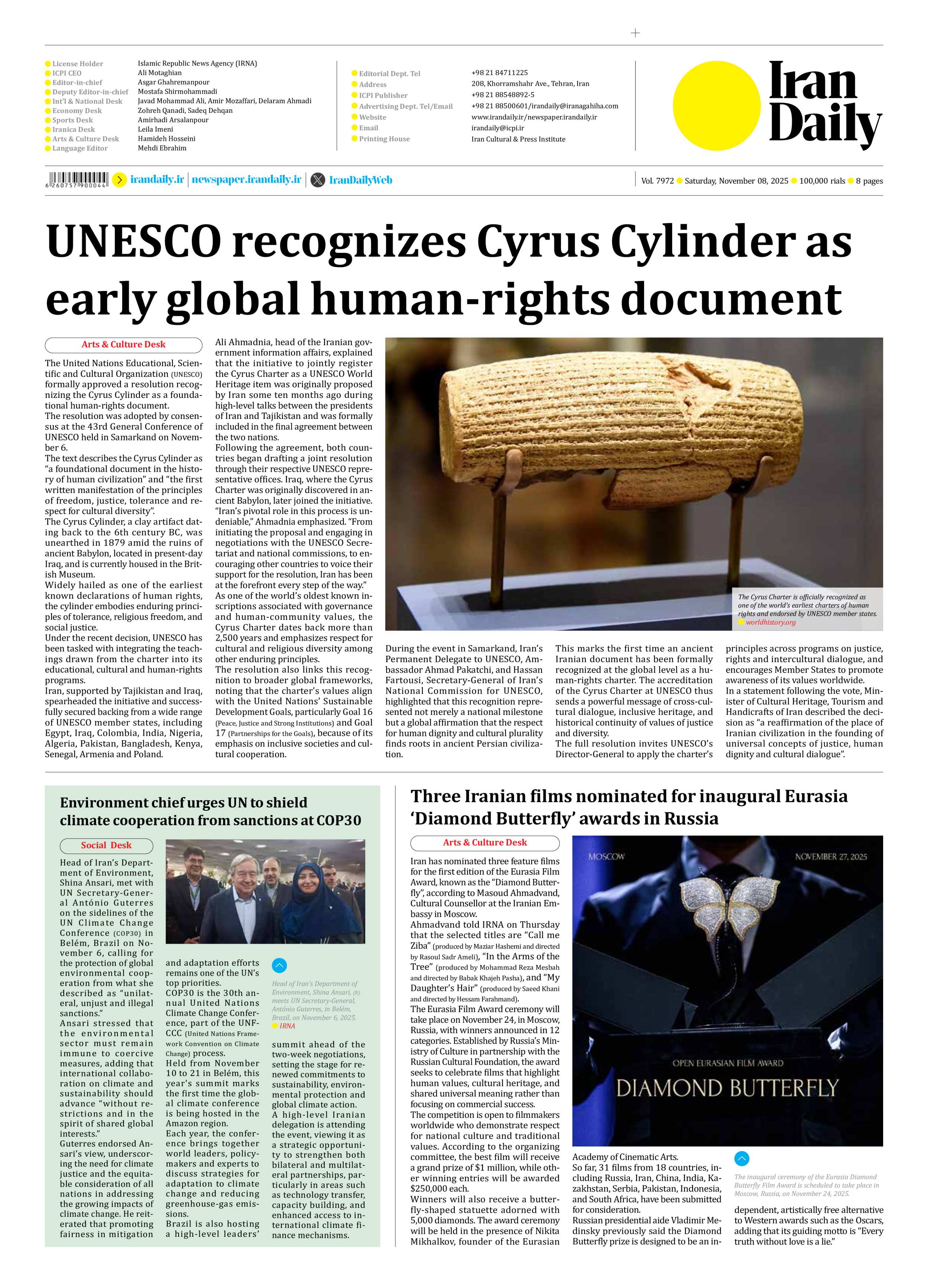
The United Nations Educational, Scientific and Cultural Organization (UNESCO) formally approved a resolution recognizing the Cyrus Cylinder as a foundational human-rights document.
The resolution was adopted by consensus at the 43rd General Conference of UNESCO held in Samarkand on November 6.
The text describes the Cyrus Cylinder as “a foundational document in the history of human civilization” and “the first written manifestation of the principles of freedom, justice, tolerance and respect for cultural diversity”.
The Cyrus Cylinder, a clay artifact dating back to the 6th century BC, was unearthed in 1879 amid the ruins of ancient Babylon, located in present-day Iraq, and is currently housed in the British Museum.
Widely hailed as one of the earliest known declarations of human rights, the cylinder embodies enduring principles of tolerance, religious freedom, and social justice.
Under the recent decision, UNESCO has been tasked with integrating the teachings drawn from the charter into its educational, cultural and human-rights programs.
Iran, supported by Tajikistan and Iraq, spearheaded the initiative and successfully secured backing from a wide range of UNESCO member states, including Egypt, Iraq, Colombia, India, Nigeria, Algeria, Pakistan, Bangladesh, Kenya, Senegal, Armenia and Poland.
Ali Ahmadnia, head of the Iranian government information affairs, explained that the initiative to jointly register the Cyrus Charter as a UNESCO World Heritage item was originally proposed by Iran some ten months ago during high-level talks between the presidents of Iran and Tajikistan and was formally included in the final agreement between the two nations.
Following the agreement, both countries began drafting a joint resolution through their respective UNESCO representative offices. Iraq, where the Cyrus Charter was originally discovered in ancient Babylon, later joined the initiative.
“Iran’s pivotal role in this process is undeniable,” Ahmadnia emphasized. “From initiating the proposal and engaging in negotiations with the UNESCO Secretariat and national commissions, to encouraging other countries to voice their support for the resolution, Iran has been at the forefront every step of the way.”
As one of the world’s oldest known inscriptions associated with governance and human-community values, the Cyrus Charter dates back more than 2,500 years and emphasizes respect for cultural and religious diversity among other enduring principles.
The resolution also links this recognition to broader global frameworks, noting that the charter’s values align with the United Nations’ Sustainable Development Goals, particularly Goal 16 (Peace, Justice and Strong Institutions) and Goal 17 (Partnerships for the Goals), because of its emphasis on inclusive societies and cultural cooperation.
During the event in Samarkand, Iran’s Permanent Delegate to UNESCO, Ambassador Ahmad Pakatchi, and Hassan Fartousi, Secretary-General of Iran’s National Commission for UNESCO, highlighted that this recognition represented not merely a national milestone but a global affirmation that the respect for human dignity and cultural plurality finds roots in ancient Persian civilization.
This marks the first time an ancient Iranian document has been formally recognized at the global level as a human-rights charter. The accreditation of the Cyrus Charter at UNESCO thus sends a powerful message of cross-cultural dialogue, inclusive heritage, and historical continuity of values of justice and diversity.
The full resolution invites UNESCO’s Director-General to apply the charter’s principles across programs on justice, rights and intercultural dialogue, and encourages Member States to promote awareness of its values worldwide.
In a statement following the vote, Minister of Cultural Heritage, Tourism and Handicrafts of Iran described the decision as “a reaffirmation of the place of Iranian civilization in the founding of universal concepts of justice, human dignity and cultural dialogue”.