







Introduction to the book:
Alas, Iran Should Not Be Destroyed
A nation’s spirit endures
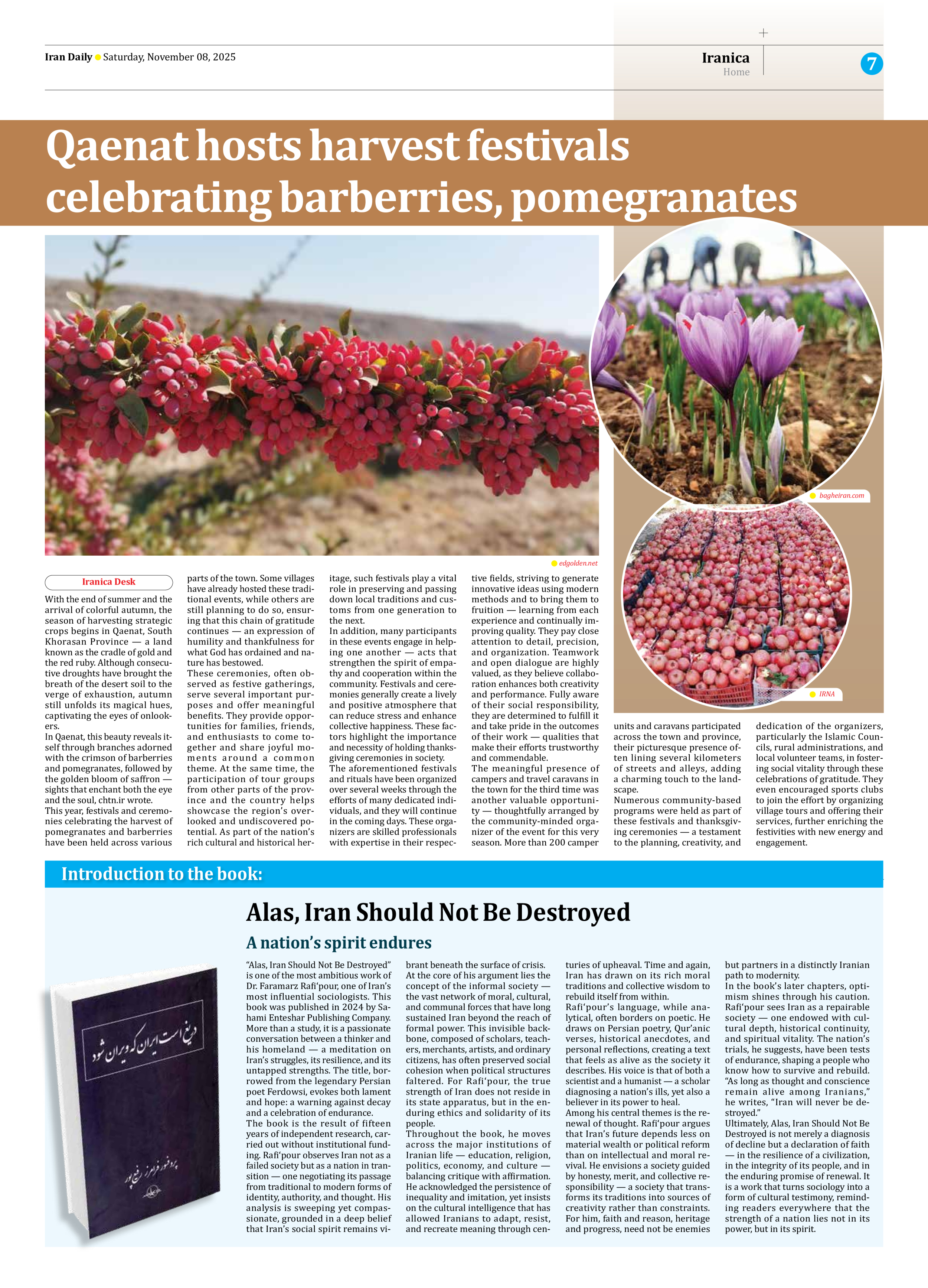
“Alas, Iran Should Not Be Destroyed” is one of the most ambitious work of Dr. Faramarz Rafi‘pour, one of Iran’s most influential sociologists. This book was published in 2024 by Sahami Enteshar Publishing Company. More than a study, it is a passionate conversation between a thinker and his homeland — a meditation on Iran’s struggles, its resilience, and its untapped strengths. The title, borrowed from the legendary Persian poet Ferdowsi, evokes both lament and hope: a warning against decay and a celebration of endurance.
The book is the result of fifteen years of independent research, carried out without institutional funding. Rafi‘pour observes Iran not as a failed society but as a nation in transition — one negotiating its passage from traditional to modern forms of identity, authority, and thought. His analysis is sweeping yet compassionate, grounded in a deep belief that Iran’s social spirit remains vibrant beneath the surface of crisis.
At the core of his argument lies the concept of the informal society — the vast network of moral, cultural, and communal forces that have long sustained Iran beyond the reach of formal power. This invisible backbone, composed of scholars, teachers, merchants, artists, and ordinary citizens, has often preserved social cohesion when political structures faltered. For Rafi‘pour, the true strength of Iran does not reside in its state apparatus, but in the enduring ethics and solidarity of its people.
Throughout the book, he moves across the major institutions of Iranian life — education, religion, politics, economy, and culture — balancing critique with affirmation. He acknowledged the persistence of inequality and imitation, yet insists on the cultural intelligence that has allowed Iranians to adapt, resist, and recreate meaning through centuries of upheaval. Time and again, Iran has drawn on its rich moral traditions and collective wisdom to rebuild itself from within.
Rafi‘pour’s language, while analytical, often borders on poetic. He draws on Persian poetry, Qur’anic verses, historical anecdotes, and personal reflections, creating a text that feels as alive as the society it describes. His voice is that of both a scientist and a humanist — a scholar diagnosing a nation’s ills, yet also a believer in its power to heal.
Among his central themes is the renewal of thought. Rafi‘pour argues that Iran’s future depends less on material wealth or political reform than on intellectual and moral revival. He envisions a society guided by honesty, merit, and collective responsibility — a society that transforms its traditions into sources of creativity rather than constraints. For him, faith and reason, heritage and progress, need not be enemies but partners in a distinctly Iranian path to modernity.
In the book’s later chapters, optimism shines through his caution. Rafi‘pour sees Iran as a repairable society — one endowed with cultural depth, historical continuity, and spiritual vitality. The nation’s trials, he suggests, have been tests of endurance, shaping a people who know how to survive and rebuild. “As long as thought and conscience remain alive among Iranians,” he writes, “Iran will never be destroyed.”
Ultimately, Alas, Iran Should Not Be Destroyed is not merely a diagnosis of decline but a declaration of faith — in the resilience of a civilization, in the integrity of its people, and in the enduring promise of renewal. It is a work that turns sociology into a form of cultural testimony, reminding readers everywhere that the strength of a nation lies not in its power, but in its spirit.