





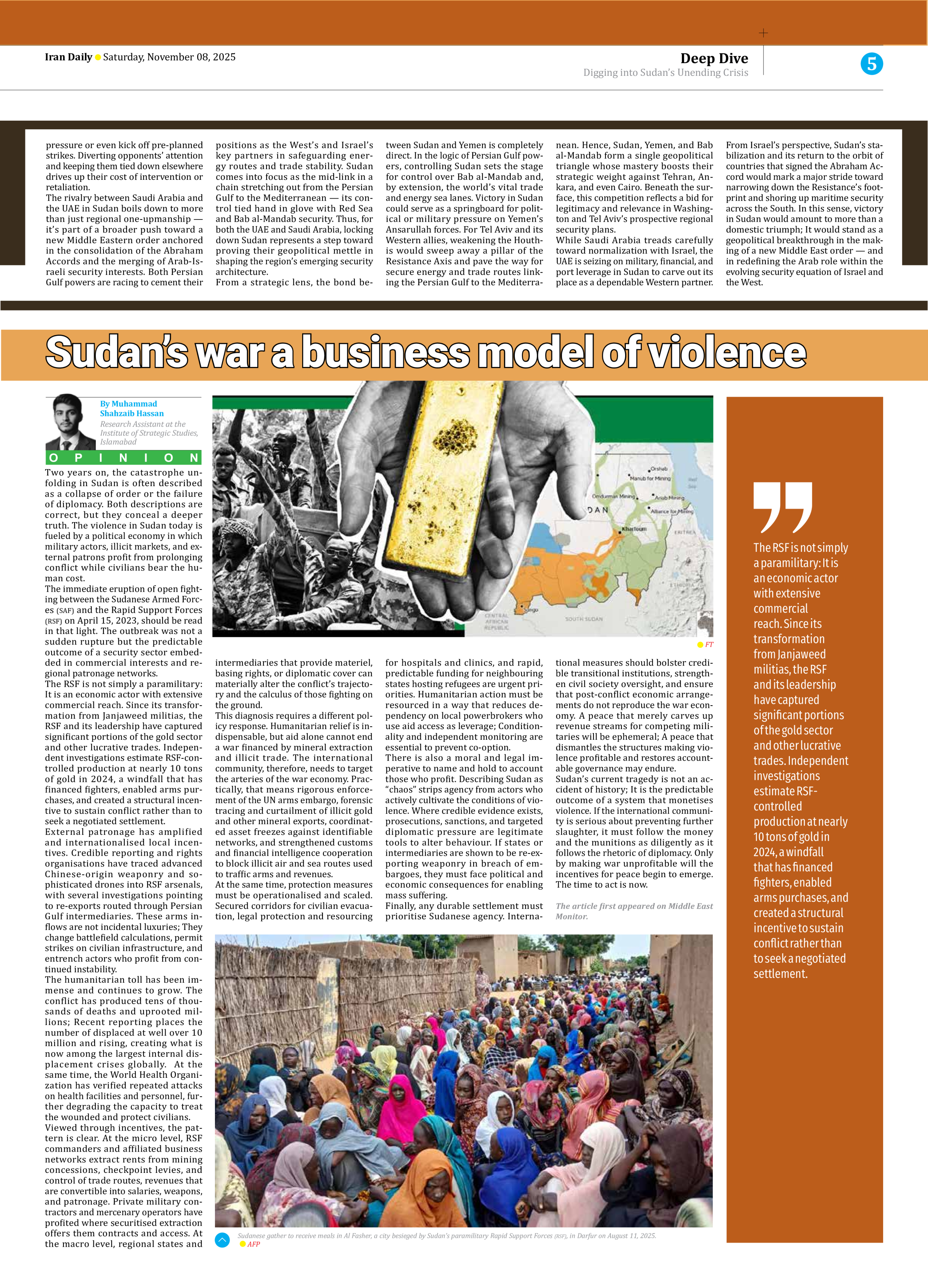


Sudan’s war a business model of violence
By Muhammad
Shahzaib Hassan
Research Assistant at the Institute of Strategic Studies, Islamabad
Two years on, the catastrophe unfolding in Sudan is often described as a collapse of order or the failure of diplomacy. Both descriptions are correct, but they conceal a deeper truth. The violence in Sudan today is fueled by a political economy in which military actors, illicit markets, and external patrons profit from prolonging conflict while civilians bear the human cost.
The immediate eruption of open fighting between the Sudanese Armed Forces (SAF) and the Rapid Support Forces (RSF) on April 15, 2023, should be read in that light. The outbreak was not a sudden rupture but the predictable outcome of a security sector embedded in commercial interests and regional patronage networks.
The RSF is not simply a paramilitary: It is an economic actor with extensive commercial reach. Since its transformation from Janjaweed militias, the RSF and its leadership have captured significant portions of the gold sector and other lucrative trades. Independent investigations estimate RSF-controlled production at nearly 10 tons of gold in 2024, a windfall that has financed fighters, enabled arms purchases, and created a structural incentive to sustain conflict rather than to seek a negotiated settlement.
External patronage has amplified and internationalised local incentives. Credible reporting and rights organisations have traced advanced Chinese-origin weaponry and sophisticated drones into RSF arsenals, with several investigations pointing to re-exports routed through Persian Gulf intermediaries. These arms inflows are not incidental luxuries; They change battlefield calculations, permit strikes on civilian infrastructure, and entrench actors who profit from continued instability.
The humanitarian toll has been immense and continues to grow. The conflict has produced tens of thousands of deaths and uprooted millions; Recent reporting places the number of displaced at well over 10 million and rising, creating what is now among the largest internal displacement crises globally. At the same time, the World Health Organization has verified repeated attacks on health facilities and personnel, further degrading the capacity to treat the wounded and protect civilians.
Viewed through incentives, the pattern is clear. At the micro level, RSF commanders and affiliated business networks extract rents from mining concessions, checkpoint levies, and control of trade routes, revenues that are convertible into salaries, weapons, and patronage. Private military contractors and mercenary operators have profited where securitised extraction offers them contracts and access. At the macro level, regional states and intermediaries that provide materiel, basing rights, or diplomatic cover can materially alter the conflict’s trajectory and the calculus of those fighting on the ground.
This diagnosis requires a different policy response. Humanitarian relief is indispensable, but aid alone cannot end a war financed by mineral extraction and illicit trade. The international community, therefore, needs to target the arteries of the war economy. Practically, that means rigorous enforcement of the UN arms embargo, forensic tracing and curtailment of illicit gold and other mineral exports, coordinated asset freezes against identifiable networks, and strengthened customs and financial intelligence cooperation to block illicit air and sea routes used to traffic arms and revenues.
At the same time, protection measures must be operationalised and scaled. Secured corridors for civilian evacuation, legal protection and resourcing for hospitals and clinics, and rapid, predictable funding for neighbouring states hosting refugees are urgent priorities. Humanitarian action must be resourced in a way that reduces dependency on local powerbrokers who use aid access as leverage; Conditionality and independent monitoring are essential to prevent co-option.
There is also a moral and legal imperative to name and hold to account those who profit. Describing Sudan as “chaos” strips agency from actors who actively cultivate the conditions of violence. Where credible evidence exists, prosecutions, sanctions, and targeted diplomatic pressure are legitimate tools to alter behaviour. If states or intermediaries are shown to be re-exporting weaponry in breach of embargoes, they must face political and economic consequences for enabling mass suffering.
Finally, any durable settlement must prioritise Sudanese agency. International measures should bolster credible transitional institutions, strengthen civil society oversight, and ensure that post-conflict economic arrangements do not reproduce the war economy. A peace that merely carves up revenue streams for competing militaries will be ephemeral; A peace that dismantles the structures making violence profitable and restores accountable governance may endure.
Sudan’s current tragedy is not an accident of history; It is the predictable outcome of a system that monetises violence. If the international community is serious about preventing further slaughter, it must follow the money and the munitions as diligently as it follows the rhetoric of diplomacy. Only by making war unprofitable will the incentives for peace begin to emerge. The time to act is now.
The article first appeared on Middle East Monitor.