





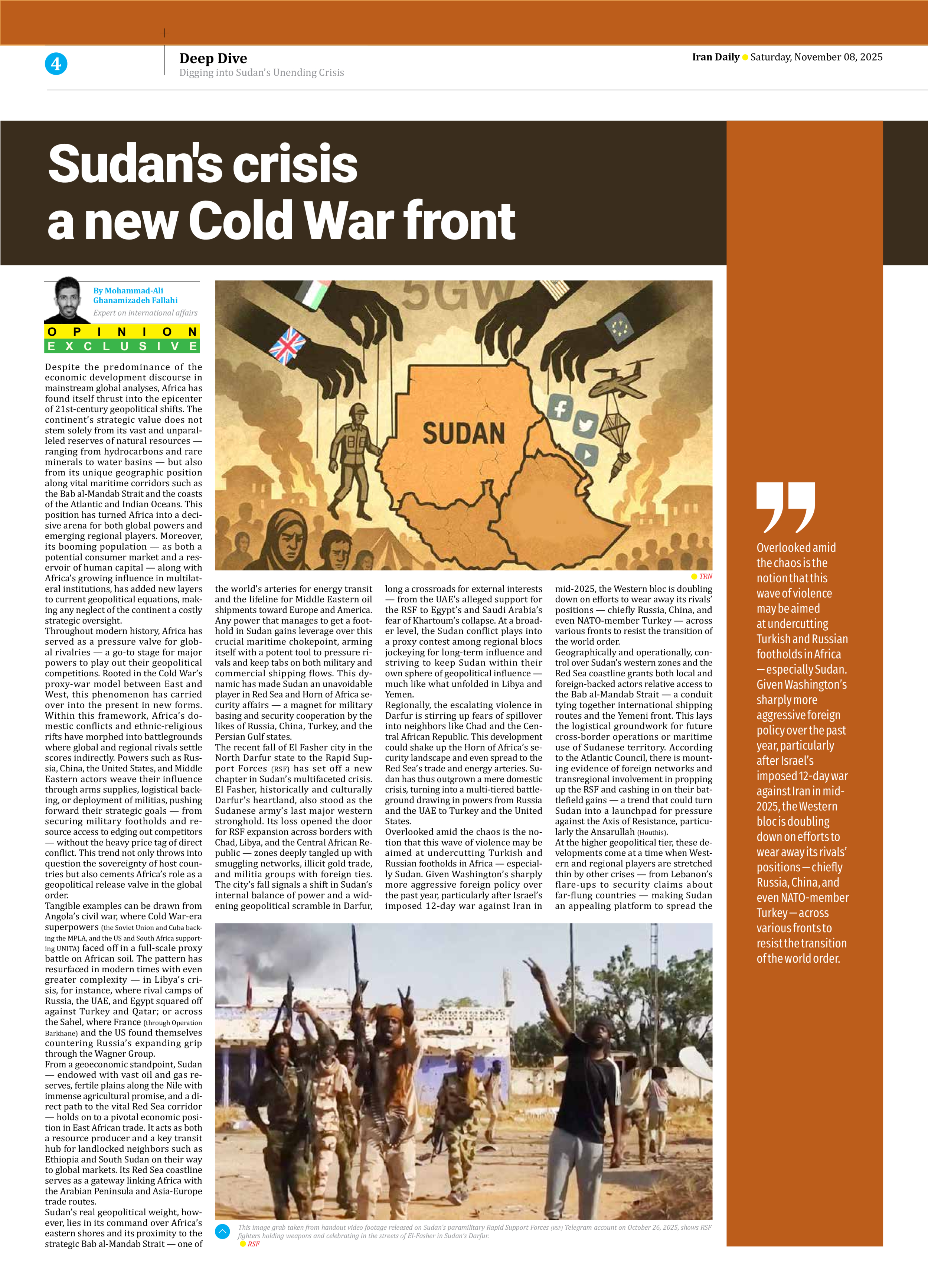


Sudan’s crisis a new Cold War front
By Mohammad-Ali Ghanamizadeh Fallahi
Expert on international affairs
Despite the predominance of the economic development discourse in mainstream global analyses, Africa has found itself thrust into the epicenter of 21st-century geopolitical shifts. The continent’s strategic value does not stem solely from its vast and unparalleled reserves of natural resources — ranging from hydrocarbons and rare minerals to water basins — but also from its unique geographic position along vital maritime corridors such as the Bab al-Mandab Strait and the coasts of the Atlantic and Indian Oceans. This position has turned Africa into a decisive arena for both global powers and emerging regional players. Moreover, its booming population — as both a potential consumer market and a reservoir of human capital — along with Africa’s growing influence in multilateral institutions, has added new layers to current geopolitical equations, making any neglect of the continent a costly strategic oversight.
Throughout modern history, Africa has served as a pressure valve for global rivalries — a go-to stage for major powers to play out their geopolitical competitions. Rooted in the Cold War’s proxy-war model between East and West, this phenomenon has carried over into the present in new forms. Within this framework, Africa’s domestic conflicts and ethnic-religious rifts have morphed into battlegrounds where global and regional rivals settle scores indirectly. Powers such as Russia, China, the United States, and Middle Eastern actors weave their influence through arms supplies, logistical backing, or deployment of militias, pushing forward their strategic goals — from securing military footholds and resource access to edging out competitors — without the heavy price tag of direct conflict. This trend not only throws into question the sovereignty of host countries but also cements Africa’s role as a geopolitical release valve in the global order.
Tangible examples can be drawn from Angola’s civil war, where Cold War-era superpowers (the Soviet Union and Cuba backing the MPLA, and the US and South Africa supporting UNITA) faced off in a full-scale proxy battle on African soil. The pattern has resurfaced in modern times with even greater complexity — in Libya’s crisis, for instance, where rival camps of Russia, the UAE, and Egypt squared off against Turkey and Qatar; or across the Sahel, where France (through Operation Barkhane) and the US found themselves countering Russia’s expanding grip through the Wagner Group.
From a geoeconomic standpoint, Sudan — endowed with vast oil and gas reserves, fertile plains along the Nile with immense agricultural promise, and a direct path to the vital Red Sea corridor — holds on to a pivotal economic position in East African trade. It acts as both a resource producer and a key transit hub for landlocked neighbors such as Ethiopia and South Sudan on their way to global markets. Its Red Sea coastline serves as a gateway linking Africa with the Arabian Peninsula and Asia-Europe trade routes.
Sudan’s real geopolitical weight, however, lies in its command over Africa’s eastern shores and its proximity to the strategic Bab al-Mandab Strait — one of the world’s arteries for energy transit and the lifeline for Middle Eastern oil shipments toward Europe and America. Any power that manages to get a foothold in Sudan gains leverage over this crucial maritime chokepoint, arming itself with a potent tool to pressure rivals and keep tabs on both military and commercial shipping flows. This dynamic has made Sudan an unavoidable player in Red Sea and Horn of Africa security affairs — a magnet for military basing and security cooperation by the likes of Russia, China, Turkey, and the Persian Gulf states.
The recent fall of El Fasher city in the North Darfur state to the Rapid Support Forces (RSF) has set off a new chapter in Sudan’s multifaceted crisis. El Fasher, historically and culturally Darfur’s heartland, also stood as the Sudanese army’s last major western stronghold. Its loss opened the door for RSF expansion across borders with Chad, Libya, and the Central African Republic — zones deeply tangled up with smuggling networks, illicit gold trade, and militia groups with foreign ties. The city’s fall signals a shift in Sudan’s internal balance of power and a widening geopolitical scramble in Darfur, long a crossroads for external interests — from the UAE’s alleged support for the RSF to Egypt’s and Saudi Arabia’s fear of Khartoum’s collapse. At a broader level, the Sudan conflict plays into a proxy contest among regional blocs jockeying for long-term influence and striving to keep Sudan within their own sphere of geopolitical influence — much like what unfolded in Libya and Yemen.
Regionally, the escalating violence in Darfur is stirring up fears of spillover into neighbors like Chad and the Central African Republic. This development could shake up the Horn of Africa’s security landscape and even spread to the Red Sea’s trade and energy arteries. Sudan has thus outgrown a mere domestic crisis, turning into a multi-tiered battleground drawing in powers from Russia and the UAE to Turkey and the United States.
Overlooked amid the chaos is the notion that this wave of violence may be aimed at undercutting Turkish and Russian footholds in Africa — especially Sudan. Given Washington’s sharply more aggressive foreign policy over the past year, particularly after Israel’s imposed 12-day war against Iran in mid-2025, the Western bloc is doubling down on efforts to wear away its rivals’ positions — chiefly Russia, China, and even NATO-member Turkey — across various fronts to resist the transition of the world order.
Geographically and operationally, control over Sudan’s western zones and the Red Sea coastline grants both local and foreign-backed actors relative access to the Bab al-Mandab Strait — a conduit tying together international shipping routes and the Yemeni front. This lays the logistical groundwork for future cross-border operations or maritime use of Sudanese territory. According to the Atlantic Council, there is mounting evidence of foreign networks and transregional involvement in propping up the RSF and cashing in on their battlefield gains — a trend that could turn Sudan into a launchpad for pressure against the Axis of Resistance, particularly the Ansarullah (Houthis).
At the higher geopolitical tier, these developments come at a time when Western and regional players are stretched thin by other crises — from Lebanon’s flare-ups to security claims about far-flung countries — making Sudan an appealing platform to spread the pressure or even kick off pre-planned strikes. Diverting opponents’ attention and keeping them tied down elsewhere drives up their cost of intervention or retaliation.
The rivalry between Saudi Arabia and the UAE in Sudan boils down to more than just regional one-upmanship — it’s part of a broader push toward a new Middle Eastern order anchored in the consolidation of the Abraham Accords and the merging of Arab-Israeli security interests. Both Persian Gulf powers are racing to cement their positions as the West’s and Israel’s key partners in safeguarding energy routes and trade stability. Sudan comes into focus as the mid-link in a chain stretching out from the Persian Gulf to the Mediterranean — its control tied hand in glove with Red Sea and Bab al-Mandab security. Thus, for both the UAE and Saudi Arabia, locking down Sudan represents a step toward proving their geopolitical mettle in shaping the region’s emerging security architecture.
From a strategic lens, the bond between Sudan and Yemen is completely direct. In the logic of Persian Gulf powers, controlling Sudan sets the stage for control over Bab al-Mandab and, by extension, the world’s vital trade and energy sea lanes. Victory in Sudan could serve as a springboard for political or military pressure on Yemen’s Ansarullah forces. For Tel Aviv and its Western allies, weakening the Houthis would sweep away a pillar of the Resistance Axis and pave the way for secure energy and trade routes linking the Persian Gulf to the Mediterranean. Hence, Sudan, Yemen, and Bab al-Mandab form a single geopolitical triangle whose mastery boosts their strategic weight against Tehran, Ankara, and even Cairo. Beneath the surface, this competition reflects a bid for legitimacy and relevance in Washington and Tel Aviv’s prospective regional security plans.
While Saudi Arabia treads carefully toward normalization with Israel, the UAE is seizing on military, financial, and port leverage in Sudan to carve out its place as a dependable Western partner. From Israel’s perspective, Sudan’s stabilization and its return to the orbit of countries that signed the Abraham Accord would mark a major stride toward narrowing down the Resistance’s footprint and shoring up maritime security across the South. In this sense, victory in Sudan would amount to more than a domestic triumph; It would stand as a geopolitical breakthrough in the making of a new Middle East order — and in redefining the Arab role within the evolving security equation of Israel and the West.