







Deputy FM: Resumption of Iran-US talks depends on Washington’s intention
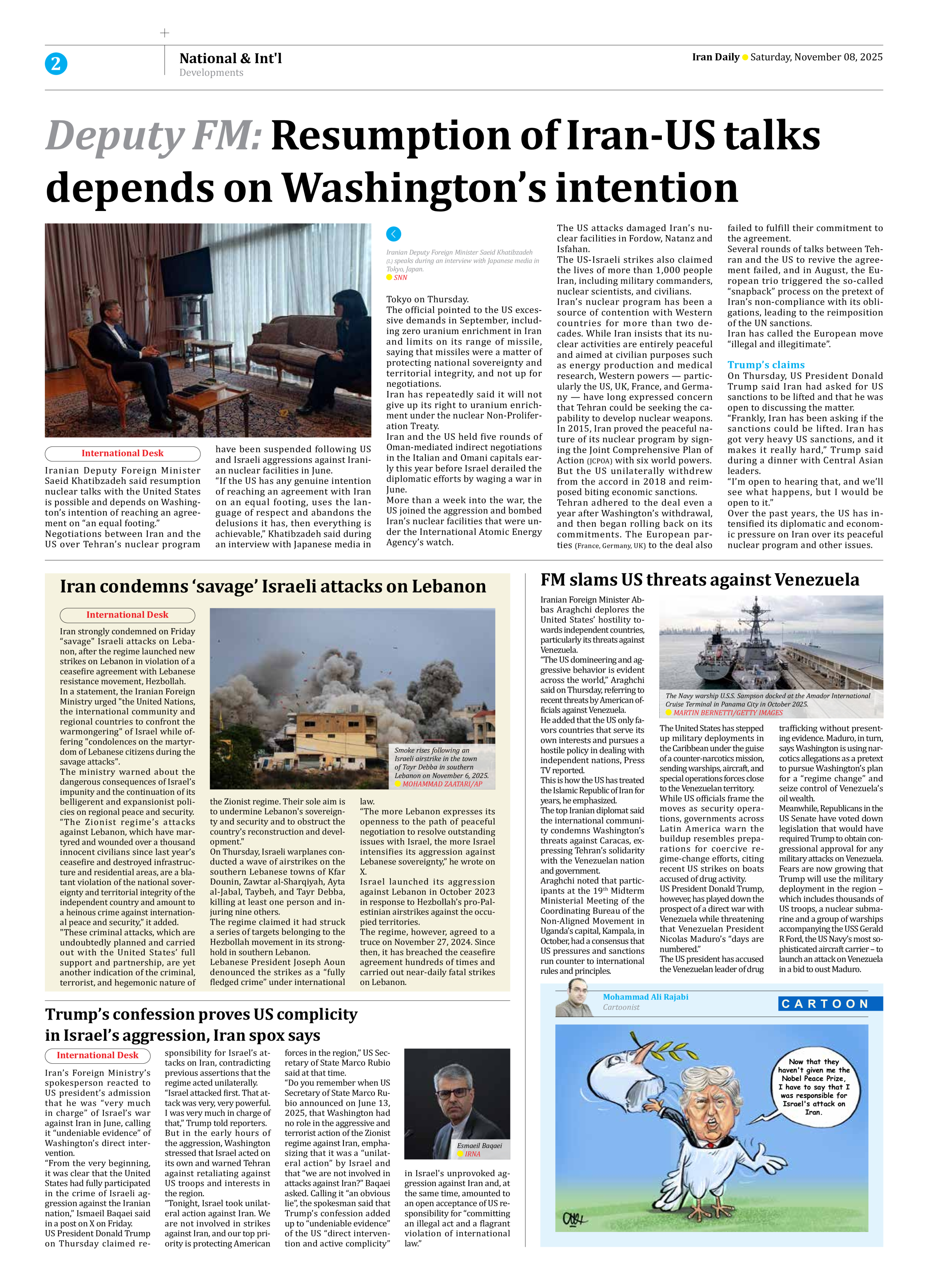
Iranian Deputy Foreign Minister Saeid Khatibzadeh said resumption nuclear talks with the United States is possible and depends on Washington’s intention of reaching an agreement on “an equal footing.”
Negotiations between Iran and the US over Tehran’s nuclear program have been suspended following US and Israeli aggressions against Iranian nuclear facilities in June.
“If the US has any genuine intention of reaching an agreement with Iran on an equal footing, uses the language of respect and abandons the delusions it has, then everything is achievable,” Khatibzadeh said during an interview with Japanese media in Tokyo on Thursday.
The official pointed to the US excessive demands in September, including zero uranium enrichment in Iran and limits on its range of missile, saying that missiles were a matter of protecting national sovereignty and territorial integrity, and not up for negotiations.
Iran has repeatedly said it will not give up its right to uranium enrichment under the nuclear Non-Proliferation Treaty.
Iran and the US held five rounds of Oman-mediated indirect negotiations in the Italian and Omani capitals early this year before Israel derailed the diplomatic efforts by waging a war in June.
More than a week into the war, the US joined the aggression and bombed Iran’s nuclear facilities that were under the International Atomic Energy Agency’s watch.
The US attacks damaged Iran’s nuclear facilities in Fordow, Natanz and Isfahan.
The US-Israeli strikes also claimed the lives of more than 1,000 people Iran, including military commanders, nuclear scientists, and civilians.
Iran’s nuclear program has been a source of contention with Western countries for more than two decades. While Iran insists that its nuclear activities are entirely peaceful and aimed at civilian purposes such as energy production and medical research, Western powers — particularly the US, UK, France, and Germany — have long expressed concern that Tehran could be seeking the capability to develop nuclear weapons.
In 2015, Iran proved the peaceful nature of its nuclear program by signing the Joint Comprehensive Plan of Action (JCPOA) with six world powers.
But the US unilaterally withdrew from the accord in 2018 and reimposed biting economic sanctions.
Tehran adhered to the deal even a year after Washington’s withdrawal, and then began rolling back on its commitments. The European parties (France, Germany, UK) to the deal also failed to fulfill their commitment to the agreement.
Several rounds of talks between Tehran and the US to revive the agreement failed, and in August, the European trio triggered the so-called “snapback” process on the pretext of Iran’s non-compliance with its obligations, leading to the reimposition of the UN sanctions.
Iran has called the European move “illegal and illegitimate”.
Trump’s claims
On Thursday, US President Donald Trump said Iran had asked for US sanctions to be lifted and that he was open to discussing the matter.
“Frankly, Iran has been asking if the sanctions could be lifted. Iran has got very heavy US sanctions, and it makes it really hard,” Trump said during a dinner with Central Asian leaders.
“I’m open to hearing that, and we’ll see what happens, but I would be open to it.”
Over the past years, the US has intensified its diplomatic and economic pressure on Iran over its peaceful nuclear program and other issues.