







Jewel of Fars Province withering
Collective battle to bring life back to Bakhtegan Lake
Wetlands, those blue jewels of the planet, are recognized as some of the most vital yet fragile ecosystems on Earth.
These bodies of water not only serve as unique habitats for a wide range of plants and animals, but also play a key role in cleaning up water naturally, keeping floods at bay, feeding groundwater reserves, holding back dust storms, and smoothing out climate extremes.
Their economic role in keeping local livelihoods afloat through tourism, fishing, and agriculture is equally undeniable.
Yet, across the world — and particularly in West Asia — these natural treasures have been facing growing threats.
Climate change, rising temperatures, declining rainfall, and most critically, poor water management and overuse of surface and groundwater have turned many wetlands into hubs of dust and salt storms.
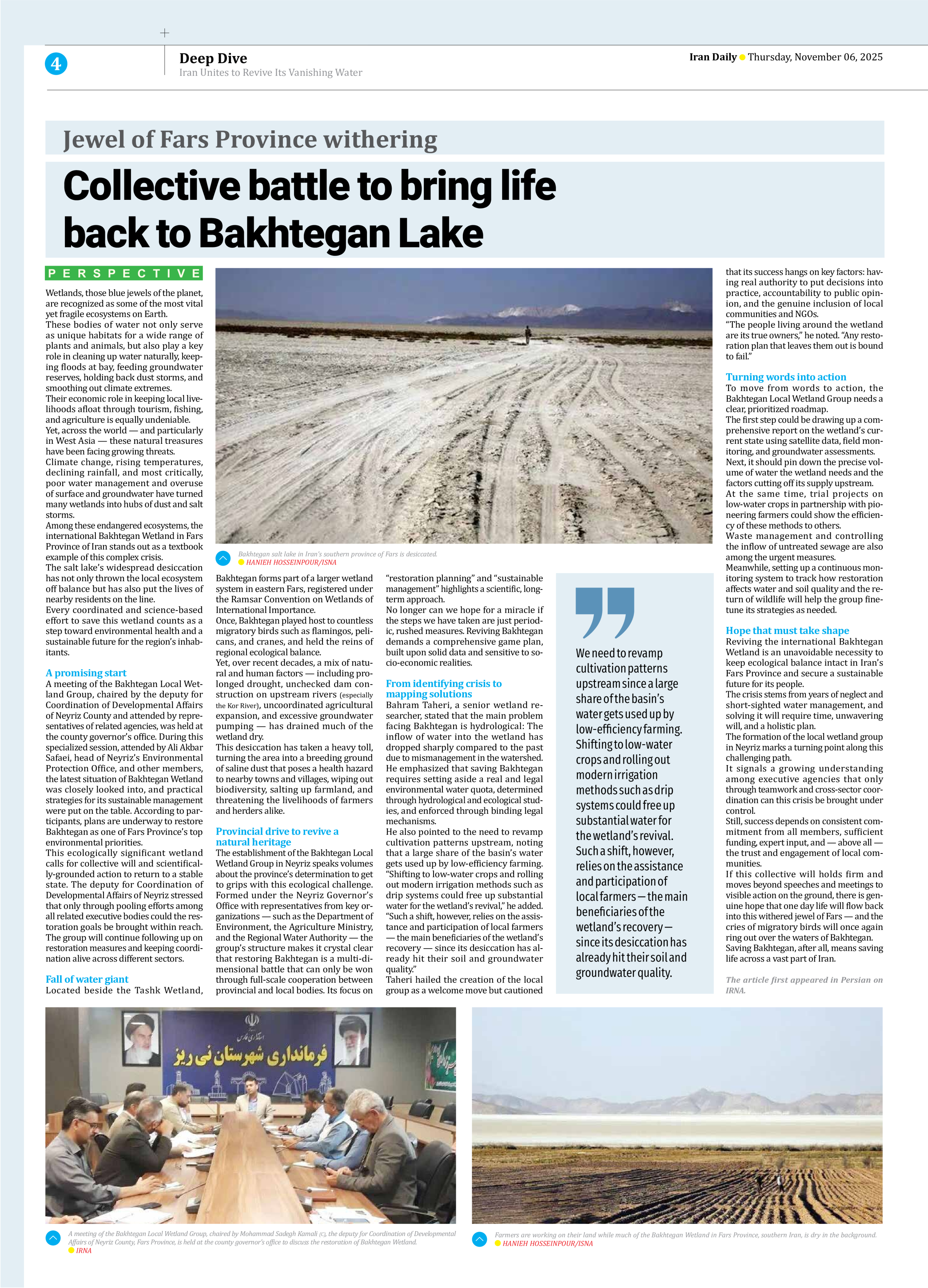
Among these endangered ecosystems, the international Bakhtegan Wetland in Fars Province of Iran stands out as a textbook example of this complex crisis.
The salt lake’s widespread desiccation has not only thrown the local ecosystem off balance but has also put the lives of nearby residents on the line.
Every coordinated and science-based effort to save this wetland counts as a step toward environmental health and a sustainable future for the region’s inhabitants.
A promising start
A meeting of the Bakhtegan Local Wetland Group, chaired by the deputy for Coordination of Developmental Affairs of Neyriz County and attended by representatives of related agencies, was held at the county governor’s office. During this specialized session, attended by Ali Akbar Safaei, head of Neyriz’s Environmental Protection Office, and other members, the latest situation of Bakhtegan Wetland was closely looked into, and practical strategies for its sustainable management were put on the table. According to participants, plans are underway to restore Bakhtegan as one of Fars Province’s top environmental priorities.
This ecologically significant wetland calls for collective will and scientifically-grounded action to return to a stable state. The deputy for Coordination of Developmental Affairs of Neyriz stressed that only through pooling efforts among all related executive bodies could the restoration goals be brought within reach. The group will continue following up on restoration measures and keeping coordination alive across different sectors.
Fall of water giant
Located beside the Tashk Wetland, Bakhtegan forms part of a larger wetland system in eastern Fars, registered under the Ramsar Convention on Wetlands of International Importance.
Once, Bakhtegan played host to countless migratory birds such as flamingos, pelicans, and cranes, and held the reins of regional ecological balance.
Yet, over recent decades, a mix of natural and human factors — including prolonged drought, unchecked dam construction on upstream rivers (especially the Kor River), uncoordinated agricultural expansion, and excessive groundwater pumping — has drained much of the wetland dry.
This desiccation has taken a heavy toll, turning the area into a breeding ground of saline dust that poses a health hazard to nearby towns and villages, wiping out biodiversity, salting up farmland, and threatening the livelihoods of farmers and herders alike.
Provincial drive to revive a natural heritage
The establishment of the Bakhtegan Local Wetland Group in Neyriz speaks volumes about the province’s determination to get to grips with this ecological challenge. Formed under the Neyriz Governor’s Office with representatives from key organizations — such as the Department of Environment, the Agriculture Ministry, and the Regional Water Authority — the group’s structure makes it crystal clear that restoring Bakhtegan is a multi-dimensional battle that can only be won through full-scale cooperation between provincial and local bodies. Its focus on “restoration planning” and “sustainable management” highlights a scientific, long-term approach.
No longer can we hope for a miracle if the steps we have taken are just periodic, rushed measures. Reviving Bakhtegan demands a comprehensive game plan, built upon solid data and sensitive to socio-economic realities.
From identifying crisis to mapping solutions
Bahram Taheri, a senior wetland researcher, stated that the main problem facing Bakhtegan is hydrological: The inflow of water into the wetland has dropped sharply compared to the past due to mismanagement in the watershed.
He emphasized that saving Bakhtegan requires setting aside a real and legal environmental water quota, determined through hydrological and ecological studies, and enforced through binding legal mechanisms.
He also pointed to the need to revamp cultivation patterns upstream, noting that a large share of the basin’s water gets used up by low-efficiency farming. “Shifting to low-water crops and rolling out modern irrigation methods such as drip systems could free up substantial water for the wetland’s revival,” he added.
“Such a shift, however, relies on the assistance and participation of local farmers — the main beneficiaries of the wetland’s recovery — since its desiccation has already hit their soil and groundwater quality.”
Taheri hailed the creation of the local group as a welcome move but cautioned that its success hangs on key factors: having real authority to put decisions into practice, accountability to public opinion, and the genuine inclusion of local communities and NGOs.
“The people living around the wetland are its true owners,” he noted. “Any restoration plan that leaves them out is bound to fail.”
Turning words into action
To move from words to action, the Bakhtegan Local Wetland Group needs a clear, prioritized roadmap.
The first step could be drawing up a comprehensive report on the wetland’s current state using satellite data, field monitoring, and groundwater assessments.
Next, it should pin down the precise volume of water the wetland needs and the factors cutting off its supply upstream.
At the same time, trial projects on low-water crops in partnership with pioneering farmers could show the efficiency of these methods to others.
Waste management and controlling the inflow of untreated sewage are also among the urgent measures.
Meanwhile, setting up a continuous monitoring system to track how restoration affects water and soil quality and the return of wildlife will help the group fine-tune its strategies as needed.
Hope that must take shape
Reviving the international Bakhtegan Wetland is an unavoidable necessity to keep ecological balance intact in Iran’s Fars Province and secure a sustainable future for its people.
The crisis stems from years of neglect and short-sighted water management, and solving it will require time, unwavering will, and a holistic plan.
The formation of the local wetland group in Neyriz marks a turning point along this challenging path.
It signals a growing understanding among executive agencies that only through teamwork and cross-sector coordination can this crisis be brought under control.
Still, success depends on consistent commitment from all members, sufficient funding, expert input, and — above all — the trust and engagement of local communities.
If this collective will holds firm and moves beyond speeches and meetings to visible action on the ground, there is genuine hope that one day life will flow back into this withered jewel of Fars — and the cries of migratory birds will once again ring out over the waters of Bakhtegan.
Saving Bakhtegan, after all, means saving life across a vast part of Iran.
The article first appeared in Persian on IRNA.