







No decline in oil revenues, spending curbs planned for next budget: Minister
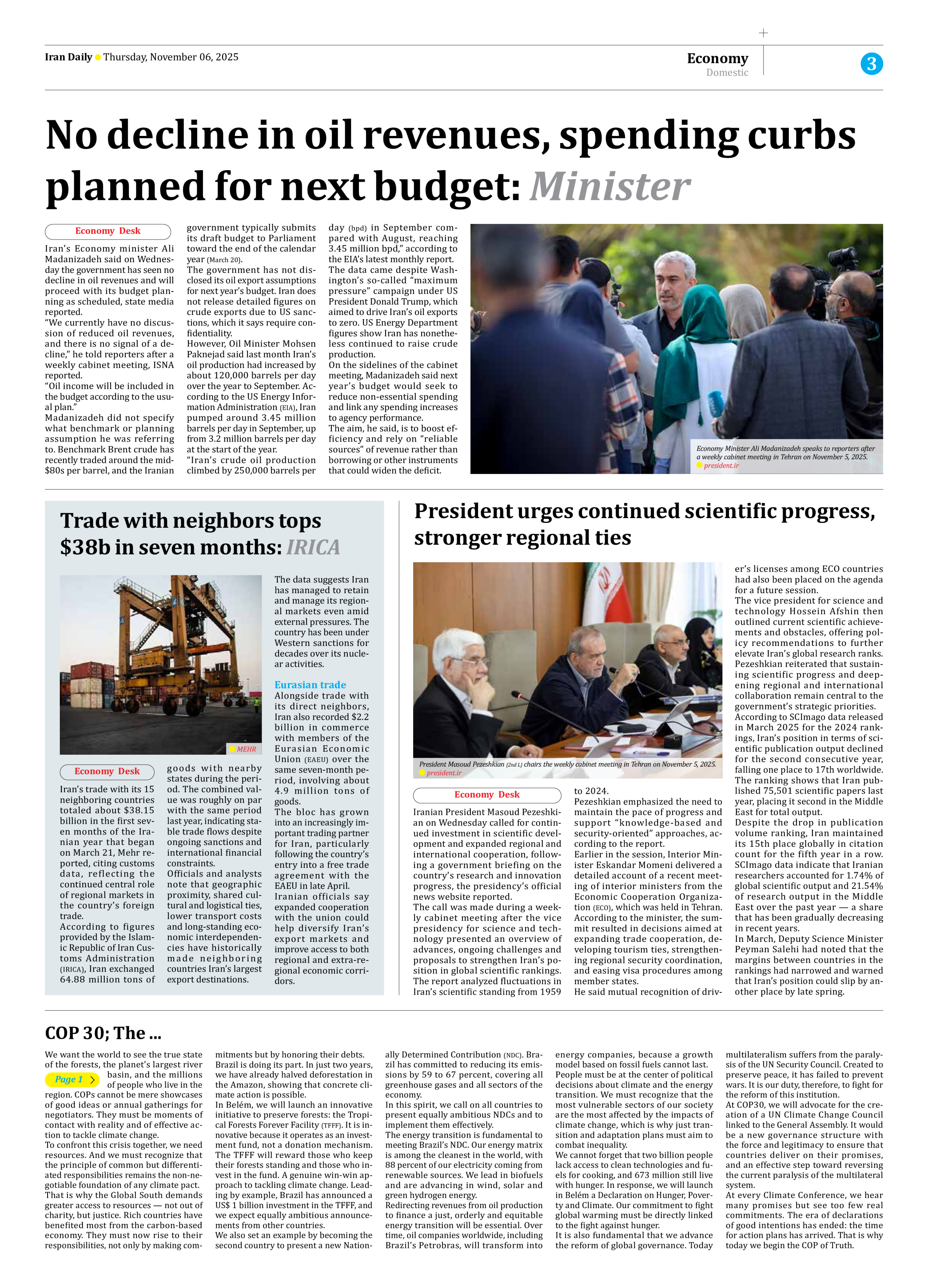
Iran’s Economy minister Ali Madanizadeh said on Wednesday the government has seen no decline in oil revenues and will proceed with its budget planning as scheduled, state media reported.
“We currently have no discussion of reduced oil revenues, and there is no signal of a decline,” he told reporters after a weekly cabinet meeting, ISNA reported.
“Oil income will be included in the budget according to the usual plan.”
Madanizadeh did not specify what benchmark or planning assumption he was referring to. Benchmark Brent crude has recently traded around the mid-$80s per barrel, and the Iranian government typically submits its draft budget to Parliament toward the end of the calendar year (March 20).
The government has not disclosed its oil export assumptions for next year’s budget. Iran does not release detailed figures on crude exports due to US sanctions, which it says require confidentiality.
However, Oil Minister Mohsen Paknejad said last month Iran’s oil production had increased by about 120,000 barrels per day over the year to September. According to the US Energy Information Administration (EIA), Iran pumped around 3.45 million barrels per day in September, up from 3.2 million barrels per day at the start of the year.
“Iran’s crude oil production climbed by 250,000 barrels per day (bpd) in September compared with August, reaching 3.45 million bpd,” according to the EIA’s latest monthly report.
The data came despite Washington’s so-called “maximum pressure” campaign under US President Donald Trump, which aimed to drive Iran’s oil exports to zero. US Energy Department figures show Iran has nonetheless continued to raise crude production.
On the sidelines of the cabinet meeting, Madanizadeh said next year’s budget would seek to reduce non-essential spending and link any spending increases to agency performance.
The aim, he said, is to boost efficiency and rely on “reliable sources” of revenue rather than borrowing or other instruments that could widen the deficit.