







From breaking barriers to joining world’s 8,000-meter club
Dreams know no boundaries: Female Iranian mountaineer
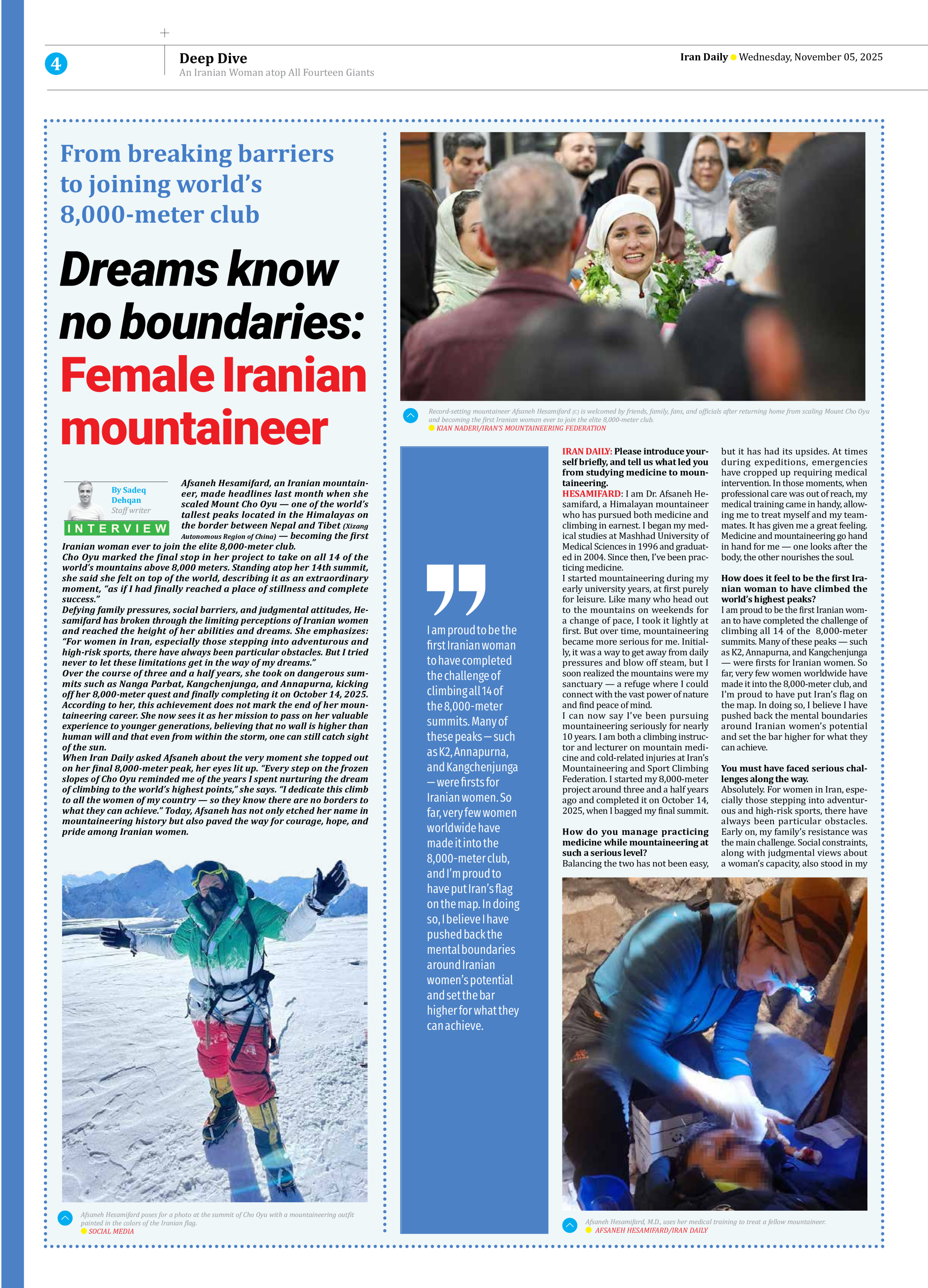
Afsaneh Hesamifard, an Iranian mountaineer, made headlines last month when she scaled Mount Cho Oyu — one of the world’s tallest peaks located in the Himalayas on the border between Nepal and Tibet (Xizang Autonomous Region of China) — becoming the first Iranian woman ever to join the elite 8,000-meter club. Cho Oyu marked the final stop in her project to take on all 14 of the world’s mountains above 8,000 meters. Standing atop her 14th summit, she said she felt on top of the world, describing it as an extraordinary moment, “as if I had finally reached a place of stillness and complete success.” Defying family pressures, social barriers, and judgmental attitudes, Hesamifard has broken through the limiting perceptions of Iranian women and reached the height of her abilities and dreams. She emphasizes: “For women in Iran, especially those stepping into adventurous and high-risk sports, there have always been particular obstacles. But I tried never to let these limitations get in the way of my dreams.” Over the course of three and a half years, she took on dangerous summits such as Nanga Parbat, Kangchenjunga, and Annapurna, kicking off her 8,000-meter quest and finally completing it on October 14, 2025. According to her, this achievement does not mark the end of her mountaineering career. She now sees it as her mission to pass on her valuable experience to younger generations, believing that no wall is higher than human will and that even from within the storm, one can still catch sight of the sun. When Iran Daily asked Afsaneh about the very moment she topped out on her final 8,000-meter peak, her eyes lit up. “Every step on the frozen slopes of Cho Oyu reminded me of the years I spent nurturing the dream of climbing to the world’s highest points,” she says. “I dedicate this climb to all the women of my country — so they know there are no borders to what they can achieve.” Today, Afsaneh has not only etched her name in mountaineering history but also paved the way for courage, hope, and pride among Iranian women.
By Sadeq Dehqan
Staff writer
IRAN DAILY: Please introduce yourself briefly, and tell us what led you from studying medicine to mountaineering.
HESAMIFARD: I am Dr. Afsaneh Hesamifard, a Himalayan mountaineer who has pursued both medicine and climbing in earnest. I began my medical studies at Mashhad University of Medical Sciences in 1996 and graduated in 2004. Since then, I’ve been practicing medicine.
I started mountaineering during my early university years, at first purely for leisure. Like many who head out to the mountains on weekends for a change of pace, I took it lightly at first. But over time, mountaineering became more serious for me. Initially, it was a way to get away from daily pressures and blow off steam, but I soon realized the mountains were my sanctuary — a refuge where I could connect with the vast power of nature and find peace of mind.
I can now say I’ve been pursuing mountaineering seriously for nearly 10 years. I am both a climbing instructor and lecturer on mountain medicine and cold-related injuries at Iran’s Mountaineering and Sport Climbing Federation. I started my 8,000-meter project around three and a half years ago and completed it on October 14, 2025, when I bagged my final summit.
How do you manage practicing medicine while mountaineering at such a serious level?
Balancing the two has not been easy, but it has had its upsides. At times during expeditions, emergencies have cropped up requiring medical intervention. In those moments, when professional care was out of reach, my medical training came in handy, allowing me to treat myself and my teammates. It has given me a great feeling. Medicine and mountaineering go hand in hand for me — one looks after the body, the other nourishes the soul.
How does it feel to be the first Iranian woman to have climbed the world’s highest peaks?
I am proud to be the first Iranian woman to have completed the challenge of climbing all 14 of the 8,000-meter summits. Many of these peaks — such as K2, Annapurna, and Kangchenjunga — were firsts for Iranian women. So far, very few women worldwide have made it into the 8,000-meter club, and I’m proud to have put Iran’s flag on the map. In doing so, I believe I have pushed back the mental boundaries around Iranian women’s potential and set the bar higher for what they can achieve.
You must have faced serious challenges along the way.
Absolutely. For women in Iran, especially those stepping into adventurous and high-risk sports, there have always been particular obstacles. Early on, my family’s resistance was the main challenge. Social constraints, along with judgmental views about a woman’s capacity, also stood in my way. But I tried never to let these limitations get in the way of my dreams. I deeply believe that dreams know no borders, and that women possess a unique energy — one that, when they tap into, can help them clear any obstacle from their path.
Climbing such a number of high and dangerous peaks has surely come with countless memories. Which of these ascents have stuck with you the most and turned into truly memorable experiences?
Each of the 14 eight-thousanders holds its own special set of memories for me — some tough, but most of them sweet and unforgettable. Yet, the climb up Everest stood out as both a major goal and the kickoff for this ambitious project. Standing on top of the world fills you with an incredible feeling. My ascent of Everest taught me that if I stick to a steady routine, train properly, and keep at it with patience and determination, I can even make it to the world’s highest summit.
The second remarkable climb I should mention is K2 — a mountain many Iranian women had long dreamt of conquering. Several had even set out for it, including the late Leila Esfandyari, who tragically lost her life in July 2011 on Gasherbrum II.
In fact, K2 and the uniquely wild landscape of Pakistan put my determination and efforts to a real test — one I eventually pulled through. The next special peak for me was Nanga Parbat, better known as the “Killer Mountain”. I must admit I feared it from the start, but with practice, hard work, and drawing on the experience of those who had climbed it before me, I managed to summit it without difficulty. The memory of that ascent will always stay vivid as the route was extremely challenging and the weather bitterly cold at that time. Still, those hardships pushed me to go beyond my limits and gave me stronger faith in myself.
Finally, during the climb up Cho Oyu, I faced entirely different weather conditions. We had a heavy snowfall, with snow piling up to more than two meters. Knowing it was the last peak of the project, I felt something very special — as if I had finally reached a place of stillness and complete success. That climb means a great deal to me and will always stay ingrained in my mind.
Since you’ve just returned from summiting Cho Oyu, could you tell us more about how that ascent went?
Climbing Cho Oyu was indeed a unique experience. According to the plan I had laid out, I was supposed to wrap up the 14 eight-thousanders project in the fall of this year. But when I went to Nepal to get my visa, I ran into serious problems. Due to the revolution and regime change in Nepal, the political scene had turned tense, and China’s visa wasn’t granted easily. I really had to hustle to get it, and at the very last moment, I finally succeeded and set off for China.
As I reached base camp, severe weather hit the region. Heavy snowstorms struck, and almost every team gave up hope of making the climb. Two meters of snow, freezing winds, and whiteouts at high altitude convinced many that summiting was out of the question. But patience often pays off in the mountains. After waiting in the base camp for the weather to ease up, our team went ahead with the climb, and I managed to reach the top of my final 8,000-meter peak.
When you’re trapped in snow, blizzards, and biting cold, do you ever feel fear or hopelessness creeping in? Have you ever thought of the worst in those situations?
Climbing the 8,000-meter peaks always comes with its dangers. Anyone who thinks everything will go smoothly and there will be no risk is living in a dream world. It’s not always like that.
Climbing the peaks where oxygen is scarce, the cold is severe, snow is endless, and avalanches are always a threat, surely comes with its own set of dangers. Many times, I felt danger breathing right down my neck. On Nanga Parbat, Kangchenjunga, and Annapurna, I faced life-threatening moments when disaster was only a step away. Still, none of these risks ever made me back off, question why I was there, or decide that I should let go of my dreams. I always believed that by pushing harder, I could move things forward and take a positive step toward my goal.
Twice, I had to turn back due to harsh weather, but I later went for it again and succeeded. Of course, the mental and emotional support from my friends and family helped me get through the roughest conditions and make it to the top.
Now that you’ve conquered all the world’s towering peaks, has that affected your motivation to keep climbing?
It’s understandable if some people think that after scaling all 14 of the world’s highest summits, I’d have no goal left and might feel a loss of drive. But quite the opposite — I feel like my work has just kicked into gear. Ending the 8,000-meter project doesn’t mean the end of my mountaineering world. I plan to carry on in two directions: first, to pass down my experiences to younger climbers, which is something deeply meaningful to me and a path that I must definitely pursue; and second, to embark on new climbing projects. With proper sponsorship, I aim to put Iran back on the map of global mountaineering.
As you implied, climbing must be financially demanding. How have you managed to cover the costs? Does the Iranian government support you?
Mountaineering is indeed a pricey sport. At the beginning, the financial burden — permits, flights, gear, and logistical support — was what really held me back from higher ambitions. I never received government funding, and my early climbs were entirely self-financed. But from the third ascent onward — starting with K2 — I was backed by a strong sponsor, Vitabiotics, a company with a progressive view of sports and women’s capabilities. Their support helped me speed up the project and bring it to fruition much sooner.
How long do you think you can keep climbing professionally?
Most sports have an age limit, meaning that you can keep pursuing them up to a certain age or until you meet certain conditions. However, mountaineering is one of those disciplines where, if you can keep yourself in shape, you can continue well into older age. This year, I met an 86-year-old man who successfully summited one of the eight-thousanders. To achieve such feats, one must train constantly and scientifically to stay on top of physical fitness and take on the mountain’s challenges.
My hope is for Iranian women in mountaineering to build up a strong, safe, and enduring movement. Our women must truly believe in their own potential and realize that no wall is too high for human will.