







Hamas accepted Gaza cease-fire for ‘tactical, strategic’ reasons: Veteran diplomat
Missing pieces of Trump’s plan
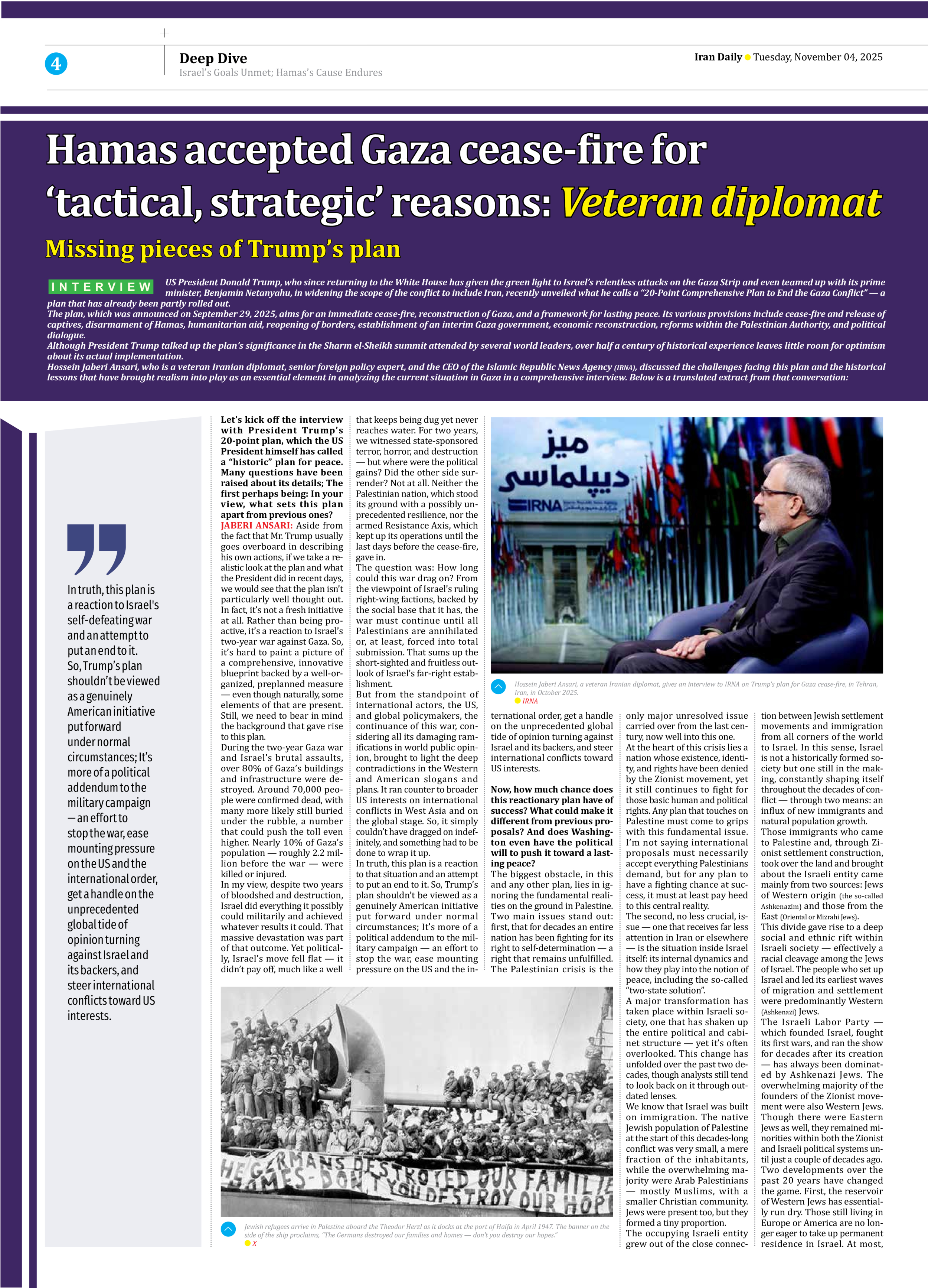
US President Donald Trump, who since returning to the White House has given the green light to Israel’s relentless attacks on the Gaza Strip and even teamed up with its prime minister, Benjamin Netanyahu, in widening the scope of the conflict to include Iran, recently unveiled what he calls a “20-Point Comprehensive Plan to End the Gaza Conflict” — a plan that has already been partly rolled out. The plan, which was announced on September 29, 2025, aims for an immediate cease-fire, reconstruction of Gaza, and a framework for lasting peace. Its various provisions include cease-fire and release of captives, disarmament of Hamas, humanitarian aid, reopening of borders, establishment of an interim Gaza government, economic reconstruction, reforms within the Palestinian Authority, and political dialogue. Although President Trump talked up the plan’s significance in the Sharm el-Sheikh summit attended by several world leaders, over half a century of historical experience leaves little room for optimism about its actual implementation. Hossein Jaberi Ansari, who is a veteran Iranian diplomat, senior foreign policy expert, and the CEO of the Islamic Republic News Agency (IRNA), discussed the challenges facing this plan and the historical lessons that have brought realism into play as an essential element in analyzing the current situation in Gaza in a comprehensive interview. Below is a translated extract from that conversation:
Let’s kick off the interview with President Trump’s 20-point plan, which the US President himself has called a “historic” plan for peace. Many questions have been raised about its details; The first perhaps being: In your view, what sets this plan apart from previous ones?
JABERI ANSARI: Aside from the fact that Mr. Trump usually goes overboard in describing his own actions, if we take a realistic look at the plan and what the President did in recent days, we would see that the plan isn’t particularly well thought out. In fact, it’s not a fresh initiative at all. Rather than being proactive, it’s a reaction to Israel’s two-year war against Gaza. So, it’s hard to paint a picture of a comprehensive, innovative blueprint backed by a well-organized, preplanned measure — even though naturally, some elements of that are present. Still, we need to bear in mind the background that gave rise to this plan.
During the two-year Gaza war and Israel’s brutal assaults, over 80% of Gaza’s buildings and infrastructure were destroyed. Around 70,000 people were confirmed dead, with many more likely still buried under the rubble, a number that could push the toll even higher. Nearly 10% of Gaza’s population — roughly 2.2 million before the war — were killed or injured.
In my view, despite two years of bloodshed and destruction, Israel did everything it possibly could militarily and achieved whatever results it could. That massive devastation was part of that outcome. Yet politically, Israel’s move fell flat — it didn’t pay off, much like a well that keeps being dug yet never reaches water. For two years, we witnessed state-sponsored terror, horror, and destruction — but where were the political gains? Did the other side surrender? Not at all. Neither the Palestinian nation, which stood its ground with a possibly unprecedented resilience, nor the armed Resistance Axis, which kept up its operations until the last days before the cease-fire, gave in.
The question was: How long could this war drag on? From the viewpoint of Israel’s ruling right-wing factions, backed by the social base that it has, the war must continue until all Palestinians are annihilated or, at least, forced into total submission. That sums up the short-sighted and fruitless outlook of Israel’s far-right establishment.
But from the standpoint of international actors, the US, and global policymakers, the continuance of this war, considering all its damaging ramifications in world public opinion, brought to light the deep contradictions in the Western and American slogans and plans. It ran counter to broader US interests on international conflicts in West Asia and on the global stage. So, it simply couldn’t have dragged on indefinitely, and something had to be done to wrap it up.
In truth, this plan is a reaction to that situation and an attempt to put an end to it. So, Trump’s plan shouldn’t be viewed as a genuinely American initiative put forward under normal circumstances; It’s more of a political addendum to the military campaign — an effort to stop the war, ease mounting pressure on the US and the international order, get a handle on the unprecedented global tide of opinion turning against Israel and its backers, and steer international conflicts toward US interests.
Now, how much chance does this reactionary plan have of success? What could make it different from previous proposals? And does Washington even have the political will to push it toward a lasting peace?
The biggest obstacle, in this and any other plan, lies in ignoring the fundamental realities on the ground in Palestine. Two main issues stand out: first, that for decades an entire nation has been fighting for its right to self-determination — a right that remains unfulfilled. The Palestinian crisis is the only major unresolved issue carried over from the last century, now well into this one.
At the heart of this crisis lies a nation whose existence, identity, and rights have been denied by the Zionist movement, yet it still continues to fight for those basic human and political rights. Any plan that touches on Palestine must come to grips with this fundamental issue. I’m not saying international proposals must necessarily accept everything Palestinians demand, but for any plan to have a fighting chance at success, it must at least pay heed to this central reality.
The second, no less crucial, issue — one that receives far less attention in Iran or elsewhere — is the situation inside Israel itself: its internal dynamics and how they play into the notion of peace, including the so-called “two-state solution”.
A major transformation has taken place within Israeli society, one that has shaken up the entire political and cabinet structure — yet it’s often overlooked. This change has unfolded over the past two decades, though analysts still tend to look back on it through outdated lenses.
We know that Israel was built on immigration. The native Jewish population of Palestine at the start of this decades-long conflict was very small, a mere fraction of the inhabitants, while the overwhelming majority were Arab Palestinians — mostly Muslims, with a smaller Christian community. Jews were present too, but they formed a tiny proportion.
The occupying Israeli entity grew out of the close connection between Jewish settlement movements and immigration from all corners of the world to Israel. In this sense, Israel is not a historically formed society but one still in the making, constantly shaping itself throughout the decades of conflict — through two means: an influx of new immigrants and natural population growth.
Those immigrants who came to Palestine and, through Zionist settlement construction, took over the land and brought about the Israeli entity came mainly from two sources: Jews of Western origin (the so-called Ashkenazim) and those from the East (Oriental or Mizrahi Jews).
This divide gave rise to a deep social and ethnic rift within Israeli society — effectively a racial cleavage among the Jews of Israel. The people who set up Israel and led its earliest waves of migration and settlement were predominantly Western (Ashkenazi) Jews.
The Israeli Labor Party — which founded Israel, fought its first wars, and ran the show for decades after its creation — has always been dominated by Ashkenazi Jews. The overwhelming majority of the founders of the Zionist movement were also Western Jews. Though there were Eastern Jews as well, they remained minorities within both the Zionist and Israeli political systems until just a couple of decades ago.
Two developments over the past 20 years have changed the game. First, the reservoir of Western Jews has essentially run dry. Those still living in Europe or America are no longer eager to take up permanent residence in Israel. At most, they may hold dual citizenship, but they prefer to stay put in their home countries rather than relocate and engage in settlement activity. Consequently, the flow of immigration has shifted toward Jews of Eastern origin.
The second development concerns demographics. The Eastern Jews who gradually made their way to Israel in previous decades have much higher birth rates. Demographically, their share of the population has been steadily on the rise, giving the social fabric of Israel an increasingly Eastern complexion. The Mizrahi Jews view the land of Palestine as utterly sacred; Not an inch of it, in their view, can be bartered or compromised. They hold on to a sanctified perception of this land, calling it “Eretz Israel,” or the historical land of Israel, in line with both their religious and Zionist narratives.
This social foundation has allowed Prime Minister Netanyahu to hold onto power for the longest premiership in Israel’s history. The right-wing coalition has stayed in charge for nearly two decades — almost a quarter of a century. The Labor Party, once the country’s founding political force and a pillar of Zionism, has been reduced to a mere shadow of its former self, holding just three seats out of 120 in the Knesset. The ruling bloc has no time for peace or compromise; It believes the entire land is theirs, leaving no room for negotiation.
The biggest obstacle to this plan or any other — just as in the case of the Oslo peace and two-state initiative — remains this same unyielding social base within Israel. Even the factions that once paid lip service to peace or the two-state solution have been pushed to the sidelines, becoming a marginal minority in Israel’s political arena.
The pivotal question facing any peace initiative is whether there exists a genuine international will to bring pressure to bear on this social base within Israel to turn things around.
Past experiences provide a clear answer. Initiatives like Oslo and similar efforts showed that when crises flare up, international actors, including the United States, jump in to patch things up — talking about peace, a two-state solution, and related issues. But once the dust settles down and the situation calms on the surface, everything is again swept under the rug and gets forgotten, largely because of internal resistance within Israeli society.
The difference between the Oslo process and the current situation lies in the fact that after October 7, 2023, Israel’s conduct in the Gaza Strip sparked a worldwide awakening in public consciousness, and that same public opinion translated into mounting pressure on political leaders. Unprecedented developments took place, such as the issuance of arrest warrants for Netanyahu and other senior Israeli officials. How much can this new public mood — which even pushed European countries to admit that they must move toward the creation of an independent Palestinian state — weigh in on this analysis? On the other hand, there had been earlier pledges to normalize relations between Arab states and Israel — some of which had already been implemented before October 7 — until that day brought things to a halt. Can these two factors bring about a different outcome for this plan?
Not necessarily. Neither of these is new; Both go back to long historical precedents. Global public opinion has long stood behind the Palestinian cause and its people.
Not to this extent, though. Even opinion polls in the United States have changed.
Yes, slightly. What’s new is that, for the first time, public sentiment in the United States and parts of Europe has come out openly in favor of the Palestinians in their conflict with Israel. That’s part of the shift we’re witnessing. But in terms of overall impact, public opinion died down after the Oslo process. The issue was effectively declared closed as people were sold the illusion that the Palestinian cause was on its way to resolution. That atmosphere eventually faded away. This also coincided with broader global shifts — the end of the Cold War and the bipolar world order, which reshaped the international power structure and left its mark on global politics.
Coming back to your question, one of the major outcomes of October 7 — despite all the destruction, massacres, and atrocities committed against the Palestinians — is precisely this: The Palestinian issue, which after Oslo had effectively slipped off the radar and even among Arab and Muslim nations was no longer seen as a living cause, has now been brought back to life. Palestinians had felt completely forgotten in a world rife with oppression and injustice, as though they were being written out of history. That feeling was one of the main driving forces behind Hamas and the broader Palestinian resistance’s major operation on October 7.
Despite all the losses and suffering the Palestinians have endured, their greatest gain lies here: The Palestinian cause has once again been thrust onto the international stage and turned into a global concern — even if only superficially — for countries around the world, particularly in the West.
You mentioned why Israel accepted Trump’s peace plan. On the other hand, the key question is: What made Hamas accept it? It’s well known that the plan includes provisions such as the disarmament of Hamas and a clause preventing it from returning to political power. What, then, persuaded Hamas to go along with the plan — albeit conditionally?
The truth is, it’s not that complicated. After two years of nonstop Israeli bombardment and atrocities, Hamas also felt accountable to its own people and didn’t want to be blamed for prolonging the bloodshed. That’s the main responsibility Hamas faced — one that carried both tactical and strategic weight. On the tactical side, it was about ensuring that Israel, not Hamas, got saddled with the blame for continued killing. For a movement with a clear political agenda, such perception matters greatly.
Strategically, the move also makes sense. The Palestinian people have demonstrated a resistance that is truly exceptional in the modern history of humankind — standing up to mass killings with extraordinary endurance. Yet every society has its limits. The Palestinian nation needed a breather, a moment to catch its breath. Conditions had become unbearable, especially in recent months as famine was added to Israel’s relentless bombardments and atrocities. The famine was not only inflicted directly, but also indirectly through the blockade and deliberate denial of essential goods like bread and flour. Such conditions took their toll, pushing Gazans to the brink of human endurance.
It was therefore natural for Hamas to take into account the strategic dimension of this reality as it remains responsible to its people and their national cause. The movement fought for two years, never threw in the towel, and put up unprecedented resistance, drawing upon the deep support and solidarity of its community. Still, this didn’t erase its responsibility to its own people; It could not be seen as enabling the continuation of slaughter, famine, and suffering across Gaza.
So, what did Hamas actually do? As you mentioned, it didn’t accept the plan outright. Psychologically motivated, it decided to thank the US president and welcome his initiative. These gestures were reflected in Hamas’s statement — perhaps also playing to Trump’s personality, which is marked by a strong streak of narcissism and self-admiration. This symbolic gesture was more about form than substance.
In terms of substance, Hamas laid on the table what it actually held: Israeli captives and the bodies of Israelis killed during the bombings. It declared its readiness to hand over both the living and the dead. Searches are still underway to locate remaining bodies, which has now turned into one of Israel’s pretexts for continued accusations.
In return, Hamas demanded the release of Palestinian prisoners — a central goal behind capturing Israelis in the first place. Around a thousand Palestinian prisoners were exchanged, including nearly 200 serving long-term or life sentences.
Over a year ago, Hamas had already announced its willingness to hand over administration of Gaza to an agreed Palestinian arrangement — a national formula, technocratic or otherwise. In colloquial terms, it was, as they say, “making a virtue of necessity” since Hamas had already made the same proposal before. Once again, it reiterated this position in its acceptance statement, expressing readiness to pass on Gaza’s governance to a joint Palestinian framework.
However, once the plan reached later stages — questions about Gaza’s future, disarmament, Palestinian statehood, and the international presence of foreign forces as outlined in Trump’s proposal — Hamas’s statement deferred all such matters to Palestinian national consensus. It essentially said these matters were beyond its authority and therefore steered clear of engaging directly, leaving them to collective Palestinian decision-making. But as we well know, achieving such internal consensus among Palestinian factions is easier said than done.
The full interview first appeared in Persian on IRNA.