







Key water, power projects launched to ease shortages, drive ‘sustainable growth’
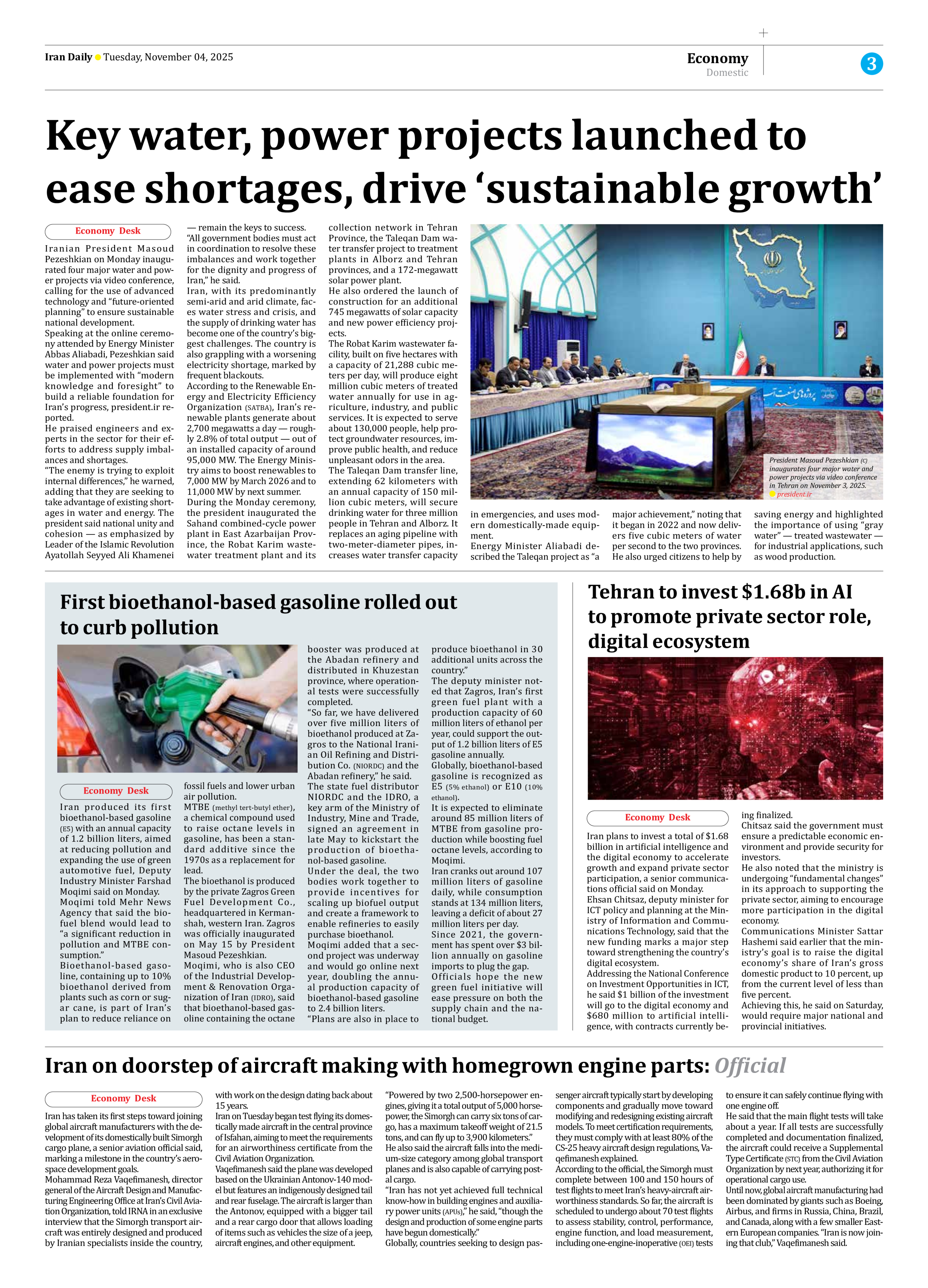
Iranian President Masoud Pezeshkian on Monday inaugurated four major water and power projects via video conference, calling for the use of advanced technology and “future-oriented planning” to ensure sustainable national development.
Speaking at the online ceremony attended by Energy Minister Abbas Aliabadi, Pezeshkian said water and power projects must be implemented with “modern knowledge and foresight” to build a reliable foundation for Iran’s progress, president.ir reported.
He praised engineers and experts in the sector for their efforts to address supply imbalances and shortages.
“The enemy is trying to exploit internal differences,” he warned, adding that they are seeking to take advantage of existing shortages in water and energy. The president said national unity and cohesion — as emphasized by Leader of the Islamic Revolution Ayatollah Seyyed Ali Khamenei — remain the keys to success.
“All government bodies must act in coordination to resolve these imbalances and work together for the dignity and progress of Iran,” he said.
Iran, with its predominantly semi-arid and arid climate, faces water stress and crisis, and the supply of drinking water has become one of the country’s biggest challenges. The country is also grappling with a worsening electricity shortage, marked by frequent blackouts.
According to the Renewable Energy and Electricity Efficiency Organization (SATBA), Iran’s renewable plants generate about 2,700 megawatts a day — roughly 2.8% of total output — out of an installed capacity of around 95,000 MW. The Energy Ministry aims to boost renewables to 7,000 MW by March 2026 and to 11,000 MW by next summer.
During the Monday ceremony, the president inaugurated the Sahand combined-cycle power plant in East Azarbaijan Province, the Robat Karim wastewater treatment plant and its collection network in Tehran Province, the Taleqan Dam water transfer project to treatment plants in Alborz and Tehran provinces, and a 172-megawatt solar power plant.
He also ordered the launch of construction for an additional 745 megawatts of solar capacity and new power efficiency projects.
The Robat Karim wastewater facility, built on five hectares with a capacity of 21,288 cubic meters per day, will produce eight million cubic meters of treated water annually for use in agriculture, industry, and public services. It is expected to serve about 130,000 people, help protect groundwater resources, improve public health, and reduce unpleasant odors in the area.
The Taleqan Dam transfer line, extending 62 kilometers with an annual capacity of 150 million cubic meters, will secure drinking water for three million people in Tehran and Alborz. It replaces an aging pipeline with two-meter-diameter pipes, increases water transfer capacity in emergencies, and uses modern domestically-made equipment.
Energy Minister Aliabadi described the Taleqan project as “a major achievement,” noting that it began in 2022 and now delivers five cubic meters of water per second to the two provinces.
He also urged citizens to help by saving energy and highlighted the importance of using “gray water” — treated wastewater — for industrial applications, such as wood production.