





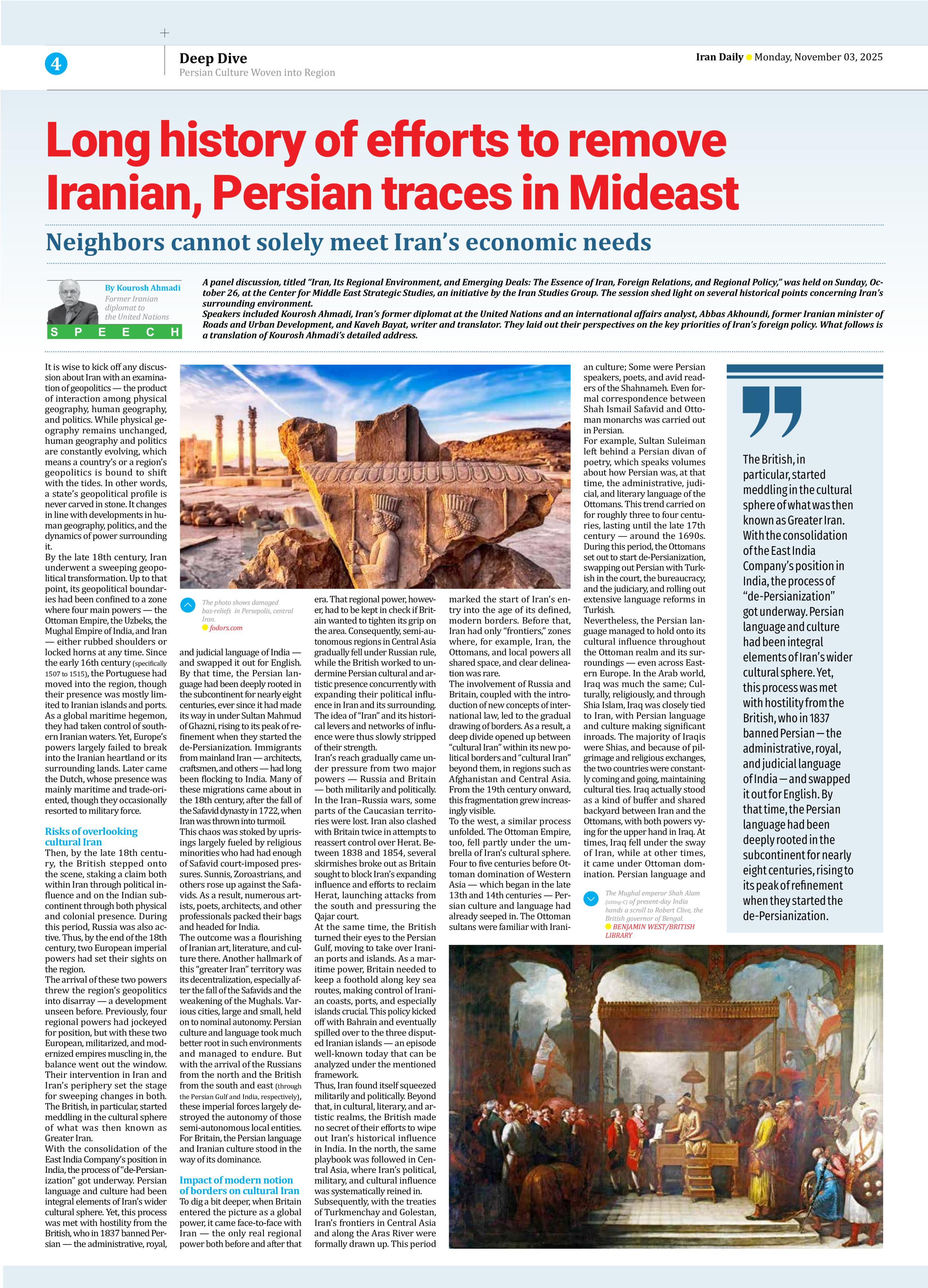


Long history of efforts to remove Iranian, Persian traces in Mideast
Neighbors cannot solely meet Iran’s economic needs
A panel discussion, titled “Iran, Its Regional Environment, and Emerging Deals: The Essence of Iran, Foreign Relations, and Regional Policy,” was held on Sunday, October 26, at the Center for Middle East Strategic Studies, an initiative by the Iran Studies Group. The session shed light on several historical points concerning Iran’s surrounding environment. Speakers included Kourosh Ahmadi, Iran’s former diplomat at the United Nations and an international affairs analyst, Abbas Akhoundi, former Iranian minister of Roads and Urban Development, and Kaveh Bayat, writer and translator. They laid out their perspectives on the key priorities of Iran’s foreign policy. What follows is a translation of Kourosh Ahmadi’s detailed address.
By Kourosh Ahmadi
Former Iranian
diplomat to
the United Nations
It is wise to kick off any discussion about Iran with an examination of geopolitics — the product of interaction among physical geography, human geography, and politics. While physical geography remains unchanged, human geography and politics are constantly evolving, which means a country’s or a region’s geopolitics is bound to shift with the tides. In other words, a state’s geopolitical profile is never carved in stone. It changes in line with developments in human geography, politics, and the dynamics of power surrounding it.
By the late 18th century, Iran underwent a sweeping geopolitical transformation. Up to that point, its geopolitical boundaries had been confined to a zone where four main powers — the Ottoman Empire, the Uzbeks, the Mughal Empire of India, and Iran — either rubbed shoulders or locked horns at any time. Since the early 16th century (specifically 1507 to 1515), the Portuguese had moved into the region, though their presence was mostly limited to Iranian islands and ports. As a global maritime hegemon, they had taken control of southern Iranian waters. Yet, Europe’s powers largely failed to break into the Iranian heartland or its surrounding lands. Later came the Dutch, whose presence was mainly maritime and trade-oriented, though they occasionally resorted to military force.
Risks of overlooking cultural Iran
Then, by the late 18th century, the British stepped onto the scene, staking a claim both within Iran through political influence and on the Indian subcontinent through both physical and colonial presence. During this period, Russia was also active. Thus, by the end of the 18th century, two European imperial powers had set their sights on the region.
The arrival of these two powers threw the region’s geopolitics into disarray — a development unseen before. Previously, four regional powers had jockeyed for position, but with these two European, militarized, and modernized empires muscling in, the balance went out the window. Their intervention in Iran and Iran’s periphery set the stage for sweeping changes in both. The British, in particular, started meddling in the cultural sphere of what was then known as Greater Iran.
With the consolidation of the East India Company’s position in India, the process of “de-Persianization” got underway. Persian language and culture had been integral elements of Iran’s wider cultural sphere. Yet, this process was met with hostility from the British, who in 1837 banned Persian — the administrative, royal, and judicial language of India — and swapped it out for English. By that time, the Persian language had been deeply rooted in the subcontinent for nearly eight centuries, ever since it had made its way in under Sultan Mahmud of Ghazni, rising to its peak of refinement when they started the de-Persianization. Immigrants from mainland Iran — architects, craftsmen, and others — had long been flocking to India. Many of these migrations came about in the 18th century, after the fall of the Safavid dynasty in 1722, when Iran was thrown into turmoil.
This chaos was stoked by uprisings largely fueled by religious minorities who had had enough of Safavid court-imposed pressures. Sunnis, Zoroastrians, and others rose up against the Safavids. As a result, numerous artists, poets, architects, and other professionals packed their bags and headed for India.
The outcome was a flourishing of Iranian art, literature, and culture there. Another hallmark of this “greater Iran” territory was its decentralization, especially after the fall of the Safavids and the weakening of the Mughals. Various cities, large and small, held on to nominal autonomy. Persian culture and language took much better root in such environments and managed to endure. But with the arrival of the Russians from the north and the British from the south and east (through the Persian Gulf and India, respectively), these imperial forces largely destroyed the autonomy of those semi-autonomous local entities. For Britain, the Persian language and Iranian culture stood in the way of its dominance.
Impact of modern notion of borders on cultural Iran
To dig a bit deeper, when Britain entered the picture as a global power, it came face-to-face with Iran — the only real regional power both before and after that era. That regional power, however, had to be kept in check if Britain wanted to tighten its grip on the area. Consequently, semi-autonomous regions in Central Asia gradually fell under Russian rule, while the British worked to undermine Persian cultural and artistic presence concurrently with expanding their political influence in Iran and its surrounding. The idea of “Iran” and its historical levers and networks of influence were thus slowly stripped of their strength.
Iran’s reach gradually came under pressure from two major powers — Russia and Britain — both militarily and politically. In the Iran–Russia wars, some parts of the Caucasian territories were lost. Iran also clashed with Britain twice in attempts to reassert control over Herat. Between 1838 and 1854, several skirmishes broke out as Britain sought to block Iran’s expanding influence and efforts to reclaim Herat, launching attacks from the south and pressuring the Qajar court.
At the same time, the British turned their eyes to the Persian Gulf, moving to take over Iranian ports and islands. As a maritime power, Britain needed to keep a foothold along key sea routes, making control of Iranian coasts, ports, and especially islands crucial. This policy kicked off with Bahrain and eventually spilled over to the three disputed Iranian islands — an episode well-known today that can be analyzed under the mentioned framework.
Thus, Iran found itself squeezed militarily and politically. Beyond that, in cultural, literary, and artistic realms, the British made no secret of their efforts to wipe out Iran’s historical influence in India. In the north, the same playbook was followed in Central Asia, where Iran’s political, military, and cultural influence was systematically reined in.
Subsequently, with the treaties of Turkmenchay and Golestan, Iran’s frontiers in Central Asia and along the Aras River were formally drawn up. This period marked the start of Iran’s entry into the age of its defined, modern borders. Before that, Iran had only “frontiers,” zones where, for example, Iran, the Ottomans, and local powers all shared space, and clear delineation was rare.
The involvement of Russia and Britain, coupled with the introduction of new concepts of international law, led to the gradual drawing of borders. As a result, a deep divide opened up between “cultural Iran” within its new political borders and “cultural Iran” beyond them, in regions such as Afghanistan and Central Asia. From the 19th century onward, this fragmentation grew increasingly visible.
To the west, a similar process unfolded. The Ottoman Empire, too, fell partly under the umbrella of Iran’s cultural sphere. Four to five centuries before Ottoman domination of Western Asia — which began in the late 13th and 14th centuries — Persian culture and language had already seeped in. The Ottoman sultans were familiar with Iranian culture; Some were Persian speakers, poets, and avid readers of the Shahnameh. Even formal correspondence between Shah Ismail Safavid and Ottoman monarchs was carried out in Persian.
For example, Sultan Suleiman left behind a Persian divan of poetry, which speaks volumes about how Persian was, at that time, the administrative, judicial, and literary language of the Ottomans. This trend carried on for roughly three to four centuries, lasting until the late 17th century — around the 1690s. During this period, the Ottomans set out to start de-Persianization, swapping out Persian with Turkish in the court, the bureaucracy, and the judiciary, and rolling out extensive language reforms in Turkish.
Nevertheless, the Persian language managed to hold onto its cultural influence throughout the Ottoman realm and its surroundings — even across Eastern Europe. In the Arab world, Iraq was much the same; Culturally, religiously, and through Shia Islam, Iraq was closely tied to Iran, with Persian language and culture making significant inroads. The majority of Iraqis were Shias, and because of pilgrimage and religious exchanges, the two countries were constantly coming and going, maintaining cultural ties. Iraq actually stood as a kind of buffer and shared backyard between Iran and the Ottomans, with both powers vying for the upper hand in Iraq. At times, Iraq fell under the sway of Iran, while at other times, it came under Ottoman domination. Persian language and culture crept into Iraq widely, leaving their mark on daily life, literature, and the arts.
Cultural Iran has maintained its historical continuity
A new development that deepened the rift was the emergence of nation-state formation, which began to get off the ground after World War I. When the Ottoman Empire fell apart, new modern states sprang up across the region. Building national identity quickly shot to the top of the agenda for these states, and the drive for distinctive cultural and political boundaries kept gathering momentum.
In line with this, starting in the 1940s, the nascent governments, such as Iraq’s Ba’ath Party, got down to the business of nation-building. Their created identities were defined by novel ideas of the nation and the state, and over time, Iran was cast as “the other” in the region’s political and cultural discourse. These moves coincided with a wave of de-Persianization that picked up speed after World War I.
At this point, Britain’s presence also came into play. As the Ottoman Empire disintegrated, areas such as Iraq fell under Britain’s thumb and were brought under direct control. In these territories, new cultural policies were rolled out to undercut the Persian language and culture. In Bahrain, for instance, a British national served as Adviser to the Ruler of Bahrain for around 30 years. This longstanding presence played a pivotal part in cutting Bahrain loose from Iran’s cultural sphere and dimming the standing of the Persian language and culture there.
Thus, the political and cultural changes after the fall of the Ottomans, the arrival of European powers, and the onset of nation-building in the Middle East opened up a rift in cultural Iran. As a result, cultural and political Iran drifted apart — an outcome that paved the way for the emergence of new borders in Central Asia. This trend intensified in the Soviet era as the Soviets rolled out systematic policies to weaken Persian language and culture, including a wholesale switch to the Cyrillic script and efforts designed to drive a wedge between Central Asian nations and Iran.
Still, even in this new age, the cultural, artistic, and literary elements of Iran and Persian kept going strong throughout the wider region. Although Persian was no longer the official language of the court or judiciary, it remained in use among the intellectual, scientific, and cultural elites of the Indian subcontinent and Central Asia.
Religiously, Iranian Islam stands apart from the Islam of the Quraysh tribe or the Arabs. This difference isn’t limited to Shia Islam; Even Sunni communities in Central Asia and parts of Afghanistan show the fingerprints of Iranian Islam. These cultural and religious factors have, over centuries, played a key role in keeping cultural Iran alive. In fact, these features have ensured that cultural Iran has held its ground historically despite shifting borders and politics. Even now, there’s a cultural Iran on one side, while on the other, Iran rubs shoulders with Arab Islam and the Western world.
The issue of “othering” came out in the open during World War I, at a time when state-building was high on the agenda in the region. In Iraq, the Ba’athists, Pan-Arabists, and Arab socialists — whose outlook was a blend of leftist and nationalist ideas — set out to cobble together a new nation from scratch. That’s why, especially in Iraq, more than anywhere else in the region, forces worked hard to forge a sense of identity by differentiating themselves from Persian and Iranian culture. During the Iraqi monarchy, Tehran and Baghdad got along reasonably well, but in Iraq’s education, arts, and broader culture, a deliberate push for Arab, Iraqi, and Sunni identity got underway. This new identity-building, often implicitly, sometimes openly, boiled down to defining Iran as “anti-Iraq” and “the outsider”. By this means, Iraq set out to distinguish its own culture and identity from Iran’s.
In Turkey, meanwhile, during Atatürk’s state-building drive, the process unfolded with far less animosity toward Iran, thanks to his relatively friendly ties with Reza Shah. In Central Asia and the Caucasus, Russia and the USSR pursued their own agenda, while in the Indian subcontinent, de-Iranization and de-Persianization went ahead unabated.
Relying on regional ties won’t cut it economically
On ties with neighbors — especially economic ties — there’s been a strong push in recent years for the notion that regional relations are enough to fall back on, and that if these are well-developed, everything will fall into place and even sanctions won’t hold Iran back. This position holds little water, and there’s little reason to buy it; From an economic perspective, it’s not realistic.
The combined GDP of Iran’s neighbors — including Persian Gulf countries — makes up barely more than six percent of the global economy, even at best. So, even supposing Iran could pull off the highest possible level of economic cooperation with all its neighbors — which, given the current climate and sanctions, is next to impossible, — this still wouldn’t go far toward meeting its economic needs.
For instance, not long ago, Turkmenistan and Iraq inked a deal on transferring oil via Iran, but since an approval from the US never came, the project ground to a halt. Or in the case of Chabahar Port, the US recently scrapped India’s sanctions waivers for the area. All of this shows that even with fewer restrictions, leaning solely on regional ties simply won’t get Iran over the line economically. Iran is a large, populous country at a crossroads of the world; Neighborly ties alone can’t solve all its problems.
Regional convergence now an uphill climb
Let’s continue by looking at the Iranian and Arab worlds — and at our main priorities over the past few decades. In several surrounding areas, we come across regions where Iran shares common cultural, historical, identity, and heritage with the neighboring Iranian world. That is, greater Iran covers territories where history, language, religion, art, thought, and lifestyle all bear the imprint of Iranian civilization. Zoroastrian heritage, Iranian mysticism, poetry and politics, and pillars of Iranian culture — wisdom, ethics, and justice — have all played a central role in shaping this civilizational zone. This is the sphere found mostly north and east of Iran — along with parts of Iraq to the west, and on the southern shores of the Persian Gulf.
Alongside this environment is a separate environment — the Arab world — which took shape under the sway of the Islam of the Quraysh tribe or the Arabs, a version of Islam that stands in contrast with Iranian Islam, whether in its Shia or Sunni branches. The key point is that in the last 40 years, Iran’s strategic focus has been on the Arab and Islamic aspects of the region, not its Iranian cultural roots. In other words, Iran has poured its energy and resources into the Arab-Islamic sphere and let the Iranian cultural ties fall by the wayside.
Globally, since the end of the Cold War, one of the major currents in international politics has been regionalism and convergence — a trend that our region has missed out on entirely. Europe’s regionalism has gone so far as to reach political union and foreign policy coordination. Here in the Middle East, though, regionalism has barely gotten off the ground. Iran’s decision to focus on the Islamic-Arab sphere — not cultural Iran — is the main culprit. Cultural Iran, especially in Central Asia, the Caucasus, and Afghanistan (setting aside the Taliban and looking instead at Afghan elites), is largely mystical and secular, which has not really been desirable for us.
When it comes to real regional convergence, structural, ideological, and cultural barriers keep cropping up. Worries over Shia ideology, ideological interpretations, power struggles, and geopolitical rivalries are all part of the mix. Within Iran, some political and cultural factions aren’t sold on the idea of closer ties with mainly secular neighboring states. On the other hand, some Iranians with secular or non-ideological leanings see themselves as a cut above places like the Caucasus, India, and Arab countries. This sense of cultural superiority itself has become a psychological sticking point, making regional coordination and cooperation that much tougher.
Under these circumstances, to genuinely move cultural and civilizational regionalism forward among Arab and neighboring countries and those within Iran’s cultural orbit, Iran would have needed to take concrete steps — sadly, that hasn’t happened to the necessary extent. Joint TV and media networks with Central Asian and Indian subcontinent countries, collaborative university programs — including faculty and student exchanges and cross-cultural research projects, expanded joint artistic and literary initiatives especially through organizations like UNESCO to showcase and protect Iranian civilizational symbols regionally, joint mystical symposiums given the deep Sufi roots linking Central Asia, the Caucasus, and India, and joint productions of TV series, films, concerts, and regional artistic teams — all of these could have gone a long way toward rebuilding cultural ties with the Iranian world.
Other countries have gotten a jump on these fronts; For example, the Turks have stitched together the Cooperation Council of Turkic-Speaking States and managed to hammer out real cultural and political convergence. Iran, meanwhile, has failed to set up any such structure and has wound up losing out on both sides. Turkey itself has been beating the drum for Ottomanism, Islamism, and Turkism. While Iran has mostly stayed focused on ideology, the Middle East, and the Arab world, it has never gone after a cultural Iran, missing out on its potential.
The truth is, Arab states have never welcomed Iran’s role in regional Middle Eastern structures and have always looked at us with suspicion. On Palestine and plenty of other fronts, they have refused to team up with Iran in earnest, always taking steps to derail Iran’s influence in the region. By overcommitting to the Arab-Islamic world, Iran has let the opportunity slip by to reconnect with the cultural Iranian world, essentially making way for Turkey to move in and take over the field.
The article first appeared in
Persian on IRNA.