







Diwali sparks fire, light traditions that connect India, Iran
India’s Ambassador to Tehran, Rudra Gaurav Shresth, offered an exclusive insight into Diwali on Saturday, describing the festival of lights as a centuries-old celebration of light, knowledge, and prosperity.
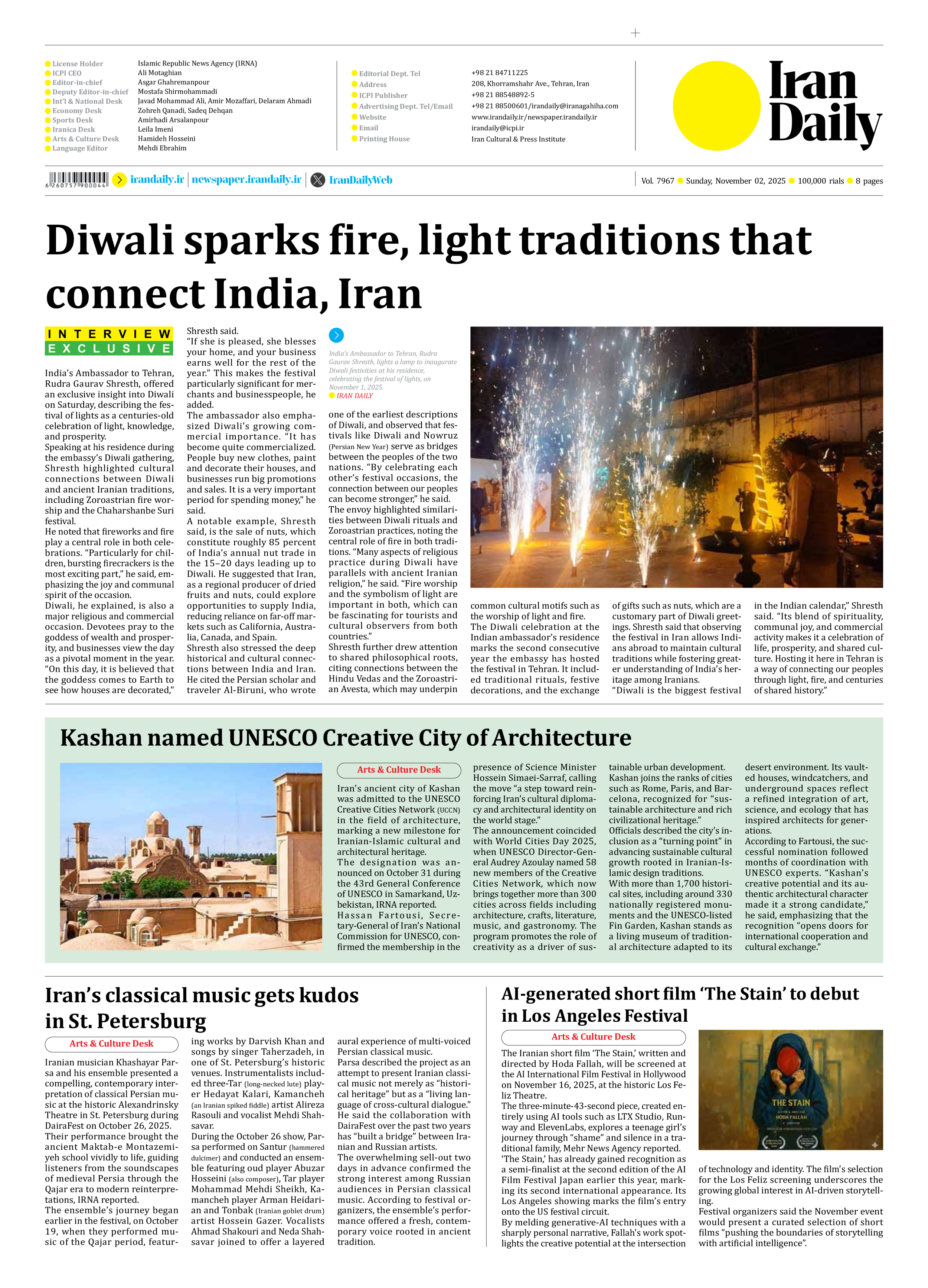
Speaking at his residence during the embassy’s Diwali gathering, Shresth highlighted cultural connections between Diwali and ancient Iranian traditions, including Zoroastrian fire worship and the Chaharshanbe Suri festival.
He noted that fireworks and fire play a central role in both celebrations. “Particularly for children, bursting firecrackers is the most exciting part,” he said, emphasizing the joy and communal spirit of the occasion.
Diwali, he explained, is also a major religious and commercial occasion. Devotees pray to the goddess of wealth and prosperity, and businesses view the day as a pivotal moment in the year. “On this day, it is believed that the goddess comes to Earth to see how houses are decorated,” Shresth said.
“If she is pleased, she blesses your home, and your business earns well for the rest of the year.” This makes the festival particularly significant for merchants and businesspeople, he added.
The ambassador also emphasized Diwali’s growing commercial importance. “It has become quite commercialized. People buy new clothes, paint and decorate their houses, and businesses run big promotions and sales. It is a very important period for spending money,” he said.
A notable example, Shresth said, is the sale of nuts, which constitute roughly 85 percent of India’s annual nut trade in the 15–20 days leading up to Diwali. He suggested that Iran, as a regional producer of dried fruits and nuts, could explore opportunities to supply India, reducing reliance on far-off markets such as California, Australia, Canada, and Spain.
Shresth also stressed the deep historical and cultural connections between India and Iran. He cited the Persian scholar and traveler Al-Biruni, who wrote one of the earliest descriptions of Diwali, and observed that festivals like Diwali and Nowruz (Persian New Year) serve as bridges between the peoples of the two nations. “By celebrating each other’s festival occasions, the connection between our peoples can become stronger,” he said.
The envoy highlighted similarities between Diwali rituals and Zoroastrian practices, noting the central role of fire in both traditions. “Many aspects of religious practice during Diwali have parallels with ancient Iranian religion,” he said. “Fire worship and the symbolism of light are important in both, which can be fascinating for tourists and cultural observers from both countries.”
Shresth further drew attention to shared philosophical roots, citing connections between the Hindu Vedas and the Zoroastrian Avesta, which may underpin common cultural motifs such as the worship of light and fire.
The Diwali celebration at the Indian ambassador’s residence marks the second consecutive year the embassy has hosted the festival in Tehran. It included traditional rituals, festive decorations, and the exchange of gifts such as nuts, which are a customary part of Diwali greetings. Shresth said that observing the festival in Iran allows Indians abroad to maintain cultural traditions while fostering greater understanding of India’s heritage among Iranians.
“Diwali is the biggest festival in the Indian calendar,” Shresth said. “Its blend of spirituality, communal joy, and commercial activity makes it a celebration of life, prosperity, and shared culture. Hosting it here in Tehran is a way of connecting our peoples through light, fire, and centuries of shared history.”