







India’s geopolitical transformation
From third-world leadership to emerging power
By Ahmad Rashidi Nejad
Geopolitical researcher
The history of international relations has witnessed the rise of actors who, by making smart use of their geography and political capital, have managed to carve out an independent role on the world stage. During the Cold War, the Republic of India stood as a textbook case of such a player — one that cemented its place as an autonomous geopolitical pole by setting forth an alternative paradigm.
However, the collapse of the bipolar order and the emergence of new global realities have brought to the surface a fundamental question: Is India still the autonomous player it once was, or has it fallen into new patterns of dependency? Unraveling this transformation calls for a deeper look into the roots of the Non-Aligned strategy in the context of the Cold War and an analysis of how it plays out in today’s complex international system. This piece argues that India has not entirely let go of its autonomy, but rather, in a pragmatic response to its shifting strategic environment, has shifted gears from idealistic non-alignment to multilateral pragmatism.
India during Cold War
When the world was split down the middle between two rival blocs, India, under Jawaharlal Nehru, took up a bold and innovative position, establishing itself as the symbol of autonomy and leadership of the Third World. The political philosophy of non-alignment, the cornerstone of India’s foreign policy at the time, was not passive neutrality but an active strategy to keep its freedom to the fullest and steer clear of the power politics of the superpowers. This approach allowed India to draw in dozens of newly independent nations that wanted to stay out of the ideological tug-of-war between Washington and Moscow. Through leadership of the Non-Aligned Movement, India effectively built up a third geopolitical bloc grounded in principles such as respect for national sovereignty and peaceful dispute resolution.
In practice, this translated into keeping an even keel in relations with both camps. Although New Delhi’s ties with Moscow ran deeper — historically, economically, and especially militarily (particularly after their 1971 treaty) — India never signed up as a full ally of the Eastern bloc. At the same time, it kept open its channels of communication and access to development aid from Europe and the United States. This knack for playing both sides deftly and extracting concessions from each, without bowing to either, showcased India’s distinctive autonomy and unique position.
Tensions with Pakistan were, for the most part, confined to a bilateral, regional rivalry over Kashmir, and India largely kept that quarrel from spilling into the broader Cold War narrative. All told, India, during this period, stood out as a self-reliant geopolitical actor, operating based on national calculations and an alternative ideological vision.
India after Cold War
The collapse of the Soviet Union and the end of the bipolar system forced India to rethink its place in the international order from the ground up. Two major developments shaped this transition most: the rise of the People’s Republic of China as a dominant economic and military rival along India’s borders, and the broader spread of global multipolarity. In response, the old doctrine of non-alignment, once meaningful in a bipolar world, gave way to a more flexible, adaptive strategy known as “multilateral pragmatism”.
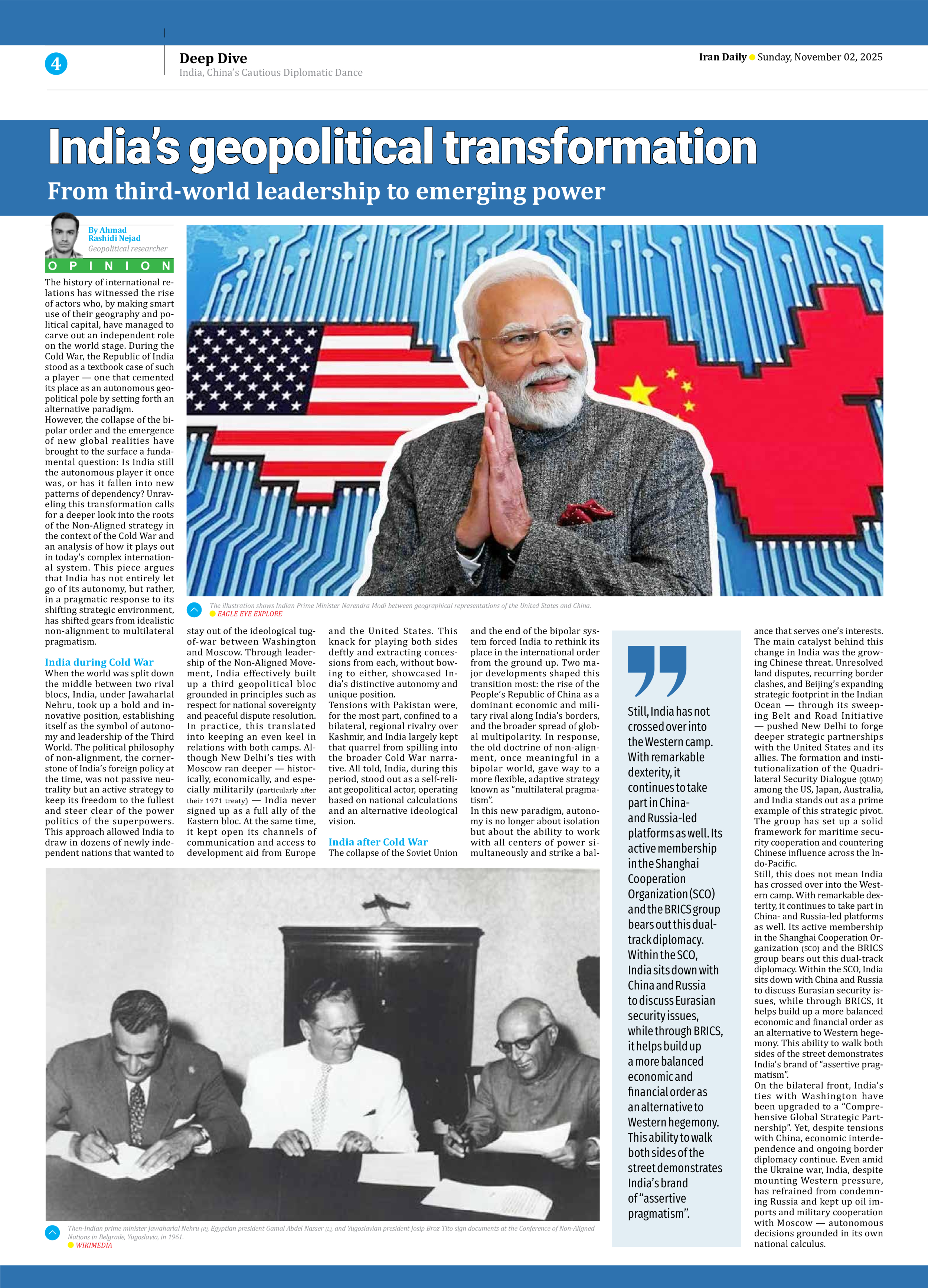
In this new paradigm, autonomy is no longer about isolation but about the ability to work with all centers of power simultaneously and strike a balance that serves one’s interests. The main catalyst behind this change in India was the growing Chinese threat. Unresolved land disputes, recurring border clashes, and Beijing’s expanding strategic footprint in the Indian Ocean — through its sweeping Belt and Road Initiative — pushed New Delhi to forge deeper strategic partnerships with the United States and its allies. The formation and institutionalization of the Quadrilateral Security Dialogue (QUAD) among the US, Japan, Australia, and India stands out as a prime example of this strategic pivot. The group has set up a solid framework for maritime security cooperation and countering Chinese influence across the Indo-Pacific.
Still, this does not mean India has crossed over into the Western camp. With remarkable dexterity, it continues to take part in China- and Russia-led platforms as well. Its active membership in the Shanghai Cooperation Organization (SCO) and the BRICS group bears out this dual-track diplomacy. Within the SCO, India sits down with China and Russia to discuss Eurasian security issues, while through BRICS, it helps build up a more balanced economic and financial order as an alternative to Western hegemony. This ability to walk both sides of the street demonstrates India’s brand of “assertive pragmatism”.
On the bilateral front, India’s ties with Washington have been upgraded to a “Comprehensive Global Strategic Partnership”. Yet, despite tensions with China, economic interdependence and ongoing border diplomacy continue. Even amid the Ukraine war, India, despite mounting Western pressure, has refrained from condemning Russia and kept up oil imports and military cooperation with Moscow — autonomous decisions grounded in its own national calculus.
Economic, technological dimensions
Alongside shifts in security and diplomacy, economics and technology have come to underpin India’s geopolitical clout. Decades of steady economic growth have turned India into one of the world’s largest emerging economies. By rising to global prominence in information technology, outsourcing, and digital innovation, India has secured a key position in the global value chain. Massive investments in renewable energy, space exploration, and domestic defense industries show New Delhi’s drive to cut down dependence and step up deterrence capacity. This economic-technological dimension not only backs up India’s nuanced foreign policy but also serves as a magnet for international partners and a lever of influence in great-power competition.
India’s geopolitical transformation can best be seen as a rational response, grounded in realism, to shifting global power balances. By moving away from idealistic non-alignment and heading toward multilateral pragmatism, India is seeking to shore up its national security and strength amid rising threats from China and Pakistan, as well as great-power rivalries. Drawing closer to the United States while keeping alive traditional ties with Russia and staying engaged in multilateral institutions reflects a classic balancing act — essential for survival in a turbulent environment.
Today, India’s geopolitical autonomy lies not in detachment from global blocs but in the ability to make the most of international organizations and economic partnerships. Its membership in BRICS, the SCO, and the QUAD shows how New Delhi builds up its status through a dense web of institutional and economic collaborations.
From a classical geopolitical standpoint, India’s position on the southern rim of Eurasia — the “Rimland” — gives it leverage over both continental and maritime dynamics, making it a key player in the global balance of power in the 21st century. Ultimately, India’s paradigm shift mirrors an evolution in its identity: from the leader of the Third World during the Cold War to a multidimensional emerging power that redefines its independence through flexibility and layered engagement in world affairs.
The article first appeared in
Persian on the Alef news website.