





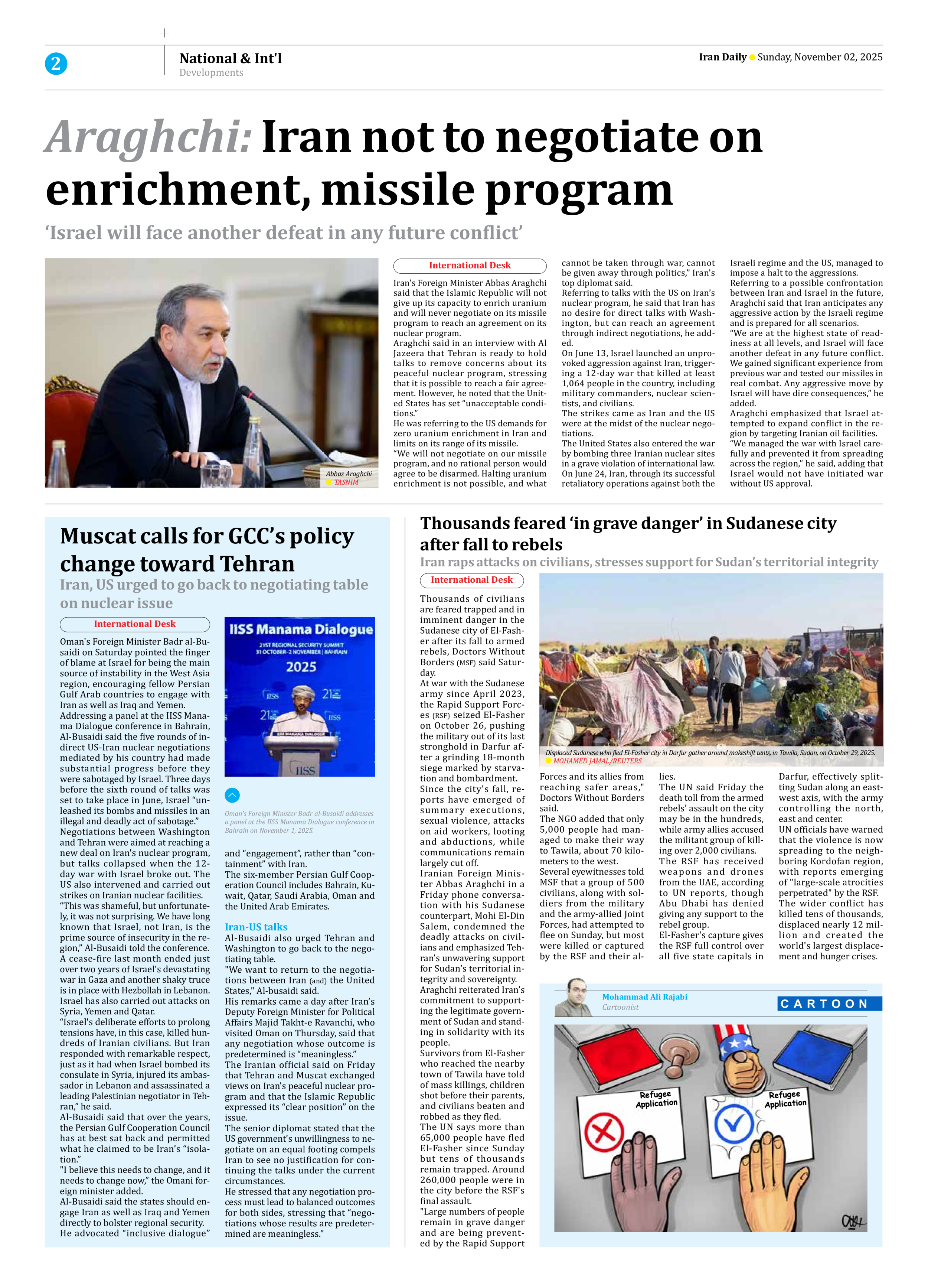


Muscat calls for GCC’s policy change toward Tehran
Iran, US urged to go back to negotiating table on nuclear issue
Oman's Foreign Minister Badr al-Busaidi on Saturday pointed the finger of blame at Israel for being the main source of instability in the West Asia region, encouraging fellow Persian Gulf Arab countries to engage with Iran as well as Iraq and Yemen.
Addressing a panel at the IISS Manama Dialogue conference in Bahrain, Al-Busaidi said the five rounds of indirect US-Iran nuclear negotiations mediated by his country had made substantial progress before they were sabotaged by Israel. Three days before the sixth round of talks was set to take place in June, Israel “unleashed its bombs and missiles in an illegal and deadly act of sabotage.”
Negotiations between Washington and Tehran were aimed at reaching a new deal on Iran's nuclear program, but talks collapsed when the 12-day war with Israel broke out. The US also intervened and carried out strikes on Iranian nuclear facilities.
“This was shameful, but unfortunately, it was not surprising. We have long known that Israel, not Iran, is the prime source of insecurity in the region,” Al-Busaidi told the conference.
A cease-fire last month ended just over two years of Israel's devastating war in Gaza and another shaky truce is in place with Hezbollah in Lebanon. Israel has also carried out attacks on Syria, Yemen and Qatar.
“Israel's deliberate efforts to prolong tensions have, in this case, killed hundreds of Iranian civilians. But Iran responded with remarkable respect, just as it had when Israel bombed its consulate in Syria, injured its ambassador in Lebanon and assassinated a leading Palestinian negotiator in Tehran,” he said.
Al-Busaidi said that over the years, the Persian Gulf Cooperation Council has at best sat back and permitted what he claimed to be Iran’s “isolation.”
"I believe this needs to change, and it needs to change now,” the Omani foreign minister added.
Al-Busaidi said the states should engage Iran as well as Iraq and Yemen directly to bolster regional security.
He advocated “inclusive dialogue” and “engagement”, rather than “containment” with Iran.
The six-member Persian Gulf Cooperation Council includes Bahrain, Kuwait, Qatar, Saudi Arabia, Oman and the United Arab Emirates.
Iran-US talks
Al-Busaidi also urged Tehran and Washington to go back to the negotiating table.
"We want to return to the negotiations between Iran (and) the United States," Al-busaidi said.
His remarks came a day after Iran’s Deputy Foreign Minister for Political Affairs Majid Takht-e Ravanchi, who visited Oman on Thursday, said that any negotiation whose outcome is predetermined is “meaningless.”
The Iranian official said on Friday that Tehran and Muscat exchanged views on Iran’s peaceful nuclear program and that the Islamic Republic expressed its “clear position” on the issue.
The senior diplomat stated that the US government’s unwillingness to negotiate on an equal footing compels Iran to see no justification for continuing the talks under the current circumstances.
He stressed that any negotiation process must lead to balanced outcomes for both sides, stressing that “negotiations whose results are predetermined are meaningless.”