







Veep calls on academies to lead scientific governance, solve challenges
Iran’s First Vice President Mohammad Reza Aref on Friday urged the nation’s academies and research institutions to take the lead in solving the country’s pressing economic, environmental, and social challenges through scientific solutions, calling them the “highest authority” in the nation’s pursuit of progress and innovation.
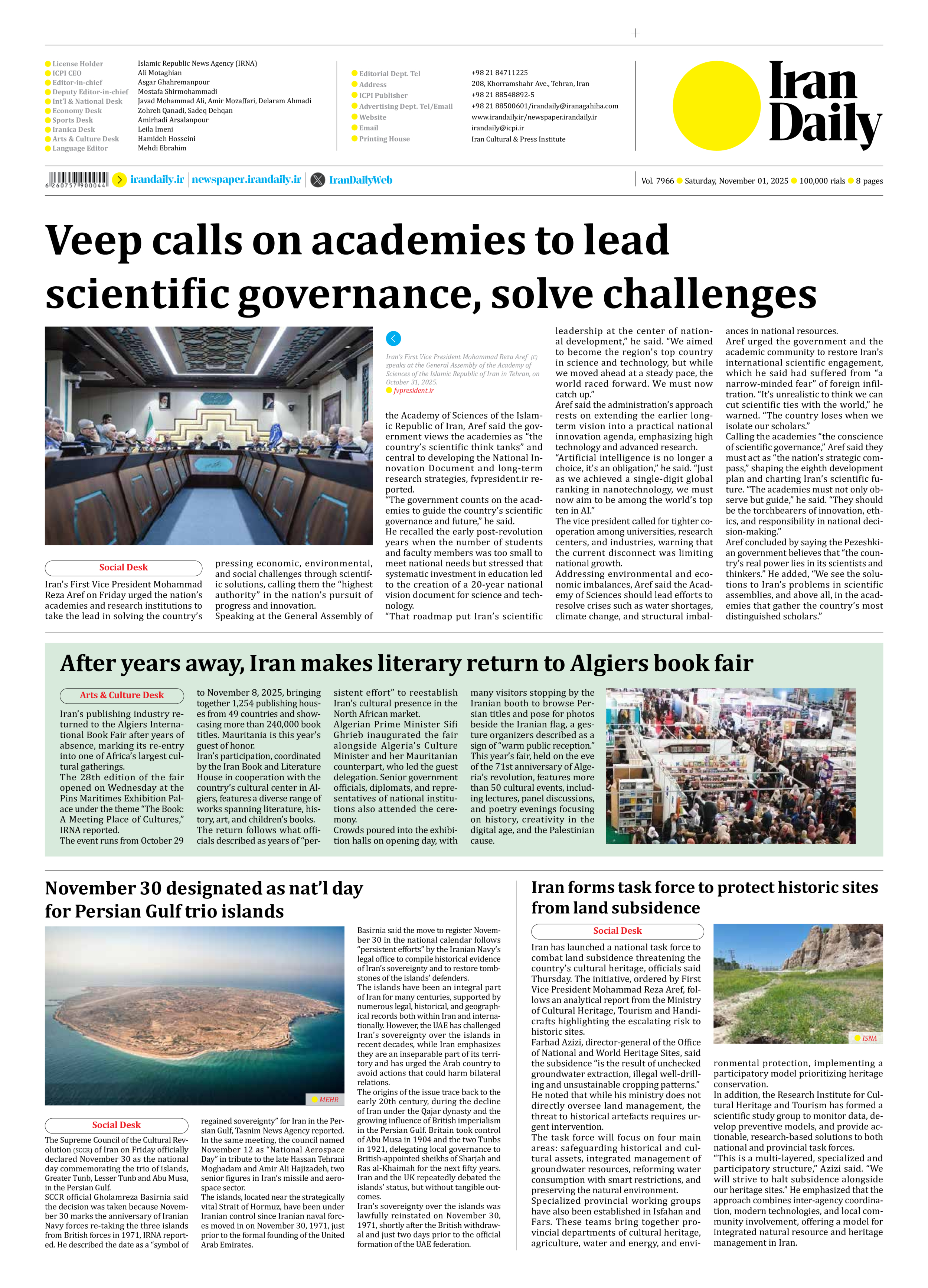
Speaking at the General Assembly of the Academy of Sciences of the Islamic Republic of Iran, Aref said the government views the academies as “the country’s scientific think tanks” and central to developing the National Innovation Document and long-term research strategies, fvpresident.ir reported.
“The government counts on the academies to guide the country’s scientific governance and future,” he said.
He recalled the early post-revolution years when the number of students and faculty members was too small to meet national needs but stressed that systematic investment in education led to the creation of a 20-year national vision document for science and technology.
“That roadmap put Iran’s scientific leadership at the center of national development,” he said. “We aimed to become the region’s top country in science and technology, but while we moved ahead at a steady pace, the world raced forward. We must now catch up.”
Aref said the administration’s approach rests on extending the earlier long-term vision into a practical national innovation agenda, emphasizing high technology and advanced research.
“Artificial intelligence is no longer a choice, it’s an obligation,” he said. “Just as we achieved a single-digit global ranking in nanotechnology, we must now aim to be among the world’s top ten in AI.”
The vice president called for tighter cooperation among universities, research centers, and industries, warning that the current disconnect was limiting national growth.
Addressing environmental and economic imbalances, Aref said the Academy of Sciences should lead efforts to resolve crises such as water shortages, climate change, and structural imbalances in national resources.
Aref urged the government and the academic community to restore Iran’s international scientific engagement, which he said had suffered from “a narrow-minded fear” of foreign infiltration. “It’s unrealistic to think we can cut scientific ties with the world,” he warned. “The country loses when we isolate our scholars.”
Calling the academies “the conscience of scientific governance,” Aref said they must act as “the nation’s strategic compass,” shaping the eighth development plan and charting Iran’s scientific future. “The academies must not only observe but guide,” he said. “They should be the torchbearers of innovation, ethics, and responsibility in national decision-making.”
Aref concluded by saying the Pezeshkian government believes that “the country’s real power lies in its scientists and thinkers.” He added, “We see the solutions to Iran’s problems in scientific assemblies, and above all, in the academies that gather the country’s most distinguished scholars.”