







Iran and Saudi Arabia
From rivalry to realism
By Zakir Hussain
Expert on political economy and Mideast affairs
Today, Iran and Saudi Arabia need to bury their old grudges. They should not waste the rapprochement mediated by China, which had not only surprised the world but also reshaped regional geopolitics that thrived on the belief that, without Israel, the Shias and Sunnis would keep fighting like “cat and dog”.
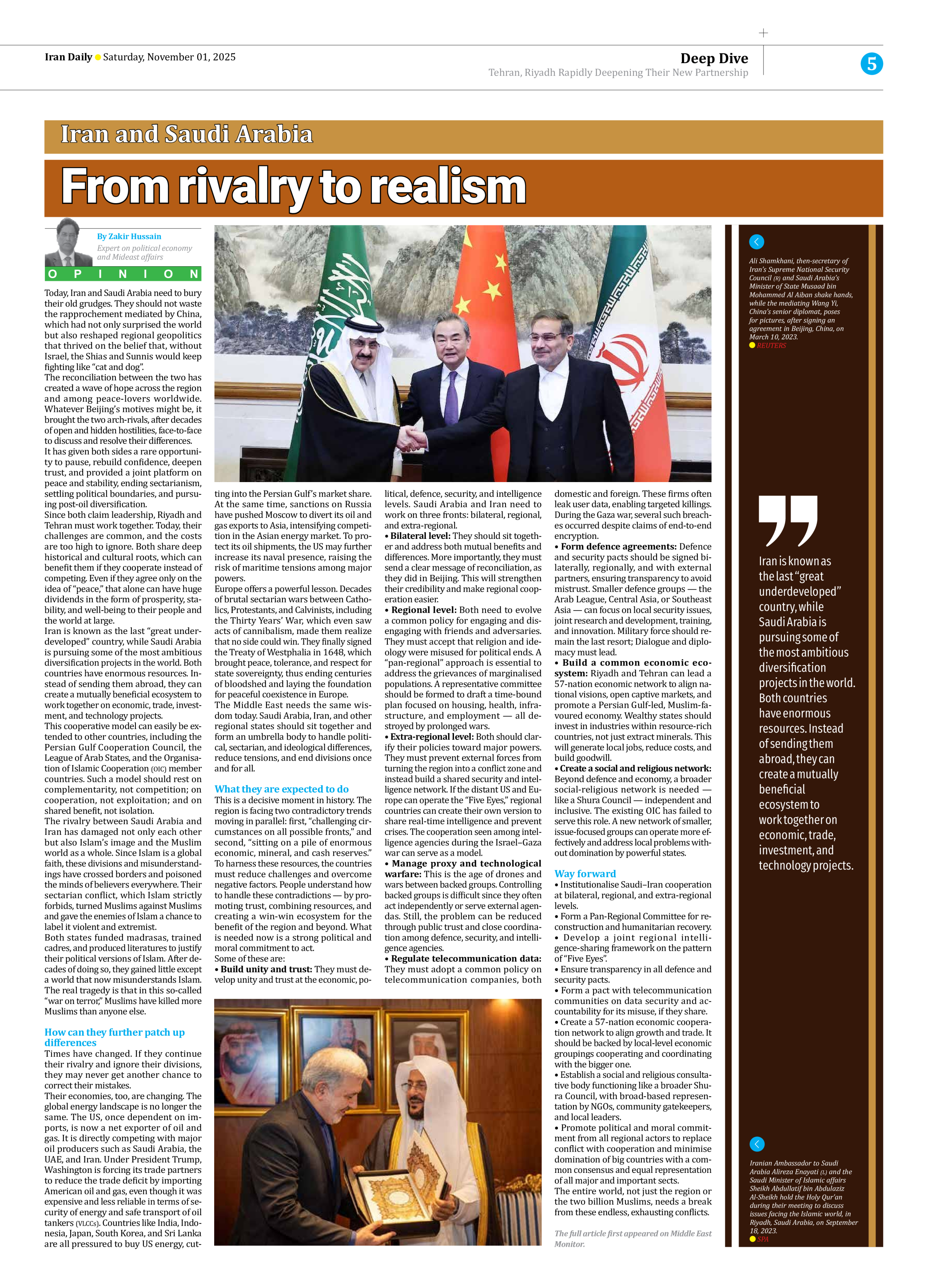
The reconciliation between the two has created a wave of hope across the region and among peace-lovers worldwide. Whatever Beijing’s motives might be, it brought the two arch-rivals, after decades of open and hidden hostilities, face-to-face to discuss and resolve their differences.
It has given both sides a rare opportunity to pause, rebuild confidence, deepen trust, and provided a joint platform on peace and stability, ending sectarianism, settling political boundaries, and pursuing post-oil diversification.
Since both claim leadership, Riyadh and Tehran must work together. Today, their challenges are common, and the costs are too high to ignore. Both share deep historical and cultural roots, which can benefit them if they cooperate instead of competing. Even if they agree only on the idea of “peace,” that alone can have huge dividends in the form of prosperity, stability, and well-being to their people and the world at large.
Iran is known as the last “great underdeveloped” country, while Saudi Arabia is pursuing some of the most ambitious diversification projects in the world. Both countries have enormous resources. Instead of sending them abroad, they can create a mutually beneficial ecosystem to work together on economic, trade, investment, and technology projects.
This cooperative model can easily be extended to other countries, including the Persian Gulf Cooperation Council, the League of Arab States, and the Organisation of Islamic Cooperation (OIC) member countries. Such a model should rest on complementarity, not competition; on cooperation, not exploitation; and on shared benefit, not isolation.
The rivalry between Saudi Arabia and Iran has damaged not only each other but also Islam’s image and the Muslim world as a whole. Since Islam is a global faith, these divisions and misunderstandings have crossed borders and poisoned the minds of believers everywhere. Their sectarian conflict, which Islam strictly forbids, turned Muslims against Muslims and gave the enemies of Islam a chance to label it violent and extremist.
Both states funded madrasas, trained cadres, and produced literatures to justify their political versions of Islam. After decades of doing so, they gained little except a world that now misunderstands Islam. The real tragedy is that in this so-called “war on terror,” Muslims have killed more Muslims than anyone else.
How can they further patch up differences
Times have changed. If they continue their rivalry and ignore their divisions, they may never get another chance to correct their mistakes.
Their economies, too, are changing. The global energy landscape is no longer the same. The US, once dependent on imports, is now a net exporter of oil and gas. It is directly competing with major oil producers such as Saudi Arabia, the UAE, and Iran. Under President Trump, Washington is forcing its trade partners to reduce the trade deficit by importing American oil and gas, even though it was expensive and less reliable in terms of security of energy and safe transport of oil tankers (VLCCs). Countries like India, Indonesia, Japan, South Korea, and Sri Lanka are all pressured to buy US energy, cutting into the Persian Gulf’s market share.
At the same time, sanctions on Russia have pushed Moscow to divert its oil and gas exports to Asia, intensifying competition in the Asian energy market. To protect its oil shipments, the US may further increase its naval presence, raising the risk of maritime tensions among major powers.
Europe offers a powerful lesson. Decades of brutal sectarian wars between Catholics, Protestants, and Calvinists, including the Thirty Years’ War, which even saw acts of cannibalism, made them realize that no side could win. They finally signed the Treaty of Westphalia in 1648, which brought peace, tolerance, and respect for state sovereignty, thus ending centuries of bloodshed and laying the foundation for peaceful coexistence in Europe.
The Middle East needs the same wisdom today. Saudi Arabia, Iran, and other regional states should sit together and form an umbrella body to handle political, sectarian, and ideological differences, reduce tensions, and end divisions once and for all.
What they are expected to do
This is a decisive moment in history. The region is facing two contradictory trends moving in parallel: first, “challenging circumstances on all possible fronts,” and second, “sitting on a pile of enormous economic, mineral, and cash reserves.” To harness these resources, the countries must reduce challenges and overcome negative factors. People understand how to handle these contradictions — by promoting trust, combining resources, and creating a win-win ecosystem for the benefit of the region and beyond. What is needed now is a strong political and moral commitment to act.
Some of these are:
• Build unity and trust: They must develop unity and trust at the economic, political, defence, security, and intelligence levels. Saudi Arabia and Iran need to work on three fronts: bilateral, regional, and extra-regional.
• Bilateral level: They should sit together and address both mutual benefits and differences. More importantly, they must send a clear message of reconciliation, as they did in Beijing. This will strengthen their credibility and make regional cooperation easier.
• Regional level: Both need to evolve a common policy for engaging and disengaging with friends and adversaries. They must accept that religion and ideology were misused for political ends. A “pan-regional” approach is essential to address the grievances of marginalised populations. A representative committee should be formed to draft a time-bound plan focused on housing, health, infrastructure, and employment — all destroyed by prolonged wars.
• Extra-regional level: Both should clarify their policies toward major powers. They must prevent external forces from turning the region into a conflict zone and instead build a shared security and intelligence network. If the distant US and Europe can operate the “Five Eyes,” regional countries can create their own version to share real-time intelligence and prevent crises. The cooperation seen among intelligence agencies during the Israel–Gaza war can serve as a model.
• Manage proxy and technological warfare: This is the age of drones and wars between backed groups. Controlling backed groups is difficult since they often act independently or serve external agendas. Still, the problem can be reduced through public trust and close coordination among defence, security, and intelligence agencies.
• Regulate telecommunication data: They must adopt a common policy on telecommunication companies, both domestic and foreign. These firms often leak user data, enabling targeted killings. During the Gaza war, several such breaches occurred despite claims of end-to-end encryption.
• Form defence agreements: Defence and security pacts should be signed bilaterally, regionally, and with external partners, ensuring transparency to avoid mistrust. Smaller defence groups — the Arab League, Central Asia, or Southeast Asia — can focus on local security issues, joint research and development, training, and innovation. Military force should remain the last resort; Dialogue and diplomacy must lead.
• Build a common economic ecosystem: Riyadh and Tehran can lead a 57-nation economic network to align national visions, open captive markets, and promote a Persian Gulf-led, Muslim-favoured economy. Wealthy states should invest in industries within resource-rich countries, not just extract minerals. This will generate local jobs, reduce costs, and build goodwill.
• Create a social and religious network: Beyond defence and economy, a broader social-religious network is needed — like a Shura Council — independent and inclusive. The existing OIC has failed to serve this role. A new network of smaller, issue-focused groups can operate more effectively and address local problems without domination by powerful states.
Way forward
• Institutionalise Saudi–Iran cooperation at bilateral, regional, and extra-regional levels.
• Form a Pan-Regional Committee for reconstruction and humanitarian recovery.
• Develop a joint regional intelligence-sharing framework on the pattern of “Five Eyes”.
• Ensure transparency in all defence and security pacts.
• Form a pact with telecommunication communities on data security and accountability for its misuse, if they share.
• Create a 57-nation economic cooperation network to align growth and trade. It should be backed by local-level economic groupings cooperating and coordinating with the bigger one.
• Establish a social and religious consultative body functioning like a broader Shura Council, with broad-based representation by NGOs, community gatekeepers, and local leaders.
• Promote political and moral commitment from all regional actors to replace conflict with cooperation and minimise domination of big countries with a common consensus and equal representation of all major and important sects.
The entire world, not just the region or the two billion Muslims, needs a break from these endless, exhausting conflicts.
The full article first appeared on Middle East Monitor.