





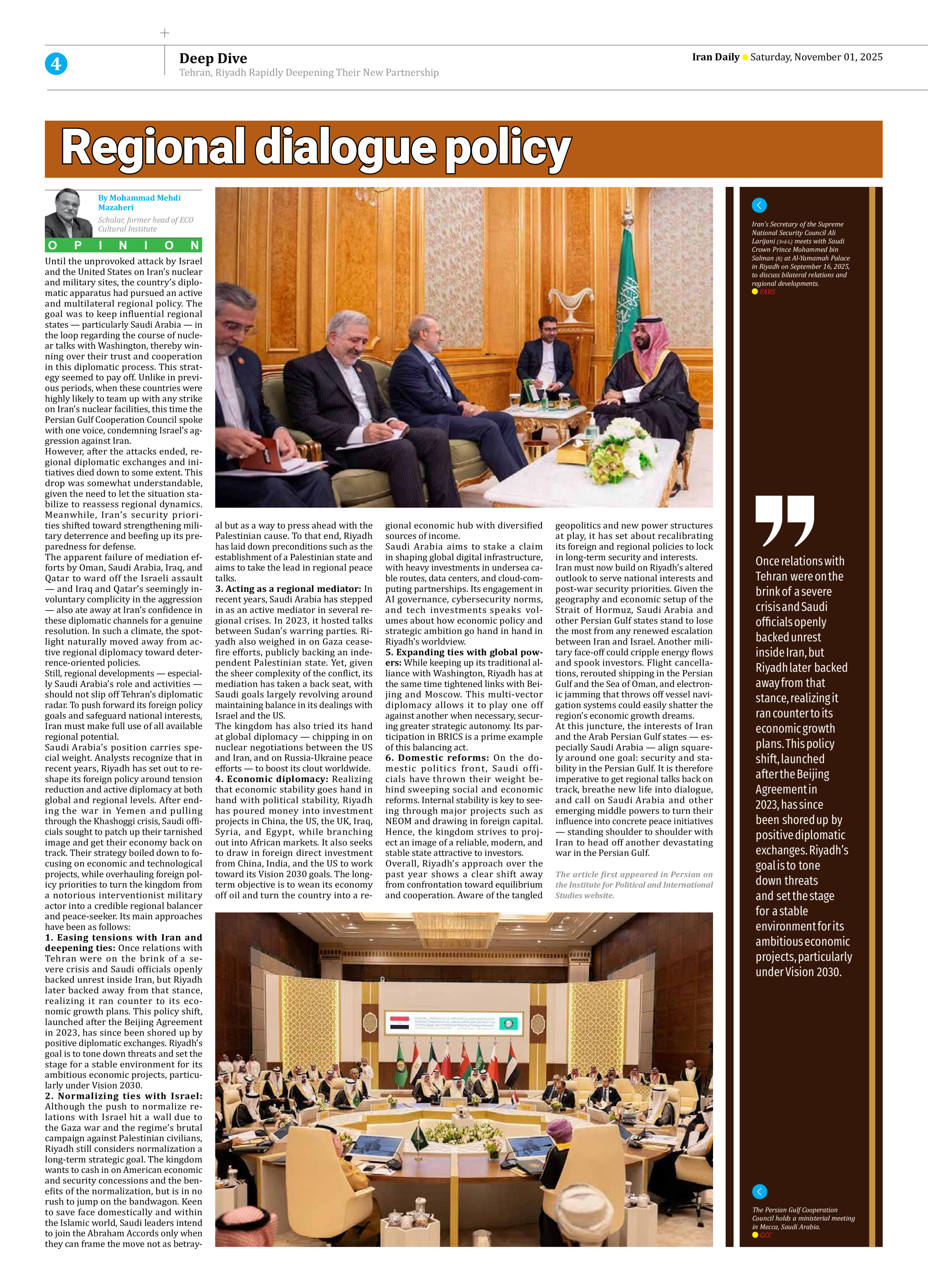


Regional dialogue policy
By Mohammad Mehdi
Mazaheri
Scholar, former head of ECO Cultural Institute
Until the unprovoked attack by Israel and the United States on Iran’s nuclear and military sites, the country’s diplomatic apparatus had pursued an active and multilateral regional policy. The goal was to keep influential regional states — particularly Saudi Arabia — in the loop regarding the course of nuclear talks with Washington, thereby winning over their trust and cooperation in this diplomatic process. This strategy seemed to pay off. Unlike in previous periods, when these countries were highly likely to team up with any strike on Iran’s nuclear facilities, this time the Persian Gulf Cooperation Council spoke with one voice, condemning Israel’s aggression against Iran.
However, after the attacks ended, regional diplomatic exchanges and initiatives died down to some extent. This drop was somewhat understandable, given the need to let the situation stabilize to reassess regional dynamics. Meanwhile, Iran’s security priorities shifted toward strengthening military deterrence and beefing up its preparedness for defense.
The apparent failure of mediation efforts by Oman, Saudi Arabia, Iraq, and Qatar to ward off the Israeli assault — and Iraq and Qatar’s seemingly involuntary complicity in the aggression — also ate away at Iran’s confidence in these diplomatic channels for a genuine resolution. In such a climate, the spotlight naturally moved away from active regional diplomacy toward deterrence-oriented policies.
Still, regional developments — especially Saudi Arabia’s role and activities — should not slip off Tehran’s diplomatic radar. To push forward its foreign policy goals and safeguard national interests, Iran must make full use of all available regional potential.
Saudi Arabia’s position carries special weight. Analysts recognize that in recent years, Riyadh has set out to reshape its foreign policy around tension reduction and active diplomacy at both global and regional levels. After ending the war in Yemen and pulling through the Khashoggi crisis, Saudi officials sought to patch up their tarnished image and get their economy back on track. Their strategy boiled down to focusing on economic and technological projects, while overhauling foreign policy priorities to turn the kingdom from a notorious interventionist military actor into a credible regional balancer and peace-seeker. Its main approaches have been as follows:
1. Easing tensions with Iran and deepening ties: Once relations with Tehran were on the brink of a severe crisis and Saudi officials openly backed unrest inside Iran, but Riyadh later backed away from that stance, realizing it ran counter to its economic growth plans. This policy shift, launched after the Beijing Agreement in 2023, has since been shored up by positive diplomatic exchanges. Riyadh’s goal is to tone down threats and set the stage for a stable environment for its ambitious economic projects, particularly under Vision 2030.
2. Normalizing ties with Israel: Although the push to normalize relations with Israel hit a wall due to the Gaza war and the regime’s brutal campaign against Palestinian civilians, Riyadh still considers normalization a long-term strategic goal. The kingdom wants to cash in on American economic and security concessions and the benefits of the normalization, but is in no rush to jump on the bandwagon. Keen to save face domestically and within the Islamic world, Saudi leaders intend to join the Abraham Accords only when they can frame the move not as betrayal but as a way to press ahead with the Palestinian cause. To that end, Riyadh has laid down preconditions such as the establishment of a Palestinian state and aims to take the lead in regional peace talks.
3. Acting as a regional mediator: In recent years, Saudi Arabia has stepped in as an active mediator in several regional crises. In 2023, it hosted talks between Sudan’s warring parties. Riyadh also weighed in on Gaza cease-fire efforts, publicly backing an independent Palestinian state. Yet, given the sheer complexity of the conflict, its mediation has taken a back seat, with Saudi goals largely revolving around maintaining balance in its dealings with Israel and the US.
The kingdom has also tried its hand at global diplomacy — chipping in on nuclear negotiations between the US and Iran, and on Russia-Ukraine peace efforts — to boost its clout worldwide.
4. Economic diplomacy: Realizing that economic stability goes hand in hand with political stability, Riyadh has poured money into investment projects in China, the US, the UK, Iraq, Syria, and Egypt, while branching out into African markets. It also seeks to draw in foreign direct investment from China, India, and the US to work toward its Vision 2030 goals. The long-term objective is to wean its economy off oil and turn the country into a regional economic hub with diversified sources of income.
Saudi Arabia aims to stake a claim in shaping global digital infrastructure, with heavy investments in undersea cable routes, data centers, and cloud-computing partnerships. Its engagement in AI governance, cybersecurity norms, and tech investments speaks volumes about how economic policy and strategic ambition go hand in hand in Riyadh’s worldview.
5. Expanding ties with global powers: While keeping up its traditional alliance with Washington, Riyadh has at the same time tightened links with Beijing and Moscow. This multi-vector diplomacy allows it to play one off against another when necessary, securing greater strategic autonomy. Its participation in BRICS is a prime example of this balancing act.
6. Domestic reforms: On the domestic politics front, Saudi officials have thrown their weight behind sweeping social and economic reforms. Internal stability is key to seeing through major projects such as NEOM and drawing in foreign capital. Hence, the kingdom strives to project an image of a reliable, modern, and stable state attractive to investors.
Overall, Riyadh’s approach over the past year shows a clear shift away from confrontation toward equilibrium and cooperation. Aware of the tangled geopolitics and new power structures at play, it has set about recalibrating its foreign and regional policies to lock in long-term security and interests.
Iran must now build on Riyadh’s altered outlook to serve national interests and post-war security priorities. Given the geography and economic setup of the Strait of Hormuz, Saudi Arabia and other Persian Gulf states stand to lose the most from any renewed escalation between Iran and Israel. Another military face-off could cripple energy flows and spook investors. Flight cancellations, rerouted shipping in the Persian Gulf and the Sea of Oman, and electronic jamming that throws off vessel navigation systems could easily shatter the region’s economic growth dreams.
At this juncture, the interests of Iran and the Arab Persian Gulf states — especially Saudi Arabia — align squarely around one goal: security and stability in the Persian Gulf. It is therefore imperative to get regional talks back on track, breathe new life into dialogue, and call on Saudi Arabia and other emerging middle powers to turn their influence into concrete peace initiatives — standing shoulder to shoulder with Iran to head off another devastating war in the Persian Gulf.
The article first appeared in Persian on the Institute for Political and International Studies website.