







IRENA meeting in Abu Dhabi
Tehran vows continued renewables expansion despite sanctions
Iran has made progress in developing renewable energy despite unilateral sanctions and remains committed to diversifying its energy mix, the country’s ambassador and permanent representative to the International Renewable Energy Agency (IRENA) said on Thursday.
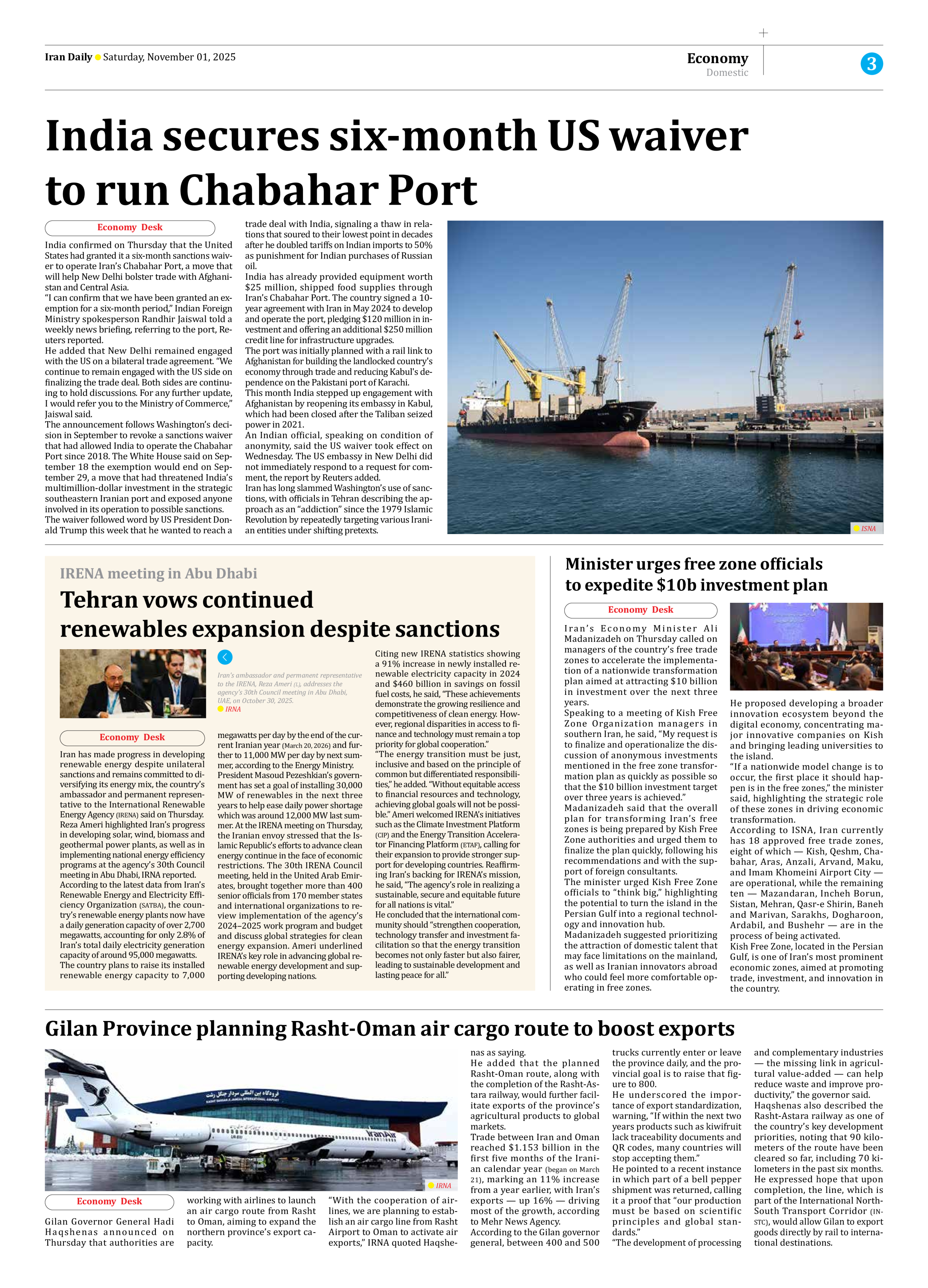
Reza Ameri highlighted Iran’s progress in developing solar, wind, biomass and geothermal power plants, as well as in implementing national energy efficiency programs at the agency’s 30th Council meeting in Abu Dhabi, IRNA reported.
According to the latest data from Iran’s Renewable Energy and Electricity Efficiency Organization (SATBA), the country’s renewable energy plants now have a daily generation capacity of over 2,700 megawatts, accounting for only 2.8% of Iran’s total daily electricity generation capacity of around 95,000 megawatts.
The country plans to raise its installed renewable energy capacity to 7,000 megawatts per day by the end of the current Iranian year (March 20, 2026) and further to 11,000 MW per day by next summer, according to the Energy Ministry.
President Masoud Pezeshkian’s government has set a goal of installing 30,000 MW of renewables in the next three years to help ease daily power shortage which was around 12,000 MW last summer. At the IRENA meeting on Thursday, the Iranian envoy stressed that the Islamic Republic’s efforts to advance clean energy continue in the face of economic restrictions. The 30th IRENA Council meeting, held in the United Arab Emirates, brought together more than 400 senior officials from 170 member states and international organizations to review implementation of the agency’s 2024–2025 work program and budget and discuss global strategies for clean energy expansion. Ameri underlined IRENA’s key role in advancing global renewable energy development and supporting developing nations.
Citing new IRENA statistics showing a 91% increase in newly installed renewable electricity capacity in 2024 and $460 billion in savings on fossil fuel costs, he said, “These achievements demonstrate the growing resilience and competitiveness of clean energy. However, regional disparities in access to finance and technology must remain a top priority for global cooperation.”
“The energy transition must be just, inclusive and based on the principle of common but differentiated responsibilities,” he added. “Without equitable access to financial resources and technology, achieving global goals will not be possible.” Ameri welcomed IRENA’s initiatives such as the Climate Investment Platform (CIP) and the Energy Transition Accelerator Financing Platform (ETAF), calling for their expansion to provide stronger support for developing countries. Reaffirming Iran’s backing for IRENA’s mission, he said, “The agency’s role in realizing a sustainable, secure and equitable future for all nations is vital.”
He concluded that the international community should “strengthen cooperation, technology transfer and investment facilitation so that the energy transition becomes not only faster but also fairer, leading to sustainable development and lasting peace for all.”