





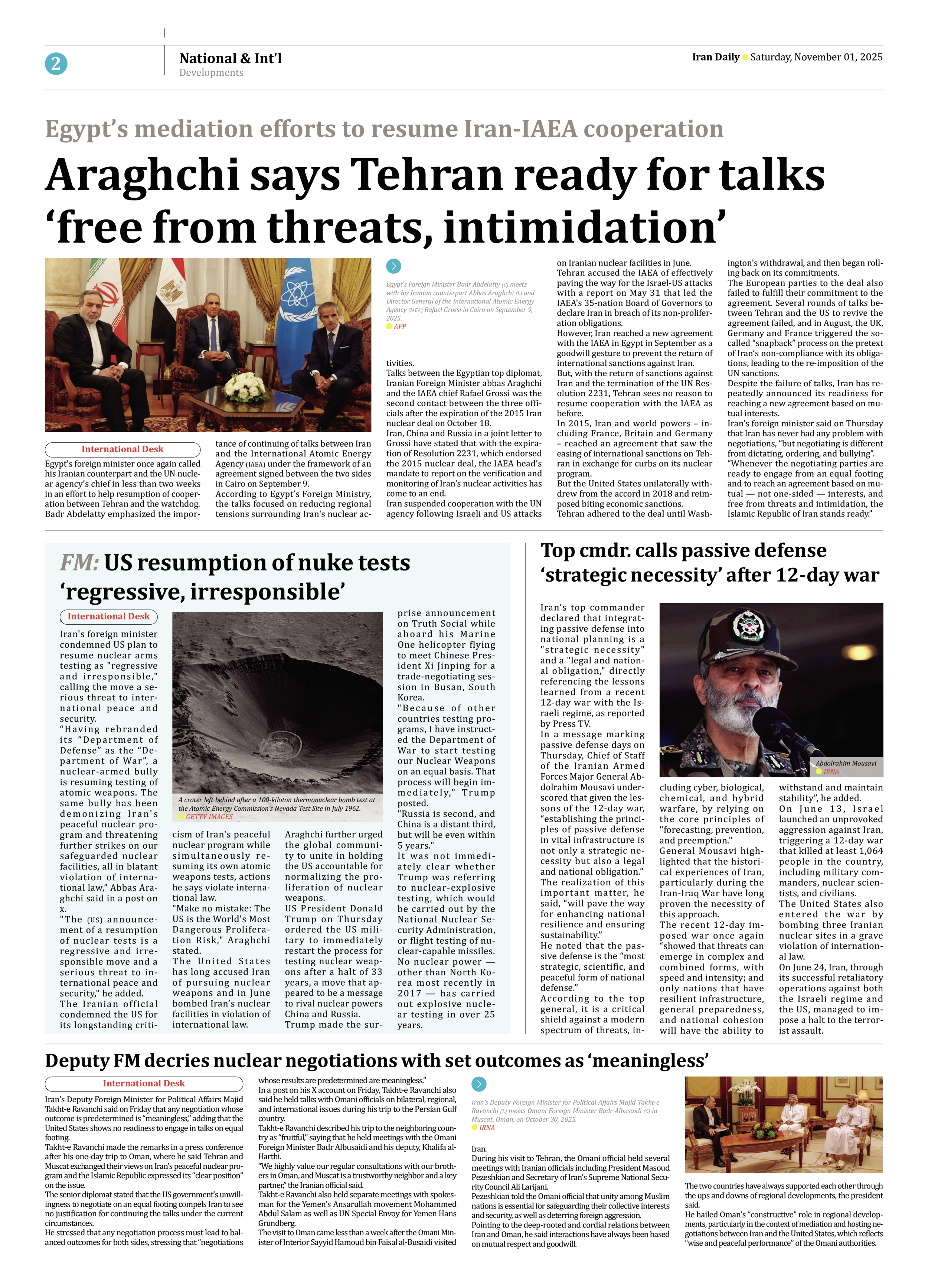


Egypt’s mediation efforts to resume Iran-IAEA cooperation
Araghchi says Tehran ready for talks ‘free from threats, intimidation’
Egypt's foreign minister once again called his Iranian counterpart and the UN nuclear agency’s chief in less than two weeks in an effort to help resumption of cooperation between Tehran and the watchdog.
Badr Abdelatty emphasized the importance of continuing of talks between Iran and the International Atomic Energy Agency (IAEA) under the framework of an agreement signed between the two sides in Cairo on September 9.
According to Egypt’s Foreign Ministry, the talks focused on reducing regional tensions surrounding Iran's nuclear activities.
Talks between the Egyptian top diplomat, Iranian Foreign Minister abbas Araghchi and the IAEA chief Rafael Grossi was the second contact between the three officials after the expiration of the 2015 Iran nuclear deal on October 18.
Iran, China and Russia in a joint letter to Grossi have stated that with the expiration of Resolution 2231, which endorsed the 2015 nuclear deal, the IAEA head’s mandate to report on the verification and monitoring of Iran’s nuclear activities has come to an end.
Iran suspended cooperation with the UN agency following Israeli and US attacks on Iranian nuclear facilities in June.
Tehran accused the IAEA of effectively paving the way for the Israel-US attacks with a report on May 31 that led the IAEA's 35-nation Board of Governors to declare Iran in breach of its non-proliferation obligations.
However, Iran reached a new agreement with the IAEA in Egypt in September as a goodwill gesture to prevent the return of international sanctions against Iran.
But, with the return of sanctions against Iran and the termination of the UN Resolution 2231, Tehran sees no reason to resume cooperation with the IAEA as before.
In 2015, Iran and world powers – including France, Britain and Germany – reached an agreement that saw the easing of international sanctions on Tehran in exchange for curbs on its nuclear program.
But the United States unilaterally withdrew from the accord in 2018 and reimposed biting economic sanctions.
Tehran adhered to the deal until Washington's withdrawal, and then began rolling back on its commitments.
The European parties to the deal also failed to fulfill their commitment to the agreement. Several rounds of talks between Tehran and the US to revive the agreement failed, and in August, the UK, Germany and France triggered the so-called “snapback” process on the pretext of Iran’s non-compliance with its obligations, leading to the re-imposition of the UN sanctions.
Despite the failure of talks, Iran has repeatedly announced its readiness for reaching a new agreement based on mutual interests.
Iran’s foreign minister said on Thursday that Iran has never had any problem with negotiations, “but negotiating is different from dictating, ordering, and bullying”.
“Whenever the negotiating parties are ready to engage from an equal footing and to reach an agreement based on mutual — not one-sided — interests, and free from threats and intimidation, the Islamic Republic of Iran stands ready.”