







Copy in clipboard...
Breaking barriers through art at Tehran’s Homam festival
The 4th Homam International Festival for People with Disabilities is drawing to a close in Tehran after a week of exhibitions and performances that brought together more than 430 Iranian and foreign artists, celebrating creativity beyond limitation.
Held at the Iran Academy of Arts since October 23, the festival has displayed works from all 31 Iranian provinces and 14 countries, including Spain, Japan, Russia, Belarus, Pakistan, India, Armenia, Nigeria and Kyrgyzstan, IRNA reported.
“This year’s Homam has moved beyond exhibition,” said festival secretary Mohammad Reza Mashhadi. “We are building bridges between Iranian and global disabled artists so that the art of perseverance can be seen worldwide.”
Named after an ancient Persian term for vitality, the Homam festival began in 2018 as a domestic event and has since evolved into a regional platform for artists with physical, visual, and hearing impairments. The displays range from painting, sculpture, calligraphy and ceramics to miniature, wood-carving, enamel, weaving and mixed media.
Submissions arrived from more than 23 countries, according to organizers, underscoring a growing international presence that Mashhadi described as “a genuine dialogue of creativity.”
Among the most striking works is ‘The Qur’an on Shells’ by Mahtab Ghanbari Rad, a deaf calligrapher who handwrote the entire Qur’an on 18 natural seashells collected from Qeshm Island in the Persian Gulf.
“I saw myself writing it in a dream on the night of Ashura,” she said. “It took me two years to complete. My wish is that the world sees this work.”
A member of the Iranian Calligraphers Association, Ghanbari Rad works in Nastaliq, Thuluth and Naskh scripts, often engraving verses on grains of rice or inscribing the word Allah on sugar crystals—miniature pieces that viewers examine with magnifying glasses.
For the first time, the festival formally included performing arts. Musicians and actors with disabilities took the stage daily, while theater performances explored inclusion and accessibility. Officials said the success of these programs could lead to a permanent “theater of ability” section next year.
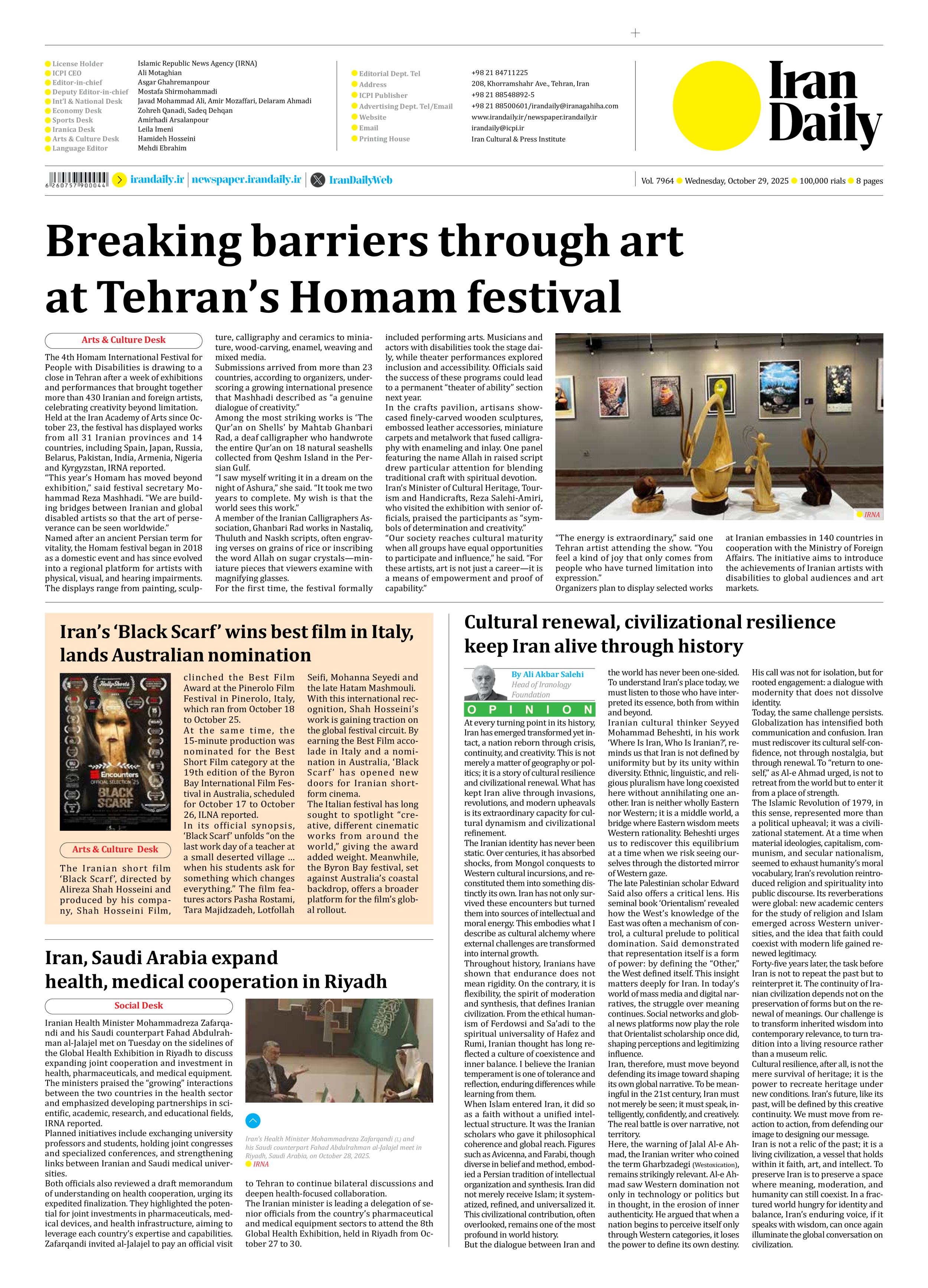
In the crafts pavilion, artisans showcased finely-carved wooden sculptures, embossed leather accessories, miniature carpets and metalwork that fused calligraphy with enameling and inlay. One panel featuring the name Allah in raised script drew particular attention for blending traditional craft with spiritual devotion.
Iran’s Minister of Cultural Heritage, Tourism and Handicrafts, Reza Salehi-Amiri, who visited the exhibition with senior officials, praised the participants as “symbols of determination and creativity.”
“Our society reaches cultural maturity when all groups have equal opportunities to participate and influence,” he said. “For these artists, art is not just a career—it is a means of empowerment and proof of capability.”
“The energy is extraordinary,” said one Tehran artist attending the show. “You feel a kind of joy that only comes from people who have turned limitation into expression.”
Organizers plan to display selected works at Iranian embassies in 140 countries in cooperation with the Ministry of Foreign Affairs. The initiative aims to introduce the achievements of Iranian artists with disabilities to global audiences and art markets.