





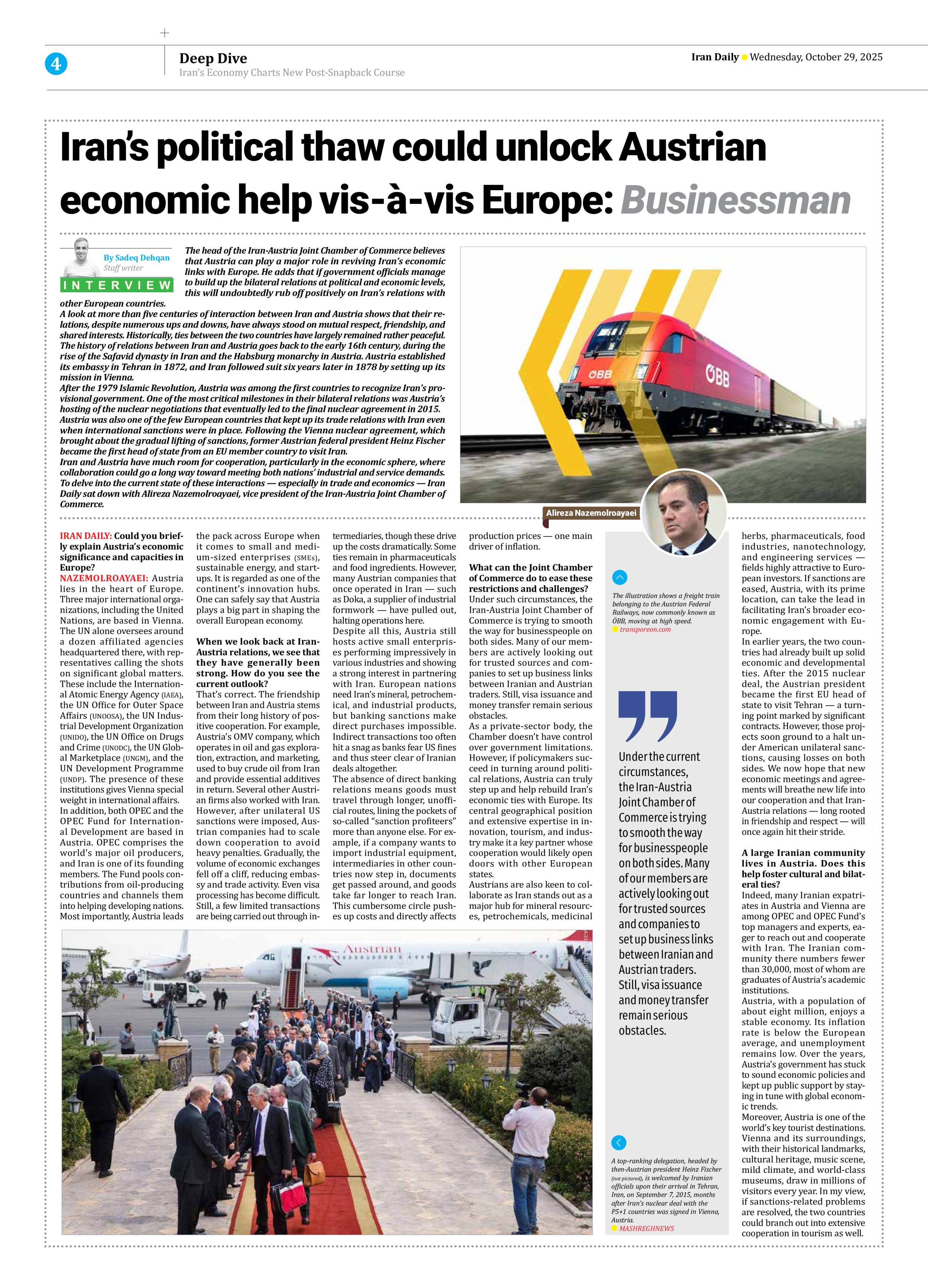


Iran’s political thaw could unlock Austrian economic help vis-à-vis Europe: Businessman
The head of the Iran-Austria Joint Chamber of Commerce believes that Austria can play a major role in reviving Iran’s economic links with Europe. He adds that if government officials manage to build up the bilateral relations at political and economic levels, this will undoubtedly rub off positively on Iran’s relations with other European countries. A look at more than five centuries of interaction between Iran and Austria shows that their relations, despite numerous ups and downs, have always stood on mutual respect, friendship, and shared interests. Historically, ties between the two countries have largely remained rather peaceful. The history of relations between Iran and Austria goes back to the early 16th century, during the rise of the Safavid dynasty in Iran and the Habsburg monarchy in Austria. Austria established its embassy in Tehran in 1872, and Iran followed suit six years later in 1878 by setting up its mission in Vienna. After the 1979 Islamic Revolution, Austria was among the first countries to recognize Iran’s provisional government. One of the most critical milestones in their bilateral relations was Austria’s hosting of the nuclear negotiations that eventually led to the final nuclear agreement in 2015. Austria was also one of the few European countries that kept up its trade relations with Iran even when international sanctions were in place. Following the Vienna nuclear agreement, which brought about the gradual lifting of sanctions, former Austrian federal president Heinz Fischer became the first head of state from an EU member country to visit Iran. Iran and Austria have much room for cooperation, particularly in the economic sphere, where collaboration could go a long way toward meeting both nations’ industrial and service demands. To delve into the current state of these interactions — especially in trade and economics — Iran Daily sat down with Alireza Nazemolroayaei, vice president of the Iran-Austria Joint Chamber of Commerce.
By Sadeq Dehqan
Staff writer
IRAN DAILY: Could you briefly explain Austria’s economic significance and capacities in Europe?
NAZEMOLROAYAEI: Austria lies in the heart of Europe. Three major international organizations, including the United Nations, are based in Vienna. The UN alone oversees around a dozen affiliated agencies headquartered there, with representatives calling the shots on significant global matters. These include the International Atomic Energy Agency (IAEA), the UN Office for Outer Space Affairs (UNOOSA), the UN Industrial Development Organization (UNIDO), the UN Office on Drugs and Crime (UNODC), the UN Global Marketplace (UNGM), and the UN Development Programme (UNDP). The presence of these institutions gives Vienna special weight in international affairs.
In addition, both OPEC and the OPEC Fund for International Development are based in Austria. OPEC comprises the world’s major oil producers, and Iran is one of its founding members. The Fund pools contributions from oil-producing countries and channels them into helping developing nations.
Most importantly, Austria leads the pack across Europe when it comes to small and medium-sized enterprises (SMEs), sustainable energy, and startups. It is regarded as one of the continent’s innovation hubs. One can safely say that Austria plays a big part in shaping the overall European economy.
When we look back at Iran-Austria relations, we see that they have generally been strong. How do you see the current outlook?
That’s correct. The friendship between Iran and Austria stems from their long history of positive cooperation. For example, Austria’s OMV company, which operates in oil and gas exploration, extraction, and marketing, used to buy crude oil from Iran and provide essential additives in return. Several other Austrian firms also worked with Iran. However, after unilateral US sanctions were imposed, Austrian companies had to scale down cooperation to avoid heavy penalties. Gradually, the volume of economic exchanges fell off a cliff, reducing embassy and trade activity. Even visa processing has become difficult.
Still, a few limited transactions are being carried out through intermediaries, though these drive up the costs dramatically. Some ties remain in pharmaceuticals and food ingredients. However, many Austrian companies that once operated in Iran — such as Doka, a supplier of industrial formwork — have pulled out, halting operations here.
Despite all this, Austria still hosts active small enterprises performing impressively in various industries and showing a strong interest in partnering with Iran. European nations need Iran’s mineral, petrochemical, and industrial products, but banking sanctions make direct purchases impossible. Indirect transactions too often hit a snag as banks fear US fines and thus steer clear of Iranian deals altogether.
The absence of direct banking relations means goods must travel through longer, unofficial routes, lining the pockets of so-called “sanction profiteers” more than anyone else. For example, if a company wants to import industrial equipment, intermediaries in other countries now step in, documents get passed around, and goods take far longer to reach Iran. This cumbersome circle pushes up costs and directly affects production prices — one main driver of inflation.
What can the Joint Chamber of Commerce do to ease these restrictions and challenges?
Under such circumstances, the Iran-Austria Joint Chamber of Commerce is trying to smooth the way for businesspeople on both sides. Many of our members are actively looking out for trusted sources and companies to set up business links between Iranian and Austrian traders. Still, visa issuance and money transfer remain serious obstacles.
As a private-sector body, the Chamber doesn’t have control over government limitations. However, if policymakers succeed in turning around political relations, Austria can truly step up and help rebuild Iran’s economic ties with Europe. Its central geographical position and extensive expertise in innovation, tourism, and industry make it a key partner whose cooperation would likely open doors with other European states.
Austrians are also keen to collaborate as Iran stands out as a major hub for mineral resources, petrochemicals, medicinal herbs, pharmaceuticals, food industries, nanotechnology, and engineering services — fields highly attractive to European investors. If sanctions are eased, Austria, with its prime location, can take the lead in facilitating Iran’s broader economic engagement with Europe.
In earlier years, the two countries had already built up solid economic and developmental ties. After the 2015 nuclear deal, the Austrian president became the first EU head of state to visit Tehran — a turning point marked by significant contracts. However, those projects soon ground to a halt under American unilateral sanctions, causing losses on both sides. We now hope that new economic meetings and agreements will breathe new life into our cooperation and that Iran-Austria relations — long rooted in friendship and respect — will once again hit their stride.
A large Iranian community lives in Austria. Does this help foster cultural and bilateral ties?
Indeed, many Iranian expatriates in Austria and Vienna are among OPEC and OPEC Fund’s top managers and experts, eager to reach out and cooperate with Iran. The Iranian community there numbers fewer than 30,000, most of whom are graduates of Austria’s academic institutions.
Austria, with a population of about eight million, enjoys a stable economy. Its inflation rate is below the European average, and unemployment remains low. Over the years, Austria’s government has stuck to sound economic policies and kept up public support by staying in tune with global economic trends.
Moreover, Austria is one of the world’s key tourist destinations. Vienna and its surroundings, with their historical landmarks, cultural heritage, music scene, mild climate, and world-class museums, draw in millions of visitors every year. In my view, if sanctions-related problems are resolved, the two countries could branch out into extensive cooperation in tourism as well.