







Why is Israel unwilling to stop war in Middle East?
By Behrouz Ayaz
Political analyst
The Hamas attack on Israel on October 7 was a major turning point for the Middle East order. Israel sees this attack as a justification for destroying Hamas, bombing Gaza, the Islamic Republic, and its four Hs — Hamas, Hezbollah, Houthis (Ansarullah), and Hashd al-Shaabi (Popular Mobilization Forces) — in the Middle East.
Given the skill of the leaders of these groups in sheltering in highly secure locations, it was not expected that Israel would be able to kill them quickly. This demonstrates Israel’s high intelligence power and deep penetration into the intelligence organization of its adversaries. This also raises the question: how was Israel so terribly surprised by the October 7 attack? More specifically, how could a intelligence organization like Mossad, which knew the exact whereabouts of the Hezbollah and Hamas leaders, not have been informed of the October 7 operation in advance?
It seems that the October 7 operation was a project and an opportunity for Tel Aviv, rather than a surprise attack, through which it could target its enemies and advance its territorial expansion plan.
But can killing ideological opponents also kill their ideologies? Definitely, not. So, why is Israel unwilling to stop the war? In other words, what is the benefit of these unfinished wars for Israel?
Some analysts within Iran believe that the war has become an identity politics for Israel, through which it can achieve its internal cohesion. Israel cannot maintain its political and social integration without war. Some other Iranians see these endless Israeli wars in line with the ideology of Zionism, “from the Nile to the Euphrates”.
Furthermore, this war is the best excuse for Israeli Prime Minister Benjamin Netanyahu to stay in power and delays his corruption cases in court. Still others see this war as a matter of regional hegemony and geopolitical competition. Tel Aviv does not see the current geopolitical order of the Middle East as being in its favor.
By considering the points above, one can understand the reasons for Israel’s attack on Iran. The Islamic Republic has declared for years that it does not intend to produce nuclear weapons. However, Israel attacked Iran on June 13 under the pretext of a preemptive strike to prevent the production of nuclear weapons, precisely when Iran was in the middle of nuclear negotiations with the United States. Despite declaring its pretext to be preventing Iran from building an atomic bomb, Israel targeted not just Iran’s nuclear power plants, but also its missile launchers, training camps, prisons, and even helicopters that were used to combat border terrorists.
After Washington joined Tel Aviv in bombing the Natanz and Fordow nuclear sites (Iran’s two main uranium enrichment sites), Trump claimed that they have destroyed Iran’s nuclear power plants and pushed back the country’s nuclear capability for years. Nevertheless, Israel emphasizes that it will attack Iran again, and that the next attack will be far more devastating than the last.
Meanwhile, Israel also attacked Qatar under the pretext of killing Hamas leaders. It was in this context that Saudi Arabia signed a “mutual defense pact” with Pakistan for its security, which other Arab countries may also join. This plan seems to be coordinated by the US to control Israel and stabilize the Middle East, especially the Persian Gulf.
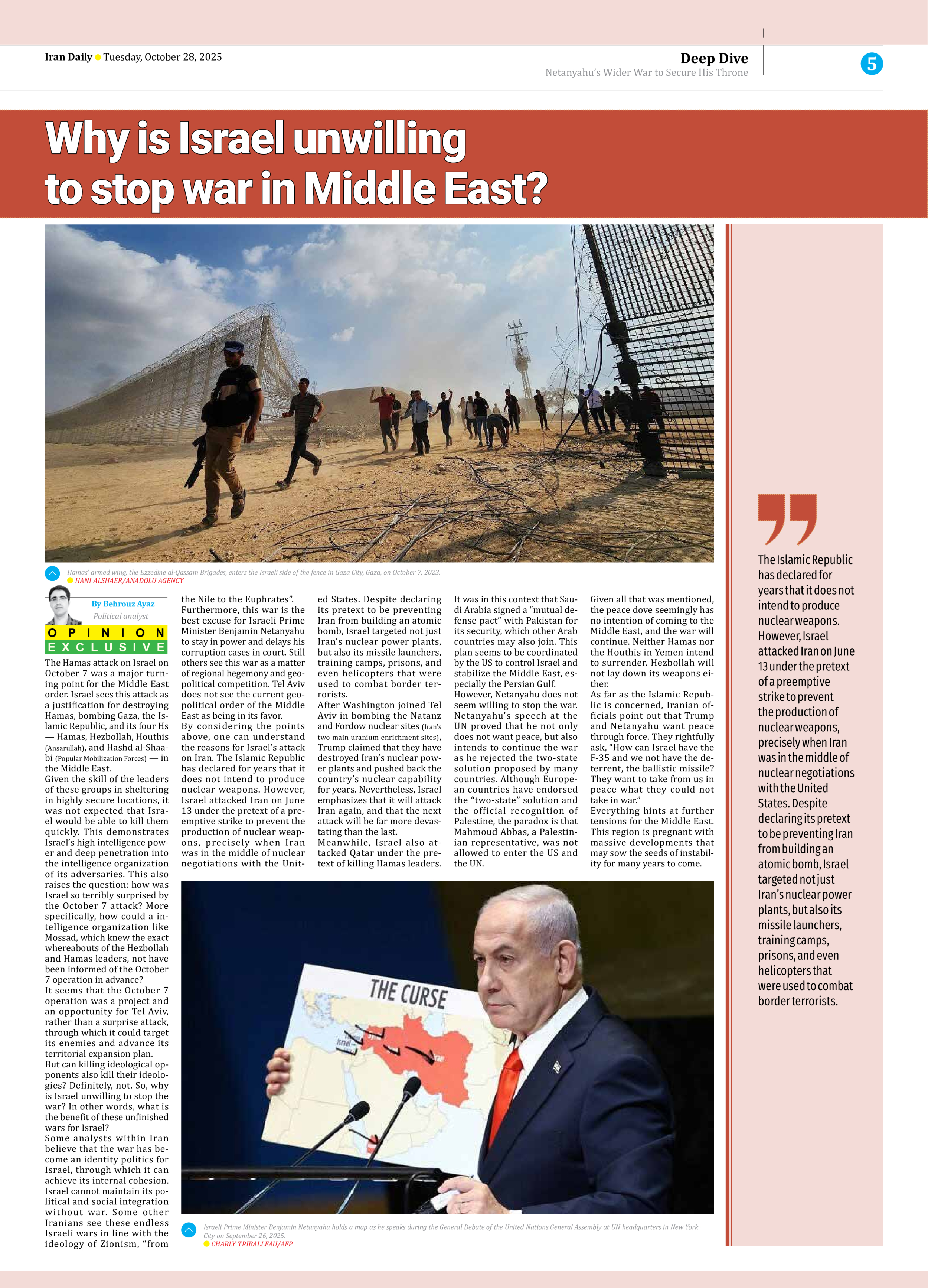
However, Netanyahu does not seem willing to stop the war. Netanyahu’s speech at the UN proved that he not only does not want peace, but also intends to continue the war as he rejected the two-state solution proposed by many countries. Although European countries have endorsed the “two-state” solution and the official recognition of Palestine, the paradox is that Mahmoud Abbas, a Palestinian representative, was not allowed to enter the US and the UN.
Given all that was mentioned, the peace dove seemingly has no intention of coming to the Middle East, and the war will continue. Neither Hamas nor the Houthis in Yemen intend to surrender. Hezbollah will not lay down its weapons either.
As far as the Islamic Republic is concerned, Iranian officials point out that Trump and Netanyahu want peace through force. They rightfully ask, “How can Israel have the F-35 and we not have the deterrent, the ballistic missile? They want to take from us in peace what they could not take in war.”
Everything hints at further tensions for the Middle East. This region is pregnant with massive developments that may sow the seeds of instability for many years to come.