





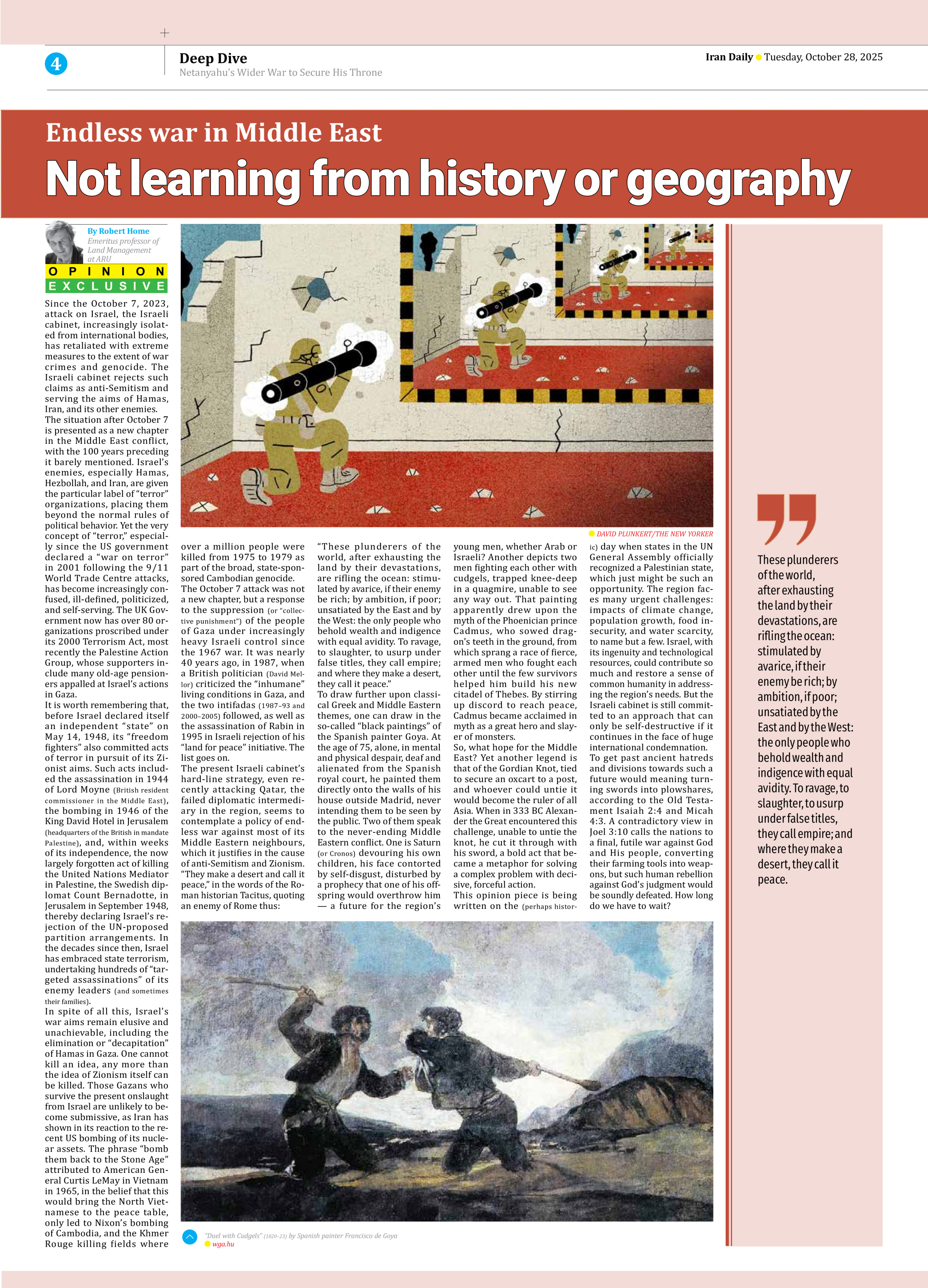


Endless war in Middle East
Not learning from history or geography
By Robert Home
Emeritus professor of Land Management
at ARU
Since the October 7, 2023, attack on Israel, the Israeli cabinet, increasingly isolated from international bodies, has retaliated with extreme measures to the extent of war crimes and genocide. The Israeli cabinet rejects such claims as anti-Semitism and serving the aims of Hamas, Iran, and its other enemies.
The situation after October 7 is presented as a new chapter in the Middle East conflict, with the 100 years preceding it barely mentioned. Israel’s enemies, especially Hamas, Hezbollah, and Iran, are given the particular label of “terror” organizations, placing them beyond the normal rules of political behavior. Yet the very concept of “terror,” especially since the US government declared a “war on terror” in 2001 following the 9/11 World Trade Centre attacks, has become increasingly confused, ill-defined, politicized, and self-serving. The UK Government now has over 80 organizations proscribed under its 2000 Terrorism Act, most recently the Palestine Action Group, whose supporters include many old-age pensioners appalled at Israel’s actions in Gaza.
It is worth remembering that, before Israel declared itself an independent “state” on May 14, 1948, its “freedom fighters” also committed acts of terror in pursuit of its Zionist aims. Such acts included the assassination in 1944 of Lord Moyne (British resident commissioner in the Middle East), the bombing in 1946 of the King David Hotel in Jerusalem (headquarters of the British in mandate Palestine), and, within weeks of its independence, the now largely forgotten act of killing the United Nations Mediator in Palestine, the Swedish diplomat Count Bernadotte, in Jerusalem in September 1948, thereby declaring Israel’s rejection of the UN-proposed partition arrangements. In the decades since then, Israel has embraced state terrorism, undertaking hundreds of “targeted assassinations” of its enemy leaders (and sometimes their families).
In spite of all this, Israel’s war aims remain elusive and unachievable, including the elimination or “decapitation” of Hamas in Gaza. One cannot kill an idea, any more than the idea of Zionism itself can be killed. Those Gazans who survive the present onslaught from Israel are unlikely to become submissive, as Iran has shown in its reaction to the recent US bombing of its nuclear assets. The phrase “bomb them back to the Stone Age” attributed to American General Curtis LeMay in Vietnam in 1965, in the belief that this would bring the North Vietnamese to the peace table, only led to Nixon’s bombing of Cambodia, and the Khmer Rouge killing fields where over a million people were killed from 1975 to 1979 as part of the broad, state-sponsored Cambodian genocide.
The October 7 attack was not a new chapter, but a response to the suppression (or “collective punishment”) of the people of Gaza under increasingly heavy Israeli control since the 1967 war. It was nearly 40 years ago, in 1987, when a British politician (David Mellor) criticized the “inhumane” living conditions in Gaza, and the two intifadas (1987–93 and 2000–2005) followed, as well as the assassination of Rabin in 1995 in Israeli rejection of his “land for peace” initiative. The list goes on.
The present Israeli cabinet’s hard-line strategy, even recently attacking Qatar, the failed diplomatic intermediary in the region, seems to contemplate a policy of endless war against most of its Middle Eastern neighbours, which it justifies in the cause of anti-Semitism and Zionism. “They make a desert and call it peace,” in the words of the Roman historian Tacitus, quoting an enemy of Rome thus:
“These plunderers of the world, after exhausting the land by their devastations, are rifling the ocean: stimulated by avarice, if their enemy be rich; by ambition, if poor; unsatiated by the East and by the West: the only people who behold wealth and indigence with equal avidity. To ravage, to slaughter, to usurp under false titles, they call empire; and where they make a desert, they call it peace.”
To draw further upon classical Greek and Middle Eastern themes, one can draw in the so-called “black paintings” of the Spanish painter Goya. At the age of 75, alone, in mental and physical despair, deaf and alienated from the Spanish royal court, he painted them directly onto the walls of his house outside Madrid, never intending them to be seen by the public. Two of them speak to the never-ending Middle Eastern conflict. One is Saturn (or Cronos) devouring his own children, his face contorted by self-disgust, disturbed by a prophecy that one of his offspring would overthrow him — a future for the region’s young men, whether Arab or Israeli? Another depicts two men fighting each other with cudgels, trapped knee-deep in a quagmire, unable to see any way out. That painting apparently drew upon the myth of the Phoenician prince Cadmus, who sowed dragon’s teeth in the ground, from which sprang a race of fierce, armed men who fought each other until the few survivors helped him build his new citadel of Thebes. By stirring up discord to reach peace, Cadmus became acclaimed in myth as a great hero and slayer of monsters.
So, what hope for the Middle East? Yet another legend is that of the Gordian Knot, tied to secure an oxcart to a post, and whoever could untie it would become the ruler of all Asia. When in 333 BC Alexander the Great encountered this challenge, unable to untie the knot, he cut it through with his sword, a bold act that became a metaphor for solving a complex problem with decisive, forceful action.
This opinion piece is being written on the (perhaps historic) day when states in the UN General Assembly officially recognized a Palestinian state, which just might be such an opportunity. The region faces many urgent challenges: impacts of climate change, population growth, food insecurity, and water scarcity, to name but a few. Israel, with its ingenuity and technological resources, could contribute so much and restore a sense of common humanity in addressing the region’s needs. But the Israeli cabinet is still committed to an approach that can only be self-destructive if it continues in the face of huge international condemnation.
To get past ancient hatreds and divisions towards such a future would meaning turning swords into plowshares, according to the Old Testament Isaiah 2:4 and Micah 4:3. A contradictory view in Joel 3:10 calls the nations to a final, futile war against God and His people, converting their farming tools into weapons, but such human rebellion against God’s judgment would be soundly defeated. How long do we have to wait?