







Turkmen women weaving history, culture
In a land where diverse ethnic groups and religions have lived side by side, indigenous arts such as Turkmen embroidery are not only expressions of beauty but also an integral part of the local people’s cultural heritage. This is a long-standing women’s art, passed down from mothers to daughters, weaving within its threads stories of the history and culture of this ancient community.
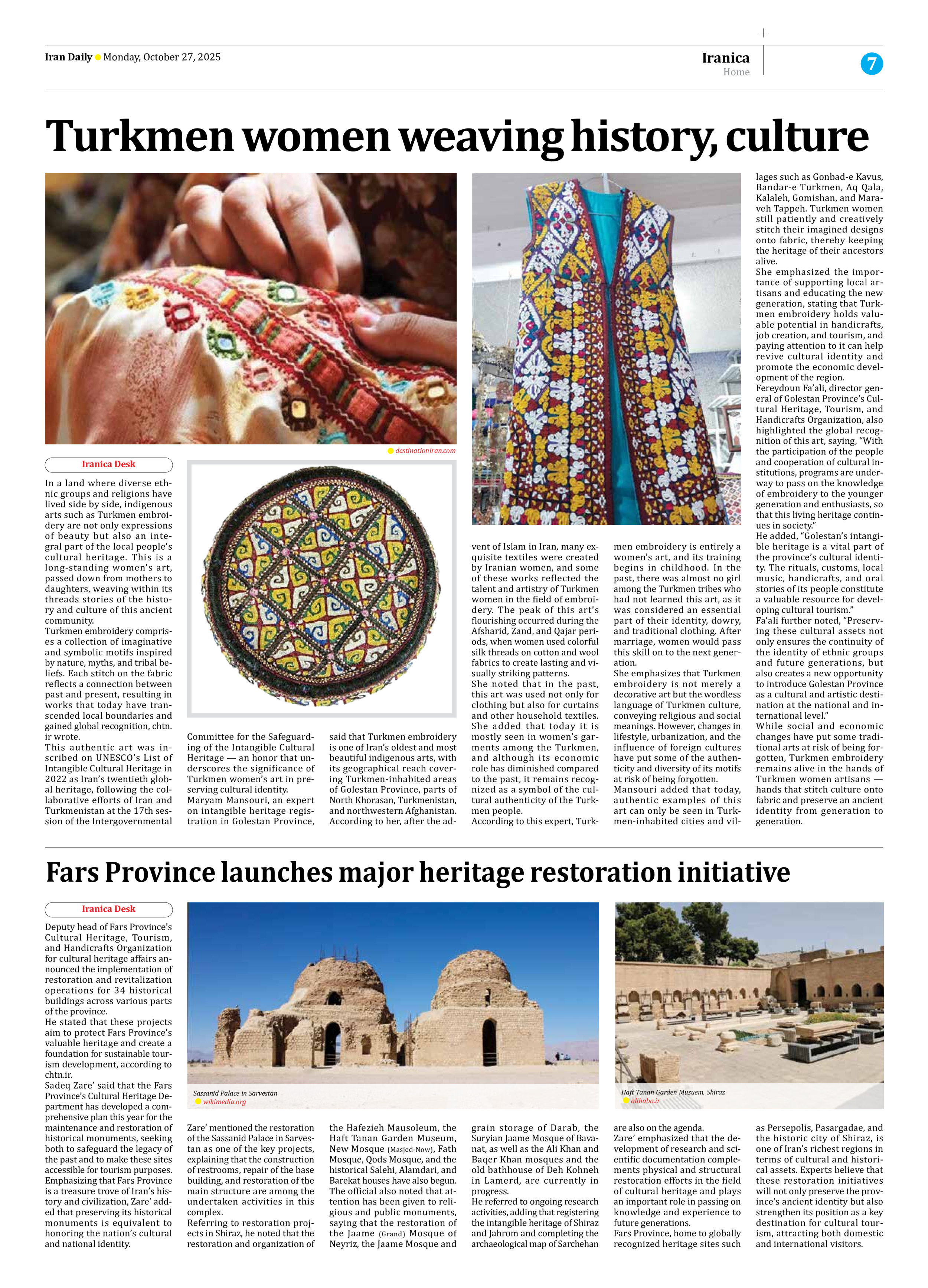
Turkmen embroidery comprises a collection of imaginative and symbolic motifs inspired by nature, myths, and tribal beliefs. Each stitch on the fabric reflects a connection between past and present, resulting in works that today have transcended local boundaries and gained global recognition, chtn.ir wrote.
This authentic art was inscribed on UNESCO’s List of Intangible Cultural Heritage in 2022 as Iran’s twentieth global heritage, following the collaborative efforts of Iran and Turkmenistan at the 17th session of the Intergovernmental Committee for the Safeguarding of the Intangible Cultural Heritage — an honor that underscores the significance of Turkmen women’s art in preserving cultural identity.
Maryam Mansouri, an expert on intangible heritage registration in Golestan Province, said that Turkmen embroidery is one of Iran’s oldest and most beautiful indigenous arts, with its geographical reach covering Turkmen-inhabited areas of Golestan Province, parts of North Khorasan, Turkmenistan, and northwestern Afghanistan.
According to her, after the advent of Islam in Iran, many exquisite textiles were created by Iranian women, and some of these works reflected the talent and artistry of Turkmen women in the field of embroidery. The peak of this art’s flourishing occurred during the Afsharid, Zand, and Qajar periods, when women used colorful silk threads on cotton and wool fabrics to create lasting and visually striking patterns.
She noted that in the past, this art was used not only for clothing but also for curtains and other household textiles. She added that today it is mostly seen in women’s garments among the Turkmen, and although its economic role has diminished compared to the past, it remains recognized as a symbol of the cultural authenticity of the Turkmen people.
According to this expert, Turkmen embroidery is entirely a women’s art, and its training begins in childhood. In the past, there was almost no girl among the Turkmen tribes who had not learned this art, as it was considered an essential part of their identity, dowry, and traditional clothing. After marriage, women would pass this skill on to the next generation.
She emphasizes that Turkmen embroidery is not merely a decorative art but the wordless language of Turkmen culture, conveying religious and social meanings. However, changes in lifestyle, urbanization, and the influence of foreign cultures have put some of the authenticity and diversity of its motifs at risk of being forgotten.
Mansouri added that today, authentic examples of this art can only be seen in Turkmen-inhabited cities and villages such as Gonbad-e Kavus, Bandar-e Turkmen, Aq Qala, Kalaleh, Gomishan, and Maraveh Tappeh. Turkmen women still patiently and creatively stitch their imagined designs onto fabric, thereby keeping the heritage of their ancestors alive.
She emphasized the importance of supporting local artisans and educating the new generation, stating that Turkmen embroidery holds valuable potential in handicrafts, job creation, and tourism, and paying attention to it can help revive cultural identity and promote the economic development of the region.
Fereydoun Fa’ali, director general of Golestan Province’s Cultural Heritage, Tourism, and Handicrafts Organization, also highlighted the global recognition of this art, saying, “With the participation of the people and cooperation of cultural institutions, programs are underway to pass on the knowledge of embroidery to the younger generation and enthusiasts, so that this living heritage continues in society.”
He added, “Golestan’s intangible heritage is a vital part of the province’s cultural identity. The rituals, customs, local music, handicrafts, and oral stories of its people constitute a valuable resource for developing cultural tourism.”
Fa’ali further noted, “Preserving these cultural assets not only ensures the continuity of the identity of ethnic groups and future generations, but also creates a new opportunity to introduce Golestan Province as a cultural and artistic destination at the national and international level.”
While social and economic changes have put some traditional arts at risk of being forgotten, Turkmen embroidery remains alive in the hands of Turkmen women artisans — hands that stitch culture onto fabric and preserve an ancient identity from generation to generation.