







US strategic missteps toward Islamic Republic of Iran
After the change in leadership in the United States and the coming to power of Donald Trump, several think tanks and policy foundations that weigh in on foreign policy and advise the White House sprang into action concurrently with the rise of neoconservatives and “Neo-Reaganites” in Washington. They have sought to reshape and redirect US foreign policy, particularly regarding Russia, China, Iran, and North Korea.
One of these think tanks is the Foundation for Defense of Democracies (FDD), based in Washington, which has had a particularly active and influential record in pushing back against the JCPOA and driving forward the US withdrawal from it. This foundation — where some radical members of the Iranian opposition abroad, such as Saeed Ghasseminejad, also operate — was among the main architects behind the economic war and the bringing back of the so‑called “crippling sanctions” against Iran.
The FDD’s website content and its members’ analyses about Iran show that, while their initial and minimal objective in the political, economic, and psychological war against the Islamic Republic is “behavioral change” (read: “regime change”), their ultimate goal is the breaking down of the Islamic Republic as a political entity and state — if necessary, even through its territorial disintegration. In other words, the ultimate aim of the neocons and Neo-Reaganites, if they cannot bring about regime change to install a puppet government, is to weaken the Iranian state and eventually tear it apart through the country’s multiethnic composition. This plan, which got off the ground after Trump’s announcement of the US withdrawal from the JCPOA, nonetheless lays bare several contradictions and strategic errors in Washington’s policy toward Iran, some of which are discussed below.
First mistake: Trying to revive a puppet regime in Iran
The first strategic blunder in this project is the assumption that Iran can be turned into a Western client state and thereby serve American and European interests while cutting down on their security costs in the region. This presumption is utterly flawed and shows that the project’s architects have little understanding of Iranian history — a key source of the nation’s strategic culture — and have failed to learn from the lessons of time.
Throughout their long history, Iranians — except during brief intervals — have never been anyone’s vassals. They have always been willing to ride out hardship to preserve their dignity and sovereignty. That is precisely why the short-lived subservience of the Pahlavi era, which began after the coup of August 19, 1953, ultimately gave rise to the Islamic Revolution and the Pahlavi regime’s collapse in pursuit of restoring Iran’s independence and honor. Any attempt to bring back that subordination is doomed to fail — and even if it succeeds briefly, it will not last. Iranians have always set their sights high and insisted on being their own masters — one of the core tenets of their strategic culture.
Second mistake: Overlooking Iran’s natural regional influence
The second major misstep by the project’s architects and the new White House team is their failure to recognize that Iran’s regional influence is natural. This influence is not limited to Shia communities; Rather, it is a supra‑sectarian, historical, civilizational, and cultural presence. Often, even non‑Shia groups in the region have called on the Islamic Republic to step in and mediate their disputes — a pattern that long predates the Republic itself.
Hence, Iran’s regional reach is fundamentally different from that of regimes like Saudi Arabia or Israel. That is why Barack Obama repeatedly pointed out to Riyadh the need to come to terms with Iran’s regional influence. The natural character of this influence means that, contrary to neocon comparisons with the Soviet Union’s domination over its satellite states in the Eastern bloc during the Cold War, Iran’s regional presence is not a material burden but a strategic asset. Even if Tehran scales back its regional spending, its influence will remain strong and effective.
Third mistake: Failing to grasp Iran’s deep‑rooted national character
A third major error in this design lies in failing to get a handle on the fabric of Iran’s national identity, which sharply differs from the more artificially constructed post‑Westphalian nation‑states of the Middle East, such as Iraq, Syria, Lebanon, or Jordan, and even from the former Soviet Union. Civilizations like Iran, Egypt, and China belong to the pre‑Westphalian world — their nations were not patched together from disparate tribes and ethnicities but rather forged through centuries of deep integration.
Therefore, comparing Iran’s immaterialized collapse to that of the Soviet Union is sheer folly, just as assuming Iraq’s fragmentation could be replicated in Iran misses the mark entirely. Iran’s social groups are so intertwined that no combination of political, economic, or even military pressure can pull them apart.
Fourth mistake: Ignoring Iran’s security‑building role
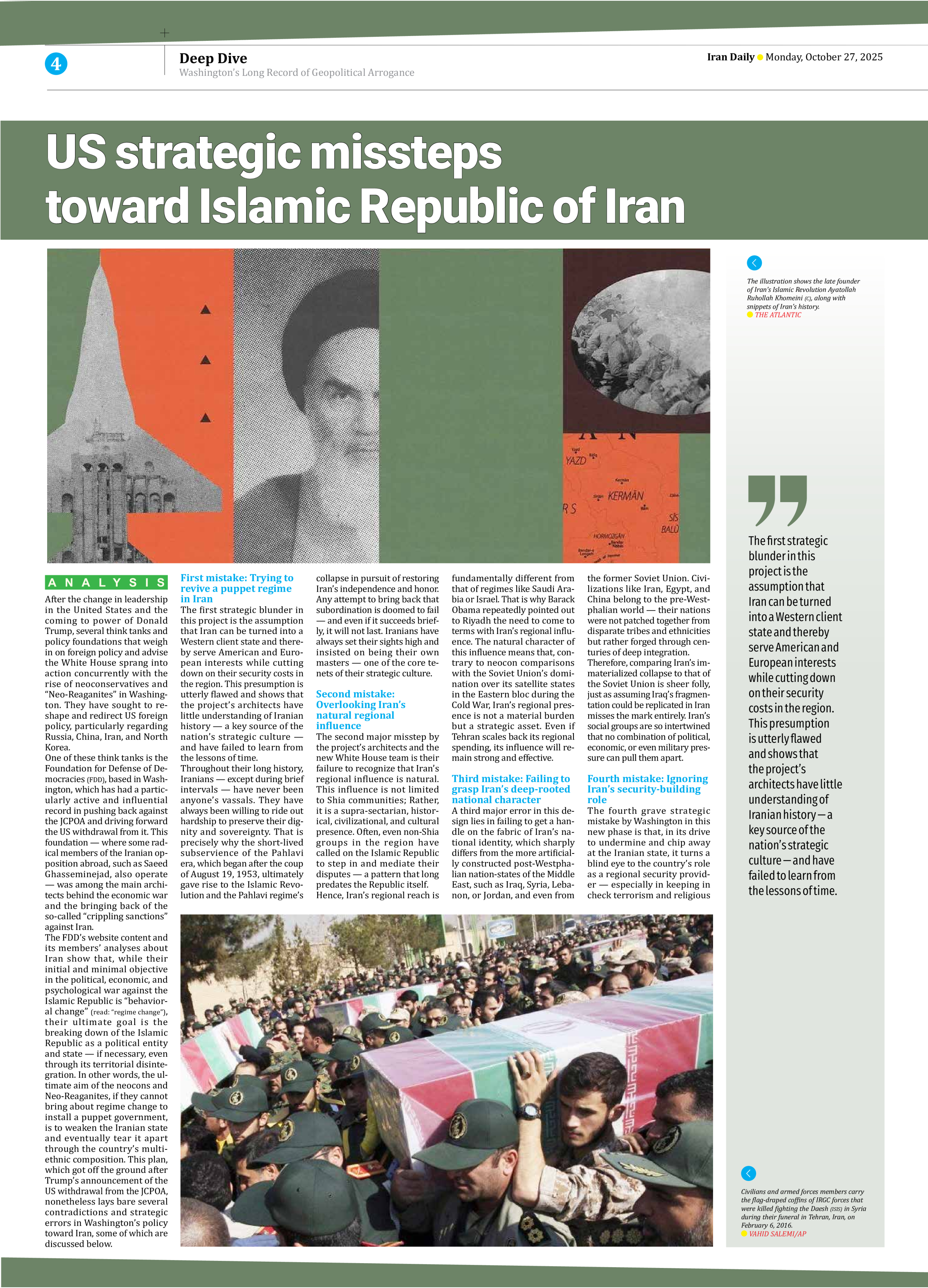
The fourth grave strategic mistake by Washington in this new phase is that, in its drive to undermine and chip away at the Iranian state, it turns a blind eye to the country’s role as a regional security provider — especially in keeping in check terrorism and religious extremism. Recent years have shown that no government in the region has had the political will, strategic capability, or geographical capacity to stand up to or balance out extremist threats as effectively as Iran. Should Iran’s state become fragile, Takfiri terrorism would find its main obstacle out of the way, sending regional and even global security costs through the roof — with the United States ending up as the biggest loser in this new equation.
A close look at America’s strategic misjudgments in its latest confrontation project against Iran reveals that, due to simplistic assumptions and glaring miscalculations, Washington will fall short even of its minimal goals. At best, it may weaken the Iranian state temporarily — but the weaker that state becomes, the higher the West’s own security costs will shoot up.
In the end, America’s aggressive policies toward Iran will, like a boomerang, come back to haunt it. In other words, the most crucial strategic failure of the White House policymakers lies in their inability to factor in the unintended consequences of their own maneuvers in the region, especially in dealing with the Islamic Republic of Iran.
The article first appeared on the
Research Institute for Strategic Studies website.