







Iran-Russia-China letters to UN, IAEA proof of shift in global power balance: Speaker
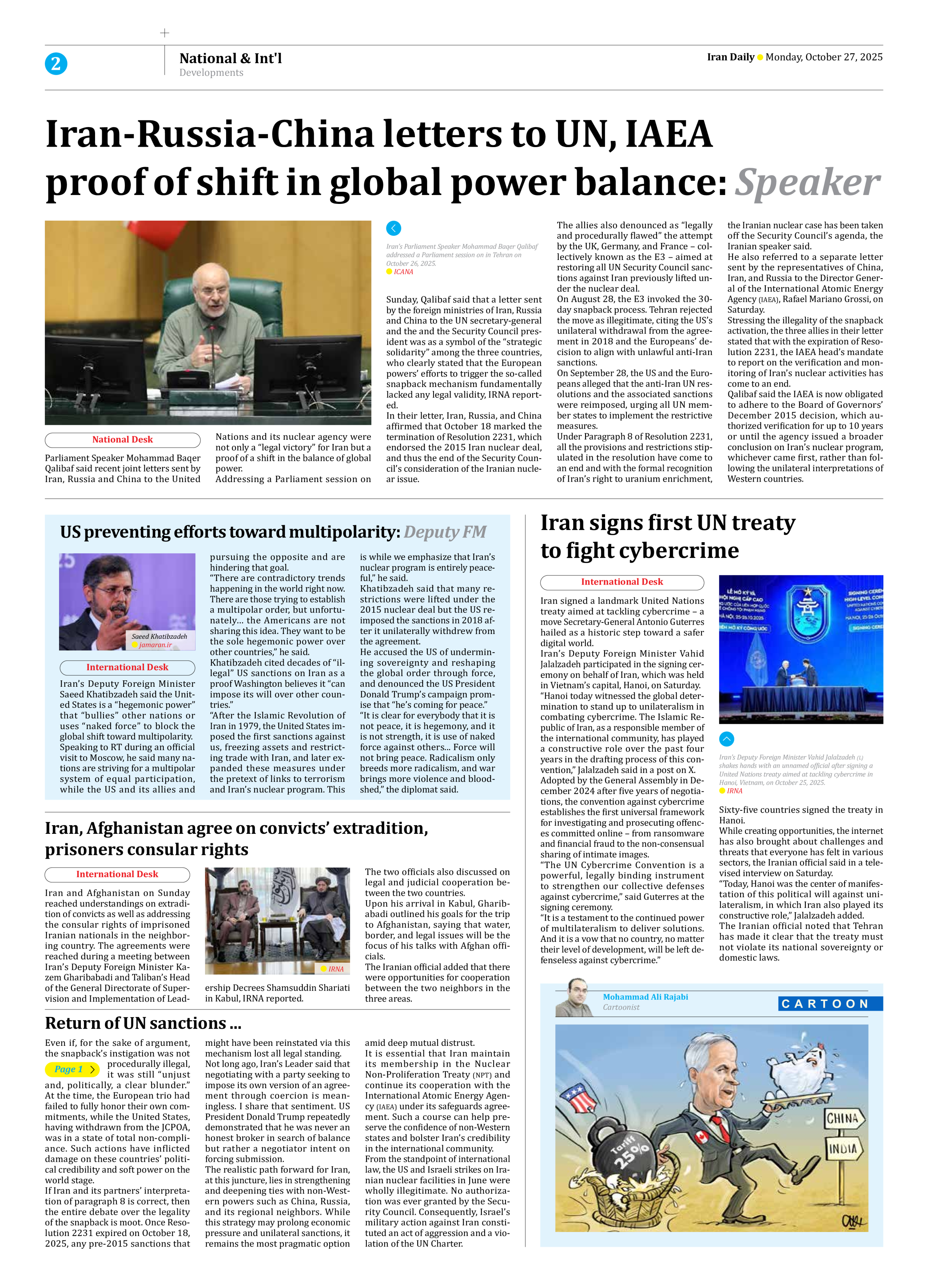
Parliament Speaker Mohammad Baqer Qalibaf said recent joint letters sent by Iran, Russia and China to the United Nations and its nuclear agency were not only a “legal victory” for Iran but a proof of a shift in the balance of global power.
Addressing a Parliament session on Sunday, Qalibaf said that a letter sent by the foreign ministries of Iran, Russia and China to the UN secretary-general and the and the Security Council president was as a symbol of the “strategic solidarity” among the three countries, who clearly stated that the European powers’ efforts to trigger the so-called snapback mechanism fundamentally lacked any legal validity, IRNA reported.
In their letter, Iran, Russia, and China affirmed that October 18 marked the termination of Resolution 2231, which endorsed the 2015 Iran nuclear deal, and thus the end of the Security Council’s consideration of the Iranian nuclear issue.
The allies also denounced as “legally and procedurally flawed” the attempt by the UK, Germany, and France – collectively known as the E3 – aimed at restoring all UN Security Council sanctions against Iran previously lifted under the nuclear deal.
On August 28, the E3 invoked the 30-day snapback process. Tehran rejected the move as illegitimate, citing the US’s unilateral withdrawal from the agreement in 2018 and the Europeans’ decision to align with unlawful anti-Iran sanctions.
On September 28, the US and the Europeans alleged that the anti-Iran UN resolutions and the associated sanctions were reimposed, urging all UN member states to implement the restrictive measures.
Under Paragraph 8 of Resolution 2231, all the provisions and restrictions stipulated in the resolution have come to an end and with the formal recognition of Iran’s right to uranium enrichment, the Iranian nuclear case has been taken off the Security Council’s agenda, the Iranian speaker said.
He also referred to a separate letter sent by the representatives of China, Iran, and Russia to the Director General of the International Atomic Energy Agency (IAEA), Rafael Mariano Grossi, on Saturday.
Stressing the illegality of the snapback activation, the three allies in their letter stated that with the expiration of Resolution 2231, the IAEA head’s mandate to report on the verification and monitoring of Iran’s nuclear activities has come to an end.
Qalibaf said the IAEA is now obligated to adhere to the Board of Governors’ December 2015 decision, which authorized verification for up to 10 years or until the agency issued a broader conclusion on Iran’s nuclear program, whichever came first, rather than following the unilateral interpretations of Western countries.