







The 2231 rift
How Iran’s defiance exposes deep divide in global order
By Peiman Salehi
Political analyst
On October 18, 2025, the date that was supposed to mark the formal end of UN Security Council Resolution 2231, the very mechanism that anchored the Iran nuclear deal, the world instead has witnessed the widening of a profound geopolitical divide. What should have been a technical expiry of restrictions has turned into a political confrontation that underscores the erosion of Western authority and the rise of a multipolar order.
According to the Joint Comprehensive Plan of Action (JCPOA), Resolution 2231 was set to lapse on this date, effectively lifting the last vestiges of UN sanctions architecture against Iran. Yet, instead of closure, the United States and its European allies (the so-called E3) have moved to unilaterally extend the restrictions, invoking the “snapback” mechanism that was meant to be dormant. Iran, backed by Russia, China, and more than 120 countries of the Non-Aligned Movement, has categorically rejected the legitimacy of this move.
In a joint letter sent just before October 18 to the UN Secretary-General, Tehran, Moscow, and Beijing announced that they “do not recognise the validity of any unilateral extension” of Resolution 2231, framing it as a violation of international law and an abuse of multilateral institutions. For Iran, this is more than a legal argument; It is a political declaration that the era of Western monopoly over global norms is ending.
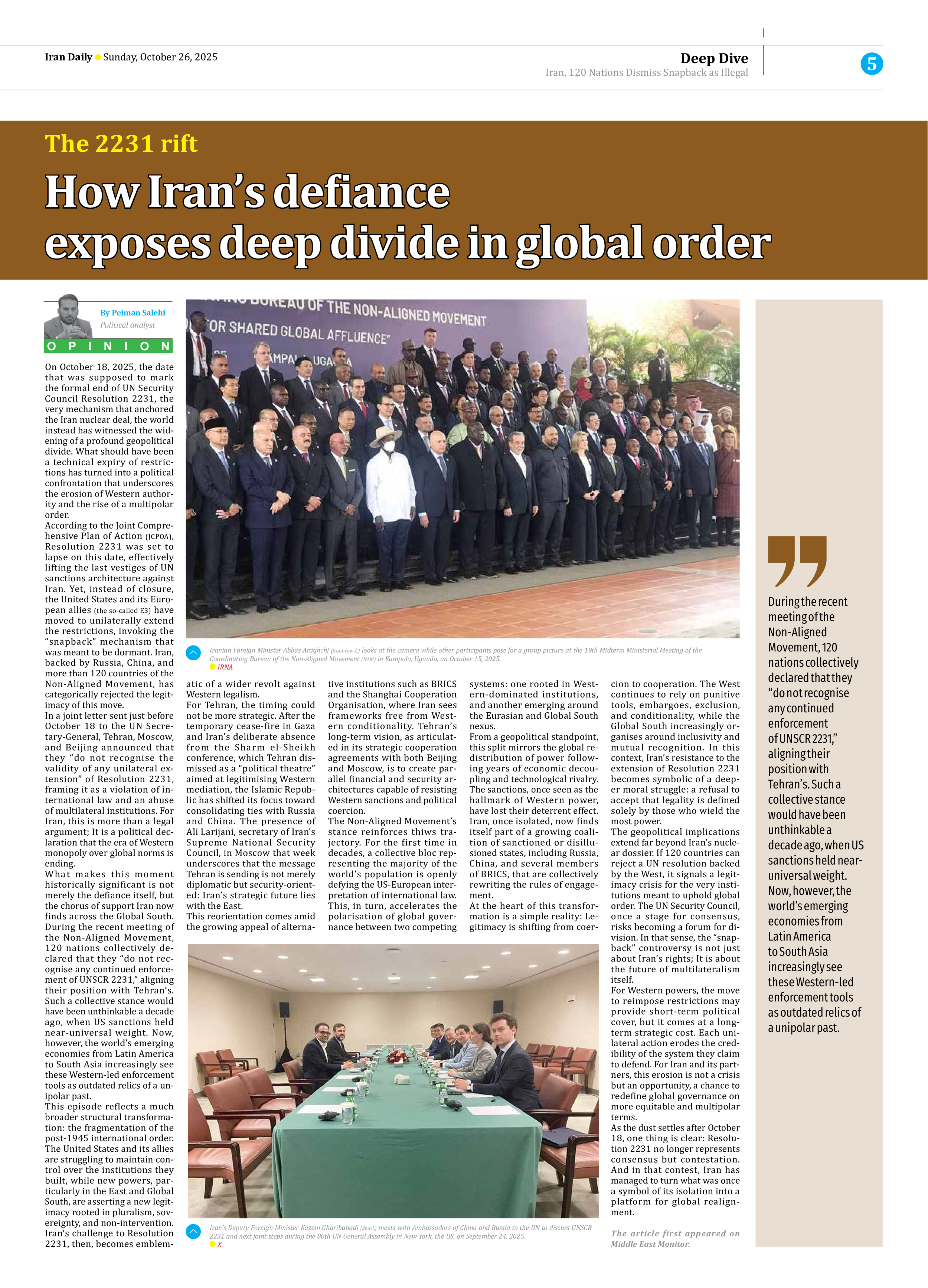
What makes this moment historically significant is not merely the defiance itself, but the chorus of support Iran now finds across the Global South. During the recent meeting of the Non-Aligned Movement, 120 nations collectively declared that they “do not recognise any continued enforcement of UNSCR 2231,” aligning their position with Tehran’s. Such a collective stance would have been unthinkable a decade ago, when US sanctions held near-universal weight. Now, however, the world’s emerging economies from Latin America to South Asia increasingly see these Western-led enforcement tools as outdated relics of a unipolar past.
This episode reflects a much broader structural transformation: the fragmentation of the post-1945 international order. The United States and its allies are struggling to maintain control over the institutions they built, while new powers, particularly in the East and Global South, are asserting a new legitimacy rooted in pluralism, sovereignty, and non-intervention. Iran’s challenge to Resolution 2231, then, becomes emblematic of a wider revolt against Western legalism.
For Tehran, the timing could not be more strategic. After the temporary cease-fire in Gaza and Iran’s deliberate absence from the Sharm el-Sheikh conference, which Tehran dismissed as a “political theatre” aimed at legitimising Western mediation, the Islamic Republic has shifted its focus toward consolidating ties with Russia and China. The presence of Ali Larijani, secretary of Iran’s Supreme National Security Council, in Moscow that week underscores that the message Tehran is sending is not merely diplomatic but security-oriented: Iran’s strategic future lies with the East.
This reorientation comes amid the growing appeal of alternative institutions such as BRICS and the Shanghai Cooperation Organisation, where Iran sees frameworks free from Western conditionality. Tehran’s long-term vision, as articulated in its strategic cooperation agreements with both Beijing and Moscow, is to create parallel financial and security architectures capable of resisting Western sanctions and political coercion.
The Non-Aligned Movement’s stance reinforces thiws trajectory. For the first time in decades, a collective bloc representing the majority of the world’s population is openly defying the US-European interpretation of international law. This, in turn, accelerates the polarisation of global governance between two competing systems: one rooted in Western-dominated institutions, and another emerging around the Eurasian and Global South nexus.
From a geopolitical standpoint, this split mirrors the global redistribution of power following years of economic decoupling and technological rivalry. The sanctions, once seen as the hallmark of Western power, have lost their deterrent effect. Iran, once isolated, now finds itself part of a growing coalition of sanctioned or disillusioned states, including Russia, China, and several members of BRICS, that are collectively rewriting the rules of engagement.
At the heart of this transformation is a simple reality: Legitimacy is shifting from coercion to cooperation. The West continues to rely on punitive tools, embargoes, exclusion, and conditionality, while the Global South increasingly organises around inclusivity and mutual recognition. In this context, Iran’s resistance to the extension of Resolution 2231 becomes symbolic of a deeper moral struggle: a refusal to accept that legality is defined solely by those who wield the most power.
The geopolitical implications extend far beyond Iran’s nuclear dossier. If 120 countries can reject a UN resolution backed by the West, it signals a legitimacy crisis for the very institutions meant to uphold global order. The UN Security Council, once a stage for consensus, risks becoming a forum for division. In that sense, the “snapback” controversy is not just about Iran’s rights; It is about the future of multilateralism itself.
For Western powers, the move to reimpose restrictions may provide short-term political cover, but it comes at a long-term strategic cost. Each unilateral action erodes the credibility of the system they claim to defend. For Iran and its partners, this erosion is not a crisis but an opportunity, a chance to redefine global governance on more equitable and multipolar terms.
As the dust settles after October 18, one thing is clear: Resolution 2231 no longer represents consensus but contestation. And in that contest, Iran has managed to turn what was once a symbol of its isolation into a platform for global realignment.
The article first appeared on
Middle East Monitor.