





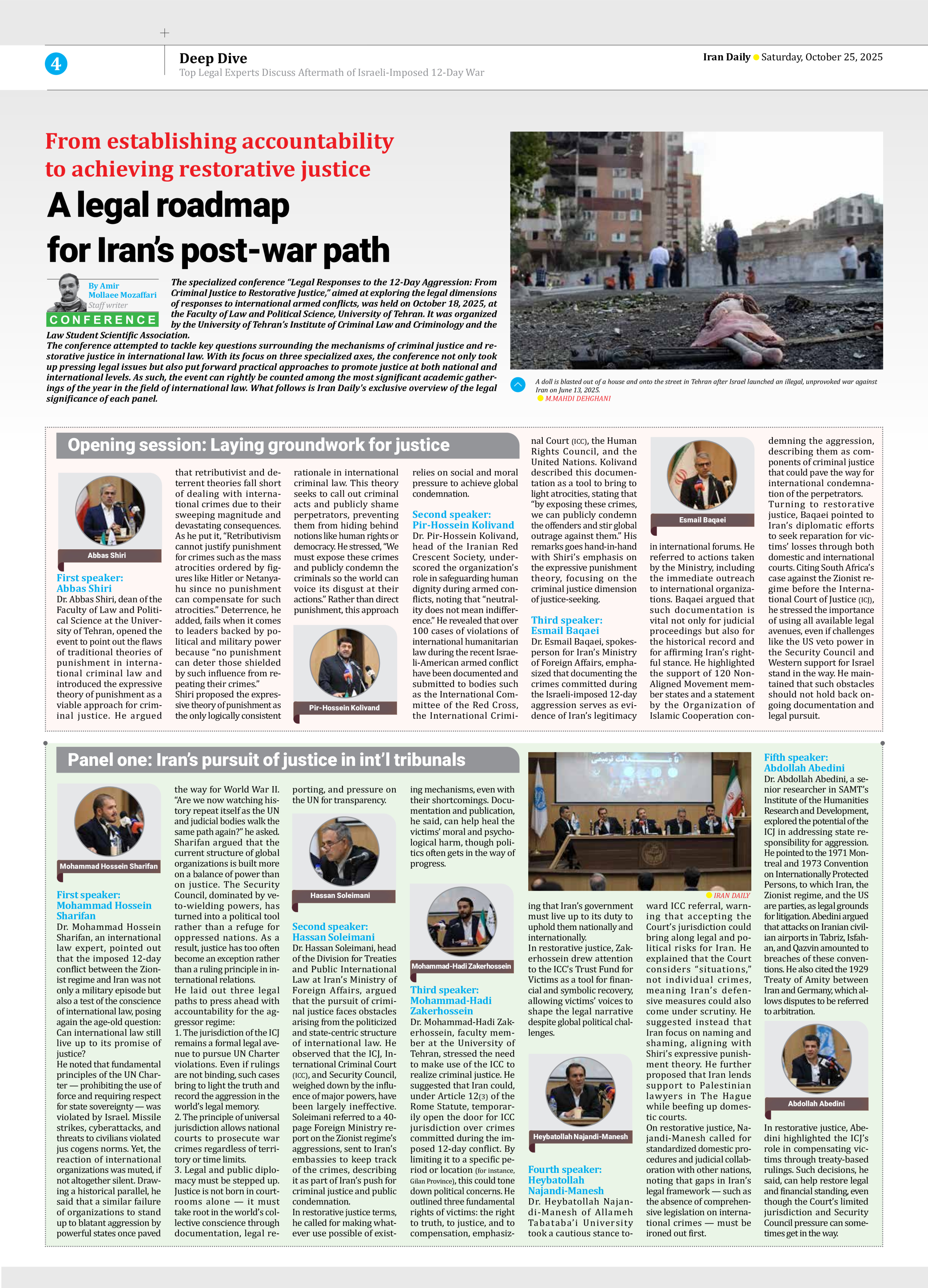


From establishing accountability to achieving restorative justice
A legal roadmap for Iran’s post-war path
The specialized conference “Legal Responses to the 12-Day Aggression: From Criminal Justice to Restorative Justice,” aimed at exploring the legal dimensions of responses to international armed conflicts, was held on October 18, 2025, at the Faculty of Law and Political Science, University of Tehran. It was organized by the University of Tehran’s Institute of Criminal Law and Criminology and the Law Student Scientific Association. The conference attempted to tackle key questions surrounding the mechanisms of criminal justice and restorative justice in international law. With its focus on three specialized axes, the conference not only took up pressing legal issues but also put forward practical approaches to promote justice at both national and international levels. As such, the event can rightly be counted among the most significant academic gatherings of the year in the field of international law. What follows is Iran Daily’s exclusive overview of the legal significance of each panel.
By AmirMollaee Mozaffari
Staff writer
Opening session: Laying groundwork for justice
Abbas Shiri
First speaker:
Abbas Shiri
Dr. Abbas Shiri, dean of the Faculty of Law and Political Science at the University of Tehran, opened the event to point out the flaws of traditional theories of punishment in international criminal law and introduced the expressive theory of punishment as a viable approach for criminal justice. He argued that retributivist and deterrent theories fall short of dealing with international crimes due to their sweeping magnitude and devastating consequences. As he put it, “Retributivism cannot justify punishment for crimes such as the mass atrocities ordered by figures like Hitler or Netanyahu since no punishment can compensate for such atrocities.” Deterrence, he added, fails when it comes to leaders backed by political and military power because “no punishment can deter those shielded by such influence from repeating their crimes.”
Shiri proposed the expressive theory of punishment as the only logically consistent rationale in international criminal law. This theory seeks to call out criminal acts and publicly shame perpetrators, preventing them from hiding behind notions like human rights or democracy. He stressed, “We must expose these crimes and publicly condemn the criminals so the world can voice its disgust at their actions.” Rather than direct punishment, this approach
Pir-Hossein Kolivand
relies on social and moral pressure to achieve global condemnation.
Second speaker:
Pir-Hossein Kolivand
Dr. Pir-Hossein Kolivand, head of the Iranian Red Crescent Society, underscored the organization’s role in safeguarding human dignity during armed conflicts, noting that “neutrality does not mean indifference.” He revealed that over 100 cases of violations of international humanitarian law during the recent Israeli-American armed conflict have been documented and submitted to bodies such as the International Committee of the Red Cross, the International Criminal Court (ICC), the Human Rights Council, and the United Nations. Kolivand described this documentation as a tool to bring to light atrocities, stating that “by exposing these crimes, we can publicly condemn the offenders and stir global outrage against them.” His remarks goes hand-in-hand with Shiri’s emphasis on the expressive punishment theory, focusing on the criminal justice dimension of justice-seeking.
Third speaker: Esmail Baqaei
Dr. Esmail Baqaei, spokesperson for Iran’s Ministry of Foreign Affairs, emphasized that documenting the crimes committed during the Israeli-imposed 12-day aggression serves as evidence of Iran’s legitimac
Esmail Baqaei
in international forums. He referred to actions taken by the Ministry, including the immediate outreach to international organizations. Baqaei argued that such documentation is vital not only for judicial proceedings but also for the historical record and for affirming Iran’s rightful stance. He highlighted the support of 120 Non-Aligned Movement member states and a statement by the Organization of Islamic Cooperation condemning the aggression, describing them as components of criminal justice that could pave the way for international condemnation of the perpetrators.
Turning to restorative justice, Baqaei pointed to Iran’s diplomatic efforts to seek reparation for victims’ losses through both domestic and international courts. Citing South Africa’s case against the Zionist regime before the International Court of Justice (ICJ), he stressed the importance of using all available legal avenues, even if challenges like the US veto power in the Security Council and Western support for Israel stand in the way. He maintained that such obstacles should not hold back ongoing documentation and legal pursuit.
Panel one: Iran’s pursuit of justice in int’l tribunals
Mohammad Hossein Sharifan
Mohammad Hossein Sharifan
Dr. Mohammad Hossein Sharifan, an international law expert, pointed out that the imposed 12-day conflict between the Zionist regime and Iran was not only a military episode but also a test of the conscience of international law, posing again the age-old question: Can international law still live up to its promise of justice?
He noted that fundamental principles of the UN Charter — prohibiting the use of force and requiring respect for state sovereignty — was violated by Israel. Missile strikes, cyberattacks, and threats to civilians violated jus cogens norms. Yet, the reaction of international organizations was muted, if not altogether silent. Drawing a historical parallel, he said that a similar failure of organizations to stand up to blatant aggression by powerful states once paved the way for World War II. “Are we now watching history repeat itself as the UN and judicial bodies walk the same path again?” he asked.
Sharifan argued that the current structure of global organizations is built more on a balance of power than on justice. The Security Council, dominated by veto-wielding powers, has turned into a political tool rather than a refuge for oppressed nations. As a result, justice has too often become an exception rather than a ruling principle in international relations.
He laid out three legal paths to press ahead with accountability for the aggressor regime:
1. The jurisdiction of the ICJ remains a formal legal avenue to pursue UN Charter violations. Even if rulings are not binding, such cases bring to light the truth and record the aggression in the world’s legal memory.
2. The principle of universal jurisdiction allows national courts to prosecute war crimes regardless of territory or time limits.
3. Legal and public diplomacy must be stepped up. Justice is not born in courtrooms alone — it must take root in the world’s collective conscience through documentation, legal reporting, and pressure on the UN for transparency.
Hassan Soleimani
Second speaker: Hassan Soleimani
Dr. Hassan Soleimani, head of the Division for Treaties and Public International Law at Iran’s Ministry of Foreign Affairs, argued that the pursuit of criminal justice faces obstacles arising from the politicized and state-centric structure of international law. He observed that the ICJ, International Criminal Court (ICC), and Security Council, weighed down by the influence of major powers, have been largely ineffective. Soleimani referred to a 40-page Foreign Ministry report on the Zionist regime’s aggressions, sent to Iran’s embassies to keep track of the crimes, describing it as part of Iran’s push for criminal justice and public condemnation.
In restorative justice terms, he called for making whatever use possible of existing mechanisms, even with their shortcomings. Documentation and publication, he said, can help heal the victims’ moral and psychological harm, though politics often gets in the way of progress.
Mohammad-Hadi Zakerhossein
Third speaker: Mohammad-Hadi Zakerhossein
Dr. Mohammad-Hadi Zakerhossein, faculty member at the University of Tehran, stressed the need to make use of the ICC to realize criminal justice. He suggested that Iran could, under Article 12(3) of the Rome Statute, temporarily open the door for ICC jurisdiction over crimes committed during the imposed 12-day conflict. By limiting it to a specific period or location (for instance, Gilan Province), this could tone down political concerns. He outlined three fundamental rights of victims: the right to truth, to justice, and to compensation, emphasizing that Iran’s government must live up to its duty to uphold them nationally and internationally.
In restorative justice, Zakerhossein drew attention to the ICC’s Trust Fund for Victims as a tool for financial and symbolic recovery, allowing victims’ voices to shape the legal narrative despite global political challenges.
Heybatollah Najandi-Manesh
Fourth speaker: Heybatollah
Najandi-Manesh
Dr. Heybatollah Najandi-Manesh of Allameh Tabataba’i University took a cautious stance toward ICC referral, warning that accepting the Court’s jurisdiction could bring along legal and political risks for Iran. He explained that the Court considers “situations,” not individual crimes, meaning Iran’s defensive measures could also come under scrutiny. He suggested instead that Iran focus on naming and shaming, aligning with Shiri’s expressive punishment theory. He further proposed that Iran lends support to Palestinian lawyers in The Hague while beefing up domestic courts.
On restorative justice, Najandi-Manesh called for standardized domestic procedures and judicial collaboration with other nations, noting that gaps in Iran’s legal framework — such as the absence of comprehensive legislation on international crimes — must be ironed out first.
Fifth speaker: Abdollah Abedini
Dr. Abdollah Abedini, a senior researcher in SAMT’s Institute of the Humanities Research and Development, explored the potential of the ICJ in addressing state responsibility for aggression. He pointed to the 1971 Montreal and 1973 Convention on Internationally Protected Persons, to which Iran, the Zionist regime, and the US are parties, as legal grounds for litigation. Abedini argued that attacks on Iranian civilian airports in Tabriz, Isfahan, and Qazvin amounted to breaches of these conventions. He also cited the 1929 Treaty of Amity between Iran and Germany, which allows disputes to be referred to arbitration
Abdollah Abedini
In restorative justice, Abedini highlighted the ICJ’s role in compensating victims through treaty-based rulings. Such decisions, he said, can help restore legal and financial standing, even though the Court’s limited jurisdiction and Security Council pressure can sometimes get in the way.
Panel two: Pursuing national justice in Iran’s domestic frameworks
Mehdi Hadi
First speaker:
Mehdi Hadi
Dr. Mehdi Hadi, deputy for Legal and Parliamentary Affairs at Iran’s Judiciary, pointed out the legal complexity of prosecuting crimes committed during the Israeli-imposed 12-day conflict and described the lack of a unified legal framework in Iran’s legal community as a major stumbling block. He posed two central questions: Did the war have legitimacy (“jus ad bellum”)? And were humanitarian laws observed (“jus in bello”)? He argued that under the UN Charter, the attack lacked any justification — neither under self-defense (Article 51) nor international security (Article 42). Moreover, Iran’s non-recognition of the Zionist regime and the absence of shared treaties with the US have made international litigation an uphill battle.
On criminal justice, Hadi pointed to legal gaps in Iran. The absence of substantive laws criminalizing international offenses — war crimes, genocide, crimes against humanity, and aggression — has prevented the opening of cases under precise headings. He disclosed three draft bills under preparation by the Judiciary:
1. Anti-terrorism bill: to criminalize acts of terrorism, now in its final drafting stage.
2. International judicial collaboration bill: a 150-article piece of legislation already approved in principle by the Parliament, aiming to pave the way for broader judicial collaboration.
3. International crimes bill: recently passed by the government, codifying the aforementioned four core crimes inspired by the ICC Statute but locally adapted, such as taking out “persecution” from the definition of crimes against humanity (Article 7 of the Rome Statute) to reduce domestic hurdles.
Hadi stressed the Judiciary’s duty to take up these cases since these crimes — murder, destruction, and physical harm — occurred on Iranian soil. Article 290 of the Criminal Procedure Code obliges the Attorney General to follow through on cases with an international dimension. “The directives of the Leader of Iran’s Islamic Revolution add weight to this responsibility,” Hadi maintained.
On restorative justice, Hadi called for a systematic assessment of material, moral, and punitive damages. He proposed that psychological injuries — like post-traumatic stress — be legally recognized as current Iranian jurisprudence falls short of compensating non-material losses. He also suggested the use of class actions to streamline the process for multiple similar claims.
Ali Khaleghi
Second speaker:
Ali Khaleghi
Dr. Ali Khaleghi, a faculty member in the Criminal Law Department at University of Tehran, focused on the theoretical and practical challenges that national courts face when pursuing international crimes. He argued that international courts such as the ICC, due to their sluggish pace, narrow jurisdiction, and Iran’s non-membership, cannot serve as immediate vehicles for justice. Thus, domestic and even foreign courts should step in.
In criminal justice, he laid out three prerequisites for national prosecution:
1. Criminalization: Iran still lacks comprehensive legislation on international crimes. Earlier legislative attempts (such as the one by the sixth Parliament) were shot down by the Guardian Council. He described Iran as a “reluctant participant” in using international treaties and cited its delayed accession to the Convention for the Suppression of the Financing of Terrorism as a case in point.
2. Jurisdiction: Since the crimes occurred on Iranian soil, Iran holds territorial jurisdiction and may even prosecute extraterritorial acts whose effects spill over into its territory. However, trials in absentia (Article 406 of the Criminal Procedure Code) don’t carry much weight internationally.
3. Mutual legal assistance: The lack of extradition treaties with many countries, political constraints, and Iran’s death penalty stand in the way of extradition. Furthermore, the restriction in the proviso to the Article 48 of the Criminal Procedure Code on attorney selection has led to refusals by countries like France that emphasize defendants’ rights.
Turning to restorative justice, Khaleghi underscored the need for accurate documentation of crimes for future proceedings. Even if domestic verdicts are not immediately enforceable, they can come in handy as legal and diplomatic leverage.
Seyed Hossein Sadat Meidani
Third speaker: Seyed Hossein Sadat Meidani
Dr. Seyed Hossein Sadat Meidani, a faculty member at the School of International Relations of Iran’s Ministry of Foreign Affairs, zoomed in on the interaction between domestic and international law in prosecuting the Israeli-imposed 12-day conflict. He distinguished between two types of liability: individual criminal responsibility and state responsibility (for both the Zionist regime and the US). He broke down four elements — jurisdiction, evidence and liability assessment, liability determination, and compensation.
In criminal justice:
1. Jurisdiction: Since the crimes occurred inside Iran, Iranian courts have higher jurisdiction. The Zionist regime is not recognized as a state, and Iranian law (amended in 2020) does away with US sovereign immunity, thus clearing the path for litigation.
2. Evidence and liability assessment: He warned against delayed documentation, which waters down evidential value in international courts. Records must be prepared by authorized bodies, duly signed and certified, with witness statements filed promptly after events. The contradictory remarks of top officials, he cautioned, could backfire, citing the ICJ’s 2022 ruling in Congo v. Uganda.
3. Liability determination: Contrary to common belief, trials in absentia are accepted in some precedents (like in the Special Tribunal for Lebanon) and can be beneficial in preliminary inquiries.
In restorative justice, Sadat Meidani highlighted the ICJ’s cautious approach to damage compensation, referring to Nicaragua v. Honduras (2007) and Congo v. Uganda (2022), where out of $13.5 billion claimed, only $225 million was granted. Damages may cover harm to the state, individuals, property, and environment. As such, he called for documenting environmental losses too.
“Iran’s legal system takes precedence over international law in damage compensation since it allows for punitive and moral damages,” he added.
His three recommendations were:
1. Give priority to national jurisdiction to prosecute crimes.
2. Speed up documentation while adhering to international standards.
3. Being cautious in official statements to prevent undermining Iran’s cases.
Panel three: Rights of victims of Israeli-imposed 12-day war
Rasoul Safarahang
First speaker:
Rasoul Safarahang
Dr. Rasoul Safarahang, a senior researcher at the Center for Middle East Strategic Studies, kicked off the panel with alarming statistics on casualties of the Israeli-imposed 12-day conflict. According to IRNA, 935 people were martyred in Iran, while the country’s Health Ministry had earlier reported 610 (including 38 children and 102 women). The Evin Prison attack alone left 75 dead. Human Rights Watch, however, placed the toll at 1,190, pointing to discrepancies across sources. Financially, Tehran’s governor reported total destruction of 120 homes and partial damage to over 500 homes, while the Tehran Construction Engineering Organization’s crisis board put the figure at around 3,000 damaged units.
Noting the shift from Plato’s “retributive justice” to modern “restorative justice,” Safarahang emphasized the capacities of domestic laws, like Articles 1–12 of the Civil Code and the Shia “no harm” principle, to support the victims. He referred to global precedents such as the UN Compensation Commission (addressing claims arising out of the Persian Gulf War), the International Criminal Tribunal for the former Yugoslavia, NATO’s $3 billion compensation fund for Afghanistan, and the Ukraine conflict as modern models aligning with the concept of “proportional redress”.
His proposals included creating claims commissions, national courts, a national compensation fund, low-interest reconstruction loans, and mandatory war insurance. Most notably, Safarahang stressed the need for rolling out standardized documentation, modeled after the ICC’s Guidelines for Documenting International Crimes and Human Rights Violations, even suggesting the innovative idea of designing a national app to gather up evidence in line with global standards.
Tavakol Habibzadeh
Second speaker: Tavakol Habibzadeh
Dr. Tavakol Habibzadeh, head of the Presidential Center for International Legal Affairs, drawing on decades of litigation experience, stressed that sound documentation is the bedrock of all legal claims. He brought up the bitter lesson of the 1980–88 Iran-Iraq War, when inadequate records held back compensation efforts. This prompted his Center to issue a Documentation Protocol to government bodies at the start of the Israeli-imposed 12-day conflict, requiring regular, admissible reports for both domestic and international use. He admitted that early submissions were mere narratives and fell short of judicial standards, but through constant back-and-forth, a credible database is now taking shape.
He looked back on the Center’s history, founded in 1980 to manage disputes regarding the exit of American nationals and the Algiers Accords. Having handled 3,955 cases at the Iran–US Claims Tribunal and six before the ICJ, the Center now takes charge of the 12-day conflict documentation. Habibzadeh laid out three international legal paths:
1. The ICJ: Without a jurisdictional clause between Iran and the US, this route is tricky, though Article 17 of the IAEA Statute might serve as a potential hook.
2. The Iran–US Claims Tribunal: Competent under the Algiers Accords to hear breaches (like the breaches of bilateral non-interference commitments).
3. The Chicago Convention: Violations of Iran’s airspace by US military aircraft could form the basis of litigation, though wartime exceptions complicate the case.
On restorative justice, Habibzadeh pointed out that the rulings of Tehran’s Branch 55 Civil Court against the US, totaling $130 billion, are unenforceable for lack of seizable Iranian assets in the US. He warned against raising victims’ expectations unrealistically but said accurate documentation can lay the groundwork for future legal and diplomatic pressure.
Mehrdad Rayejian
Third speaker: Mehrdad Rayejian
With two decades of victimology research under his belt, Dr. Mehrdad Rayejian, a faculty member at the SAMT’s Institute of the Humanities Research and Development, shifted focus to the rights of war victims, arguing that since their suffering stems from “criminal nature,” they should be seen as “victims of crime”. He referred to two key UN documents: the 1985 Declaration of Basic Principles of Justice for Victims of Crime and the 2005 Principles on Remedy and Reparation. These guarantee two core rights for victims:
1. Fair treatment: a respect for the dignity of victims and empathy with them.
2. Access to justice: through establishing enforceable and judicial mechanisms for remedy and reparation.
Rayejian, citing data by the Foundation of Martyrs and Veterans Affairs (164 killed and 5,800 wounded as of September 2022), described the Israeli-imposed 12-day conflict as an instance of “collective victimization”. For fair treatment, he commended the Foundation’s verification of martyrdom status and public condemnation, proposing memorial billboards and monuments to keep alive the sense of recognition.
On access to justice, he took note of efforts like the Foundation’s commitments, expedited disability assessments, Ministry of Labor benefits, and 24-hour counseling, but took aim at slow judicial procedures. He pointed out ICC’s lack of jurisdiction and ICJ’s limits, suggesting Article 9 of Iran’s Islamic Penal Code and a national tribunal as viable alternatives.
Firouz Mahmoudi Janaki
Fourth speaker: Firouz Mahmoudi Janaki
Dr. Firouz Mahmoudi Janaki, head of the University of Tehran’s Institute of Criminal Law and Criminology and the conference’s director, pressed for giving victims a voice. He criticized the absence of research into the feelings and expectations of those affected by the Israeli-imposed 12-day conflict. Inspired by the Max Planck Institute’s early 2000s studies, he proposed national research projects or student theses exploring two themes:
1. The experience of victimhood: personal accounts of loss and displacement.
2. Victims’ attitudes: their expectations from justice mechanisms (national or international), desired outcomes (criminal or restorative), and goals (truth-telling, reparation, or responsiveness from national officials).
Mahmoudi Janaki warned against assuming Iran’s total passivity and the enemy’s full initiative as this may gloss over domestic inactions that added to victims’ suffering. He urged Dr. Habibzadeh to create channels for victims to “share their stories” rather than merely “be reported on”.
Fifth speaker:
Abbas Shiri
Dr. Abbas Shiri, dean of the Faculty of Law and Political Science at the University of Tehran, building on his earlier session’s “Expressive Theory of Punishment,” carried forward the same concept into compensation
Abbas Shiri
He spelled out the unique traits of war-related harm: its unlimited nature, prolonged victimhood, lack of offender accountability, and the non-judicial nature of reparations. He insisted on the government’s duty to cover losses — whether through blood money or reconstruction — from the perpetrators’ assets. He called for distinguishing “war” from “aggression” as the latter carries inherent responsibility. Shiri also announced plans to bring out a special journal issue and set up an international conference on the subject.