





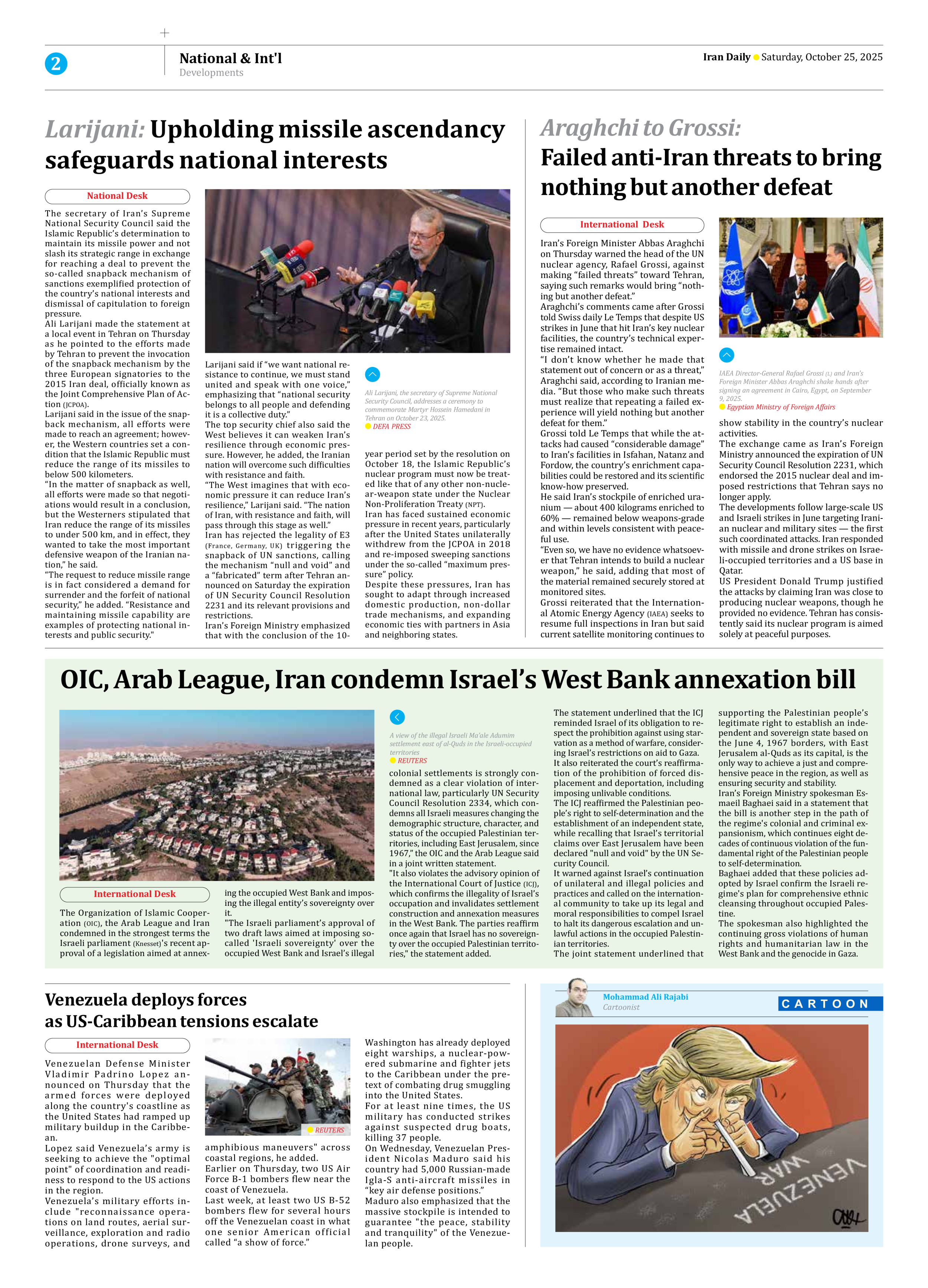


Larijani: Upholding missile ascendancy safeguards national interests
The secretary of Iran’s Supreme National Security Council said the Islamic Republic’s determination to maintain its missile power and not slash its strategic range in exchange for reaching a deal to prevent the so-called snapback mechanism of sanctions exemplified protection of the country’s national interests and dismissal of capitulation to foreign pressure.
Ali Larijani made the statement at a local event in Tehran on Thursday as he pointed to the efforts made by Tehran to prevent the invocation of the snapback mechanism by the three European signatories to the 2015 Iran deal, officially known as the Joint Comprehensive Plan of Action (JCPOA).
Larijani said in the issue of the snapback mechanism, all efforts were made to reach an agreement; however, the Western countries set a condition that the Islamic Republic must reduce the range of its missiles to below 500 kilometers.
“In the matter of snapback as well, all efforts were made so that negotiations would result in a conclusion, but the Westerners stipulated that Iran reduce the range of its missiles to under 500 km, and in effect, they wanted to take the most important defensive weapon of the Iranian nation,” he said.
“The request to reduce missile range is in fact considered a demand for surrender and the forfeit of national security,” he added. “Resistance and maintaining missile capability are examples of protecting national interests and public security."
Larijani said if “we want national resistance to continue, we must stand united and speak with one voice,” emphasizing that “national security belongs to all people and defending it is a collective duty.”
The top security chief also said the West believes it can weaken Iran’s resilience through economic pressure. However, he added, the Iranian nation will overcome such difficulties with resistance and faith.
“The West imagines that with economic pressure it can reduce Iran’s resilience,” Larijani said. “The nation of Iran, with resistance and faith, will pass through this stage as well.”
Iran has rejected the legality of E3 (France, Germany, UK) triggering the snapback of UN sanctions, calling the mechanism “null and void” and a “fabricated” term after Tehran announced on Saturday the expiration of UN Security Council Resolution 2231 and its relevant provisions and restrictions.
Iran’s Foreign Ministry emphasized that with the conclusion of the 10-year period set by the resolution on October 18, the Islamic Republic’s nuclear program must now be treated like that of any other non-nuclear-weapon state under the Nuclear Non-Proliferation Treaty (NPT).
Iran has faced sustained economic pressure in recent years, particularly after the United States unilaterally withdrew from the JCPOA in 2018 and re-imposed sweeping sanctions under the so-called “maximum pressure” policy.
Despite these pressures, Iran has sought to adapt through increased domestic production, non-dollar trade mechanisms, and expanding economic ties with partners in Asia and neighboring states.