







Ancient windmills of Nashtifan face modern threats
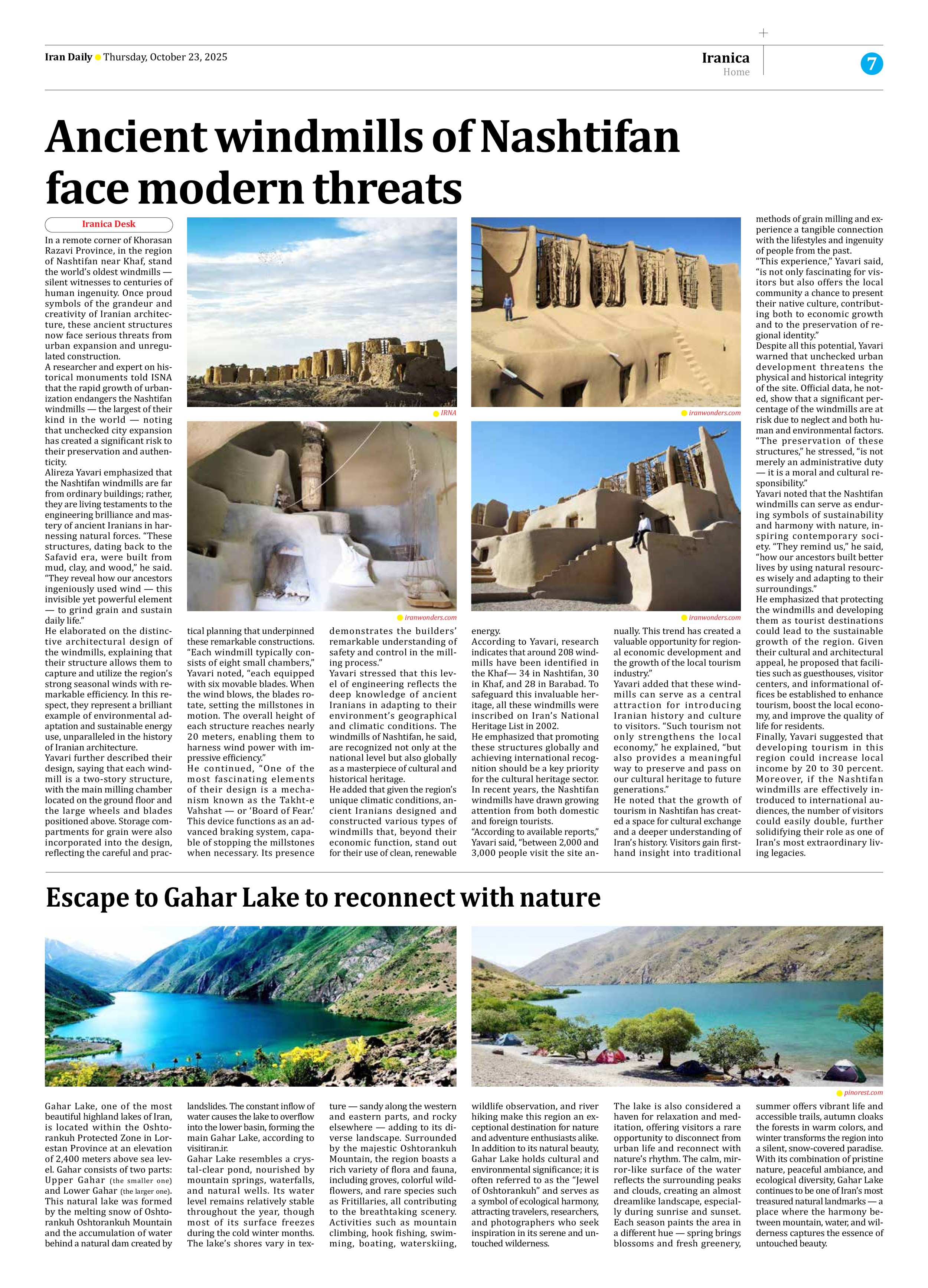
In a remote corner of Khorasan Razavi Province, in the region of Nashtifan near Khaf, stand the world’s oldest windmills — silent witnesses to centuries of human ingenuity. Once proud symbols of the grandeur and creativity of Iranian architecture, these ancient structures now face serious threats from urban expansion and unregulated construction.
A researcher and expert on historical monuments told ISNA that the rapid growth of urbanization endangers the Nashtifan windmills — the largest of their kind in the world — noting that unchecked city expansion has created a significant risk to their preservation and authenticity.
Alireza Yavari emphasized that the Nashtifan windmills are far from ordinary buildings; rather, they are living testaments to the engineering brilliance and mastery of ancient Iranians in harnessing natural forces. “These structures, dating back to the Safavid era, were built from mud, clay, and wood,” he said. “They reveal how our ancestors ingeniously used wind — this invisible yet powerful element — to grind grain and sustain daily life.”
He elaborated on the distinctive architectural design of the windmills, explaining that their structure allows them to capture and utilize the region’s strong seasonal winds with remarkable efficiency. In this respect, they represent a brilliant example of environmental adaptation and sustainable energy use, unparalleled in the history of Iranian architecture.
Yavari further described their design, saying that each windmill is a two-story structure, with the main milling chamber located on the ground floor and the large wheels and blades positioned above. Storage compartments for grain were also incorporated into the design, reflecting the careful and practical planning that underpinned these remarkable constructions.
“Each windmill typically consists of eight small chambers,” Yavari noted, “each equipped with six movable blades. When the wind blows, the blades rotate, setting the millstones in motion. The overall height of each structure reaches nearly 20 meters, enabling them to harness wind power with impressive efficiency.”
He continued, “One of the most fascinating elements of their design is a mechanism known as the Takht-e Vahshat — or ‘Board of Fear.’ This device functions as an advanced braking system, capable of stopping the millstones when necessary. Its presence demonstrates the builders’ remarkable understanding of safety and control in the milling process.”
Yavari stressed that this level of engineering reflects the deep knowledge of ancient Iranians in adapting to their environment’s geographical and climatic conditions. The windmills of Nashtifan, he said, are recognized not only at the national level but also globally as a masterpiece of cultural and historical heritage.
He added that given the region’s unique climatic conditions, ancient Iranians designed and constructed various types of windmills that, beyond their economic function, stand out for their use of clean, renewable energy.
According to Yavari, research indicates that around 208 windmills have been identified in the Khaf— 34 in Nashtifan, 30 in Khaf, and 28 in Barabad. To safeguard this invaluable heritage, all these windmills were inscribed on Iran’s National Heritage List in 2002.
He emphasized that promoting these structures globally and achieving international recognition should be a key priority for the cultural heritage sector. In recent years, the Nashtifan windmills have drawn growing attention from both domestic and foreign tourists.
“According to available reports,” Yavari said, “between 2,000 and 3,000 people visit the site annually. This trend has created a valuable opportunity for regional economic development and the growth of the local tourism industry.”
Yavari added that these windmills can serve as a central attraction for introducing Iranian history and culture to visitors. “Such tourism not only strengthens the local economy,” he explained, “but also provides a meaningful way to preserve and pass on our cultural heritage to future generations.”
He noted that the growth of tourism in Nashtifan has created a space for cultural exchange and a deeper understanding of Iran’s history. Visitors gain first-hand insight into traditional methods of grain milling and experience a tangible connection with the lifestyles and ingenuity of people from the past.
“This experience,” Yavari said, “is not only fascinating for visitors but also offers the local community a chance to present their native culture, contributing both to economic growth and to the preservation of regional identity.”
Despite all this potential, Yavari warned that unchecked urban development threatens the physical and historical integrity of the site. Official data, he noted, show that a significant percentage of the windmills are at risk due to neglect and both human and environmental factors.
“The preservation of these structures,” he stressed, “is not merely an administrative duty — it is a moral and cultural responsibility.”
Yavari noted that the Nashtifan windmills can serve as enduring symbols of sustainability and harmony with nature, inspiring contemporary society. “They remind us,” he said, “how our ancestors built better lives by using natural resources wisely and adapting to their surroundings.”
He emphasized that protecting the windmills and developing them as tourist destinations could lead to the sustainable growth of the region. Given their cultural and architectural appeal, he proposed that facilities such as guesthouses, visitor centers, and informational offices be established to enhance tourism, boost the local economy, and improve the quality of life for residents.
Finally, Yavari suggested that developing tourism in this region could increase local income by 20 to 30 percent. Moreover, if the Nashtifan windmills are effectively introduced to international audiences, the number of visitors could easily double, further solidifying their role as one of Iran’s most extraordinary living legacies.