







Pakistan-Saudi strategic pact to pioneer global south extended nuclear deterrence
By Driss Larafi
Professor of Political Science at Ibn Tofail University
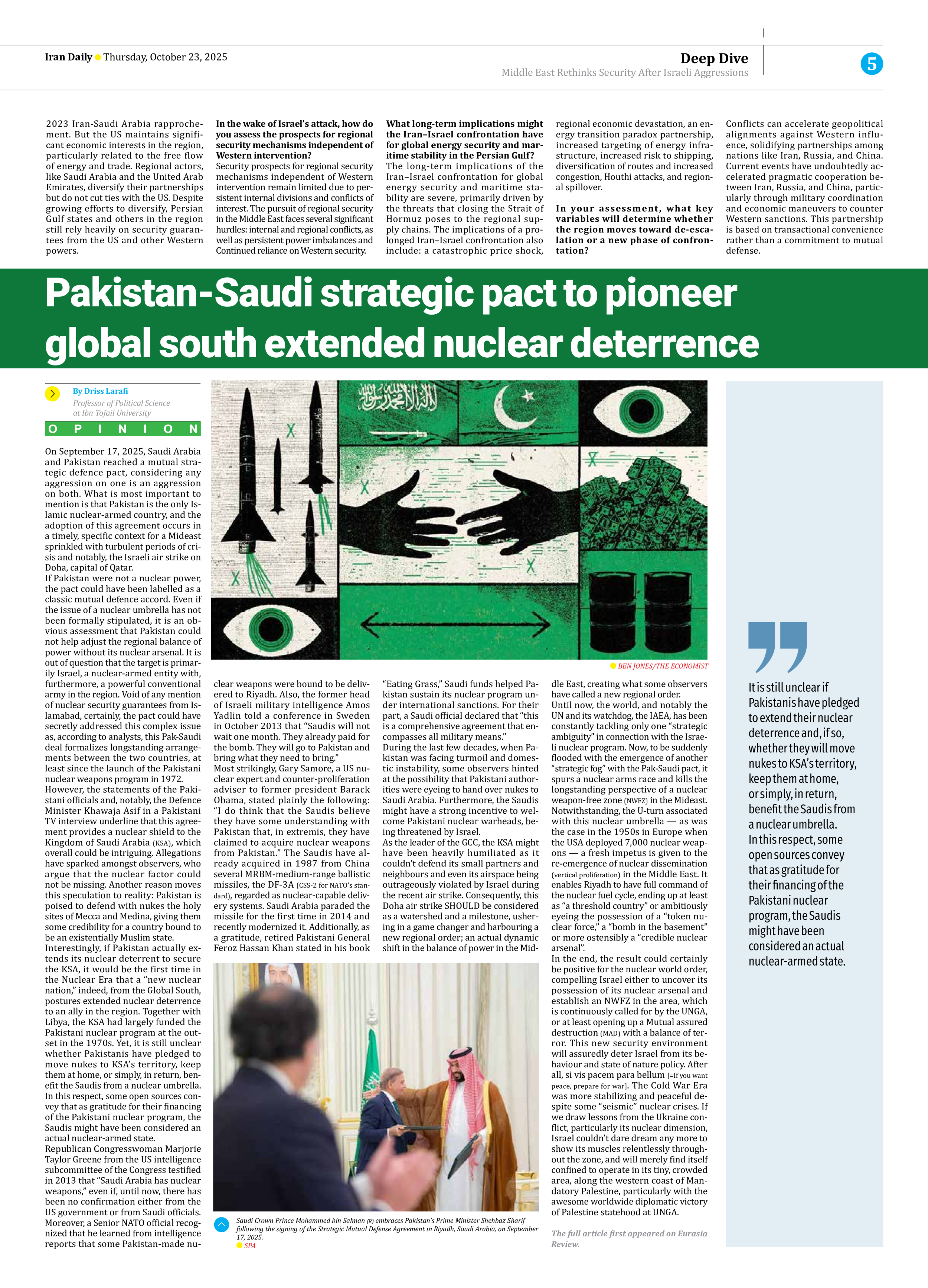
On September 17, 2025, Saudi Arabia and Pakistan reached a mutual strategic defence pact, considering any aggression on one is an aggression on both. What is most important to mention is that Pakistan is the only Islamic nuclear-armed country, and the adoption of this agreement occurs in a timely, specific context for a Mideast sprinkled with turbulent periods of crisis and notably, the Israeli air strike on Doha, capital of Qatar.
If Pakistan were not a nuclear power, the pact could have been labelled as a classic mutual defence accord. Even if the issue of a nuclear umbrella has not been formally stipulated, it is an obvious assessment that Pakistan could not help adjust the regional balance of power without its nuclear arsenal. It is out of question that the target is primarily Israel, a nuclear-armed entity with, furthermore, a powerful conventional army in the region. Void of any mention of nuclear security guarantees from Islamabad, certainly, the pact could have secretly addressed this complex issue as, according to analysts, this Pak-Saudi deal formalizes longstanding arrangements between the two countries, at least since the launch of the Pakistani nuclear weapons program in 1972.
However, the statements of the Pakistani officials and, notably, the Defence Minister Khawaja Asif in a Pakistani TV interview underline that this agreement provides a nuclear shield to the Kingdom of Saudi Arabia (KSA), which overall could be intriguing. Allegations have sparked amongst observers, who argue that the nuclear factor could not be missing. Another reason moves this speculation to reality: Pakistan is poised to defend with nukes the holy sites of Mecca and Medina, giving them some credibility for a country bound to be an existentially Muslim state.
Interestingly, if Pakistan actually extends its nuclear deterrent to secure the KSA, it would be the first time in the Nuclear Era that a “new nuclear nation,” indeed, from the Global South, postures extended nuclear deterrence to an ally in the region. Together with Libya, the KSA had largely funded the Pakistani nuclear program at the outset in the 1970s. Yet, it is still unclear whether Pakistanis have pledged to move nukes to KSA’s territory, keep them at home, or simply, in return, benefit the Saudis from a nuclear umbrella. In this respect, some open sources convey that as gratitude for their financing of the Pakistani nuclear program, the Saudis might have been considered an actual nuclear-armed state.
Republican Congresswoman Marjorie Taylor Greene from the US intelligence subcommittee of the Congress testified in 2013 that “Saudi Arabia has nuclear weapons,” even if, until now, there has been no confirmation either from the US government or from Saudi officials. Moreover, a Senior NATO official recognized that he learned from intelligence reports that some Pakistan-made nuclear weapons were bound to be delivered to Riyadh. Also, the former head of Israeli military intelligence Amos Yadlin told a conference in Sweden in October 2013 that “Saudis will not wait one month. They already paid for the bomb. They will go to Pakistan and bring what they need to bring.”
Most strikingly, Gary Samore, a US nuclear expert and counter-proliferation adviser to former president Barack Obama, stated plainly the following: “I do think that the Saudis believe they have some understanding with Pakistan that, in extremis, they have claimed to acquire nuclear weapons from Pakistan.” The Saudis have already acquired in 1987 from China several MRBM-medium-range ballistic missiles, the DF-3A (CSS-2 for NATO’s standard), regarded as nuclear-capable delivery systems. Saudi Arabia paraded the missile for the first time in 2014 and recently modernized it. Additionally, as a gratitude, retired Pakistani General Feroz Hassan Khan stated in his book “Eating Grass,” Saudi funds helped Pakistan sustain its nuclear program under international sanctions. For their part, a Saudi official declared that “this is a comprehensive agreement that encompasses all military means.”
During the last few decades, when Pakistan was facing turmoil and domestic instability, some observers hinted at the possibility that Pakistani authorities were eyeing to hand over nukes to Saudi Arabia. Furthermore, the Saudis might have a strong incentive to welcome Pakistani nuclear warheads, being threatened by Israel.
As the leader of the GCC, the KSA might have been heavily humiliated as it couldn’t defend its small partners and neighbours and even its airspace being outrageously violated by Israel during the recent air strike. Consequently, this Doha air strike SHOULD be considered as a watershed and a milestone, ushering in a game changer and harbouring a new regional order; an actual dynamic shift in the balance of power in the Middle East, creating what some observers have called a new regional order.
Until now, the world, and notably the UN and its watchdog, the IAEA, has been constantly tackling only one “strategic ambiguity” in connection with the Israeli nuclear program. Now, to be suddenly flooded with the emergence of another “strategic fog” with the Pak-Saudi pact, it spurs a nuclear arms race and kills the longstanding perspective of a nuclear weapon-free zone (NWFZ) in the Mideast. Notwithstanding, the U-turn associated with this nuclear umbrella — as was the case in the 1950s in Europe when the USA deployed 7,000 nuclear weapons — a fresh impetus is given to the re-emergence of nuclear dissemination (vertical proliferation) in the Middle East. It enables Riyadh to have full command of the nuclear fuel cycle, ending up at least as “a threshold country” or ambitiously eyeing the possession of a “token nuclear force,” a “bomb in the basement” or more ostensibly a “credible nuclear arsenal”.
In the end, the result could certainly be positive for the nuclear world order, compelling Israel either to uncover its possession of its nuclear arsenal and establish an NWFZ in the area, which is continuously called for by the UNGA, or at least opening up a Mutual assured destruction (MAD) with a balance of terror. This new security environment will assuredly deter Israel from its behaviour and state of nature policy. After all, si vis pacem para bellum [=If you want peace, prepare for war]. The Cold War Era was more stabilizing and peaceful despite some “seismic” nuclear crises. If we draw lessons from the Ukraine conflict, particularly its nuclear dimension, Israel couldn’t dare dream any more to show its muscles relentlessly throughout the zone, and will merely find itself confined to operate in its tiny, crowded area, along the western coast of Mandatory Palestine, particularly with the awesome worldwide diplomatic victory of Palestine statehood at UNGA.
The full article first appeared on Eurasia Review.