







Shifting sands
How Iran-Israel clashes reshape Mideast security architecture, global geopolitics
Professor Hoda Rizk, a distinguished political sociologist and full professor at the Lebanese University, provided Iran Daily with the following expert analysis, shedding light on the complexities behind recent events in the Middle East, including the intense clashes between Iran and Israel, and their far-reaching implications for regional and global security. Professor Rizk’s nuanced perspective helps us understand not only the immediate consequences of these conflicts but also the underlying shifts in alliances, strategies, and geopolitical calculations across the Middle East. The imposed “12-day war” of June 2025 marked a significant turning point, dramatically reshaping Iran’s deterrence strategy and altering the security architecture that had long defined the region. This conflict overturned established deterrence norms and shattered prior conventions that discouraged open military confrontations, raising the stakes and increasing the likelihood of future escalations. The subsequent missile and drone attacks by Iran, and the US intervention that followed, underscore the fragile balance of power and the volatility of the regional landscape. Professor Rizk also highlights how Israel’s actions have influenced the strategic calculus of regional players like Saudi Arabia and Turkey, as well as extra-regional powers such as the United States. The pause in US-brokered normalization talks between Israel and Saudi Arabia reflects the complex dilemmas faced by Riyadh, caught between security interests and public opinion. Meanwhile, Turkey’s emergence as a key diplomatic actor in Gaza signals shifting regional alignments. These developments, alongside the ongoing instability involving non-state actors like Hezbollah and Ansarullah (the Houthis), illustrate the multi-layered nature of Middle Eastern security challenges. Looking ahead, the broader confrontation between Tehran and Tel Aviv holds significant implications for global energy security and maritime stability, especially regarding the critical Strait of Hormuz. The future trajectory of the region — whether toward de-escalation or intensified conflict — will depend on various factors, including geopolitical realignments, the role of Western powers, and regional cooperation mechanisms. In light of these complexities, Professor Rizk’s insights provide an essential framework for understanding the evolving Middle East, emphasizing the urgency for informed diplomacy and strategic foresight in this pivotal era. We extend our sincere gratitude to Professor Rizk for her invaluable insights into the rapidly evolving security dynamics of the Middle East.
By Asgar Ghahremanpoor
Editor-in-chief
IRAN DAILY: What do the recent clashes between Iran and Israel reveal about the shifting security architecture in the Middle East?
RIZK: The regional security architecture overturned old deterrence norms and exposed new vulnerabilities. The direct exchange shattered the prior convention of avoiding open military confrontation, raising the stakes and making future conflicts more likely.
The 12-day war of June 2025 significantly reshaped Iran’s deterrence strategy and regional posture, particularly concerning Israel and the United States. Iran responded with a large-scale missile and drone attack, prompting US intervention.
To what extent has Israel’s attack altered the calculations of regional and extra-regional actors, including Saudi Arabia, Turkey, and the United States?
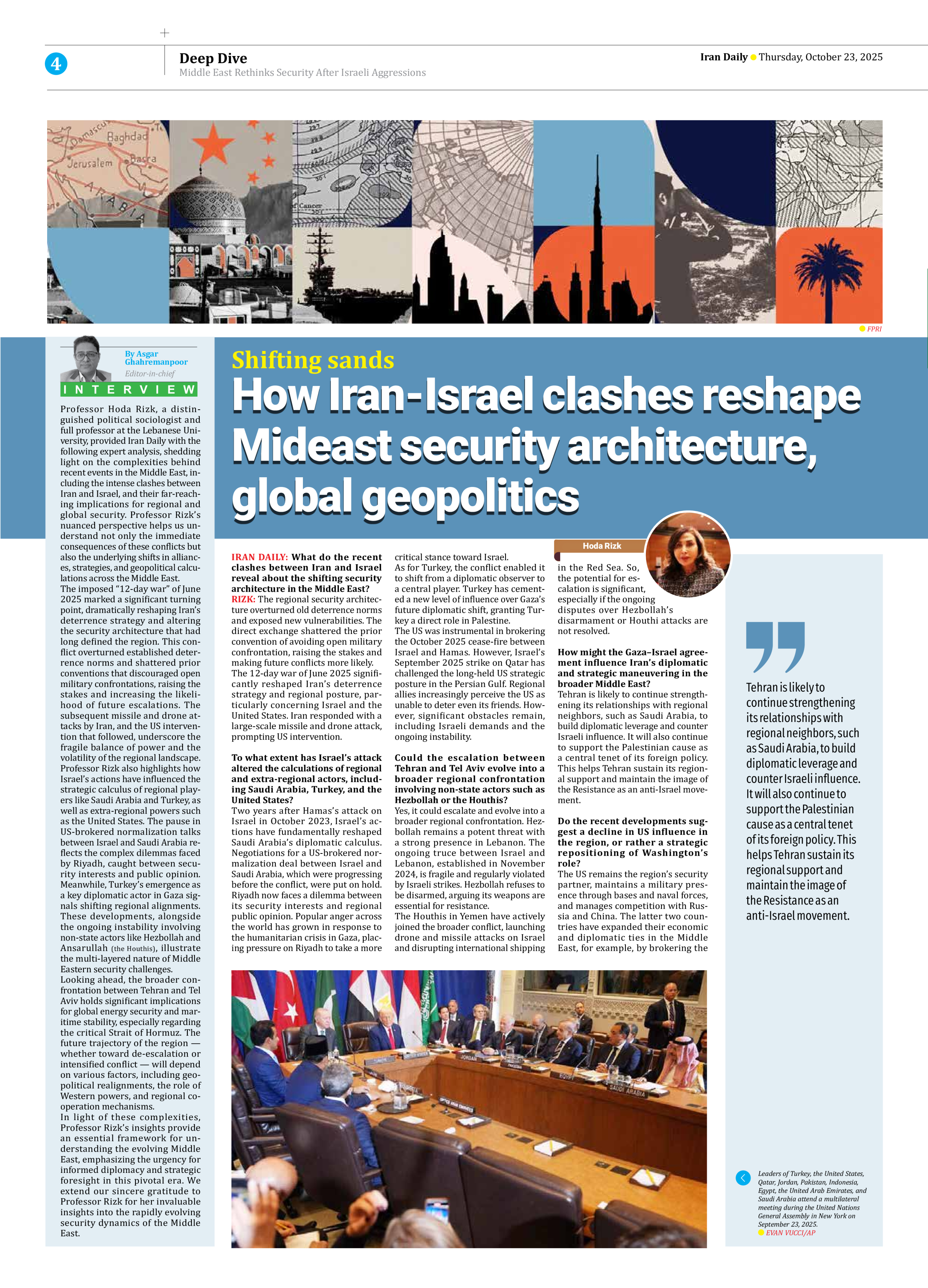
Two years after Hamas’s attack on Israel in October 2023, Israel’s actions have fundamentally reshaped Saudi Arabia’s diplomatic calculus. Negotiations for a US-brokered normalization deal between Israel and Saudi Arabia, which were progressing before the conflict, were put on hold. Riyadh now faces a dilemma between its security interests and regional public opinion. Popular anger across the world has grown in response to the humanitarian crisis in Gaza, placing pressure on Riyadh to take a more critical stance toward Israel.
As for Turkey, the conflict enabled it to shift from a diplomatic observer to a central player. Turkey has cemented a new level of influence over Gaza’s future diplomatic shift, granting Turkey a direct role in Palestine.
The US was instrumental in brokering the October 2025 cease-fire between Israel and Hamas. However, Israel’s September 2025 strike on Qatar has challenged the long-held US strategic posture in the Persian Gulf. Regional allies increasingly perceive the US as unable to deter even its friends. However, significant obstacles remain, including Israeli demands and the ongoing instability.
Could the escalation between Tehran and Tel Aviv evolve into a broader regional confrontation involving non-state actors such as Hezbollah or the Houthis?
Yes, it could escalate and evolve into a broader regional confrontation. Hezbollah remains a potent threat with a strong presence in Lebanon. The ongoing truce between Israel and Lebanon, established in November 2024, is fragile and regularly violated by Israeli strikes. Hezbollah refuses to be disarmed, arguing its weapons are essential for resistance.
The Houthis in Yemen have actively joined the broader conflict, launching drone and missile attacks on Israel and disrupting international shipping in the Red Sea. So, the potential for escalation is significant, especially if the ongoing disputes over Hezbollah’s disarmament or Houthi attacks are not resolved.
How might the Gaza–Israel agreement influence Iran’s diplomatic and strategic maneuvering in the broader Middle East?
Tehran is likely to continue strengthening its relationships with regional neighbors, such as Saudi Arabia, to build diplomatic leverage and counter Israeli influence. It will also continue to support the Palestinian cause as a central tenet of its foreign policy. This helps Tehran sustain its regional support and maintain the image of the Resistance as an anti-Israel movement.
Do the recent developments suggest a decline in US influence in the region, or rather a strategic repositioning of Washington’s role?
The US remains the region’s security partner, maintains a military presence through bases and naval forces, and manages competition with Russia and China. The latter two countries have expanded their economic and diplomatic ties in the Middle East, for example, by brokering the 2023 Iran-Saudi Arabia rapprochement. But the US maintains significant economic interests in the region, particularly related to the free flow of energy and trade. Regional actors, like Saudi Arabia and the United Arab Emirates, diversify their partnerships but do not cut ties with the US. Despite growing efforts to diversify, Persian Gulf states and others in the region still rely heavily on security guarantees from the US and other Western powers.
In the wake of Israel’s attack, how do you assess the prospects for regional security mechanisms independent of Western intervention?
Security prospects for regional security mechanisms independent of Western intervention remain limited due to persistent internal divisions and conflicts of interest. The pursuit of regional security in the Middle East faces several significant hurdles: internal and regional conflicts, as well as persistent power imbalances and Continued reliance on Western security.
What long-term implications might the Iran–Israel confrontation have for global energy security and maritime stability in the Persian Gulf?
The long-term implications of the Iran–Israel confrontation for global energy security and maritime stability are severe, primarily driven by the threats that closing the Strait of Hormuz poses to the regional supply chains. The implications of a prolonged Iran–Israel confrontation also include: a catastrophic price shock, regional economic devastation, an energy transition paradox partnership, increased targeting of energy infrastructure, increased risk to shipping, diversification of routes and increased congestion, Houthi attacks, and regional spillover.
In your assessment, what key variables will determine whether the region moves toward de-escalation or a new phase of confrontation?
Conflicts can accelerate geopolitical alignments against Western influence, solidifying partnerships among nations like Iran, Russia, and China. Current events have undoubtedly accelerated pragmatic cooperation between Iran, Russia, and China, particularly through military coordination and economic maneuvers to counter Western sanctions. This partnership is based on transactional convenience rather than a commitment to mutual defense.