





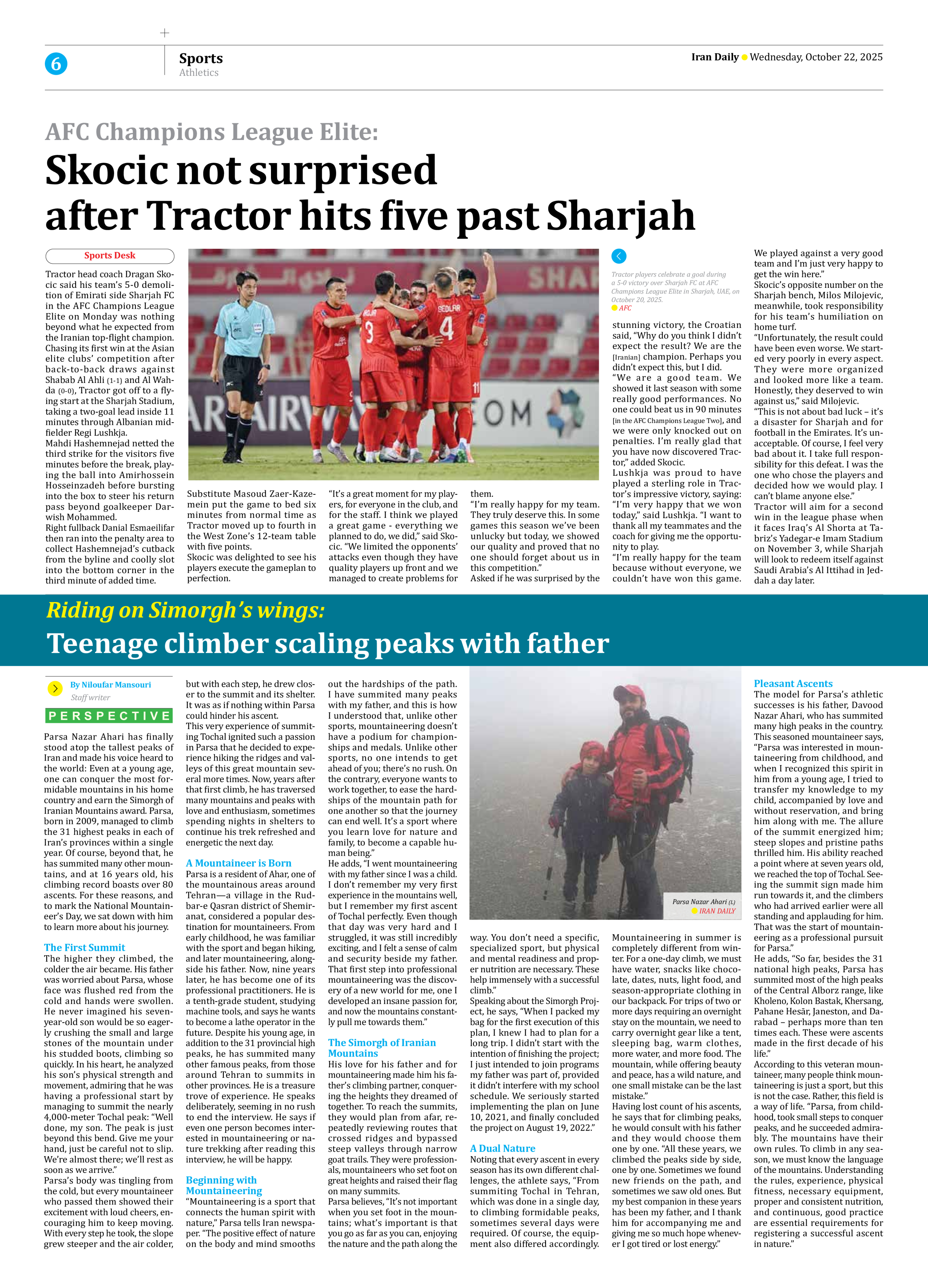


Riding on Simorgh’s wings: Teenage climber scaling peaks with father
By Niloufar Mansouri
Staff writer
Parsa Nazar Ahari has finally stood atop the tallest peaks of Iran and made his voice heard to the world: Even at a young age, one can conquer the most formidable mountains in his home country and earn the Simorgh of Iranian Mountains award. Parsa, born in 2009, managed to climb the 31 highest peaks in each of Iran’s provinces within a single year. Of course, beyond that, he has summited many other mountains, and at 16 years old, his climbing record boasts over 80 ascents. For these reasons, and to mark the National Mountaineer’s Day, we sat down with him to learn more about his journey.
The First Summit
The higher they climbed, the colder the air became. His father was worried about Parsa, whose face was flushed red from the cold and hands were swollen. He never imagined his seven-year-old son would be so eagerly crushing the small and large stones of the mountain under his studded boots, climbing so quickly. In his heart, he analyzed his son’s physical strength and movement, admiring that he was having a professional start by managing to summit the nearly 4,000-meter Tochal peak: “Well done, my son. The peak is just beyond this bend. Give me your hand, just be careful not to slip. We’re almost there; we’ll rest as soon as we arrive.”
Parsa’s body was tingling from the cold, but every mountaineer who passed them showed their excitement with loud cheers, encouraging him to keep moving. With every step he took, the slope grew steeper and the air colder, but with each step, he drew closer to the summit and its shelter. It was as if nothing within Parsa could hinder his ascent.
This very experience of summiting Tochal ignited such a passion in Parsa that he decided to experience hiking the ridges and valleys of this great mountain several more times. Now, years after that first climb, he has traversed many mountains and peaks with love and enthusiasm, sometimes spending nights in shelters to continue his trek refreshed and energetic the next day.
A Mountaineer is Born
Parsa is a resident of Ahar, one of the mountainous areas around Tehran—a village in the Rudbar-e Qasran district of Shemiranat, considered a popular destination for mountaineers. From early childhood, he was familiar with the sport and began hiking, and later mountaineering, alongside his father. Now, nine years later, he has become one of its professional practitioners. He is a tenth-grade student, studying machine tools, and says he wants to become a lathe operator in the future. Despite his young age, in addition to the 31 provincial high peaks, he has summited many other famous peaks, from those around Tehran to summits in other provinces. He is a treasure trove of experience. He speaks deliberately, seeming in no rush to end the interview. He says if even one person becomes interested in mountaineering or nature trekking after reading this interview, he will be happy.
Beginning with Mountaineering
“Mountaineering is a sport that connects the human spirit with nature,” Parsa tells Iran newspaper. “The positive effect of nature on the body and mind smooths out the hardships of the path. I have summited many peaks with my father, and this is how I understood that, unlike other sports, mountaineering doesn’t have a podium for championships and medals. Unlike other sports, no one intends to get ahead of you; there’s no rush. On the contrary, everyone wants to work together, to ease the hardships of the mountain path for one another so that the journey can end well. It’s a sport where you learn love for nature and family, to become a capable human being.”
He adds, “I went mountaineering with my father since I was a child. I don’t remember my very first experience in the mountains well, but I remember my first ascent of Tochal perfectly. Even though that day was very hard and I struggled, it was still incredibly exciting, and I felt a sense of calm and security beside my father. That first step into professional mountaineering was the discovery of a new world for me, one I developed an insane passion for, and now the mountains constantly pull me towards them.”
The Simorgh of Iranian Mountains
His love for his father and for mountaineering made him his father’s climbing partner, conquering the heights they dreamed of together. To reach the summits, they would plan from afar, repeatedly reviewing routes that crossed ridges and bypassed steep valleys through narrow goat trails. They were professionals, mountaineers who set foot on great heights and raised their flag on many summits.
Parsa believes, “It’s not important when you set foot in the mountains; what’s important is that you go as far as you can, enjoying the nature and the path along the way. You don’t need a specific, specialized sport, but physical and mental readiness and proper nutrition are necessary. These help immensely with a successful climb.”
Speaking about the Simorgh Project, he says, “When I packed my bag for the first execution of this plan, I knew I had to plan for a long trip. I didn’t start with the intention of finishing the project; I just intended to join programs my father was part of, provided it didn’t interfere with my school schedule. We seriously started implementing the plan on June 10, 2021, and finally concluded the project on August 19, 2022.”
A Dual Nature
Noting that every ascent in every season has its own different challenges, the athlete says, “From summiting Tochal in Tehran, which was done in a single day, to climbing formidable peaks, sometimes several days were required. Of course, the equipment also differed accordingly. Mountaineering in summer is completely different from winter. For a one-day climb, we must have water, snacks like chocolate, dates, nuts, light food, and season-appropriate clothing in our backpack. For trips of two or more days requiring an overnight stay on the mountain, we need to carry overnight gear like a tent, sleeping bag, warm clothes, more water, and more food. The mountain, while offering beauty and peace, has a wild nature, and one small mistake can be the last mistake.”
Having lost count of his ascents, he says that for climbing peaks, he would consult with his father and they would choose them one by one. “All these years, we climbed the peaks side by side, one by one. Sometimes we found new friends on the path, and sometimes we saw old ones. But my best companion in these years has been my father, and I thank him for accompanying me and giving me so much hope whenever I got tired or lost energy.”
Pleasant Ascents
The model for Parsa’s athletic successes is his father, Davood Nazar Ahari, who has summited many high peaks in the country. This seasoned mountaineer says, “Parsa was interested in mountaineering from childhood, and when I recognized this spirit in him from a young age, I tried to transfer my knowledge to my child, accompanied by love and without reservation, and bring him along with me. The allure of the summit energized him; steep slopes and pristine paths thrilled him. His ability reached a point where at seven years old, we reached the top of Tochal. Seeing the summit sign made him run towards it, and the climbers who had arrived earlier were all standing and applauding for him. That was the start of mountaineering as a professional pursuit for Parsa.”
He adds, “So far, besides the 31 national high peaks, Parsa has summited most of the high peaks of the Central Alborz range, like Kholeno, Kolon Bastak, Khersang, Pahane Hesār, Janeston, and Darabad – perhaps more than ten times each. These were ascents made in the first decade of his life.”
According to this veteran mountaineer, many people think mountaineering is just a sport, but this is not the case. Rather, this field is a way of life. “Parsa, from childhood, took small steps to conquer peaks, and he succeeded admirably. The mountains have their own rules. To climb in any season, we must know the language of the mountains. Understanding the rules, experience, physical fitness, necessary equipment, proper and consistent nutrition, and continuous, good practice are essential requirements for registering a successful ascent in nature.”