





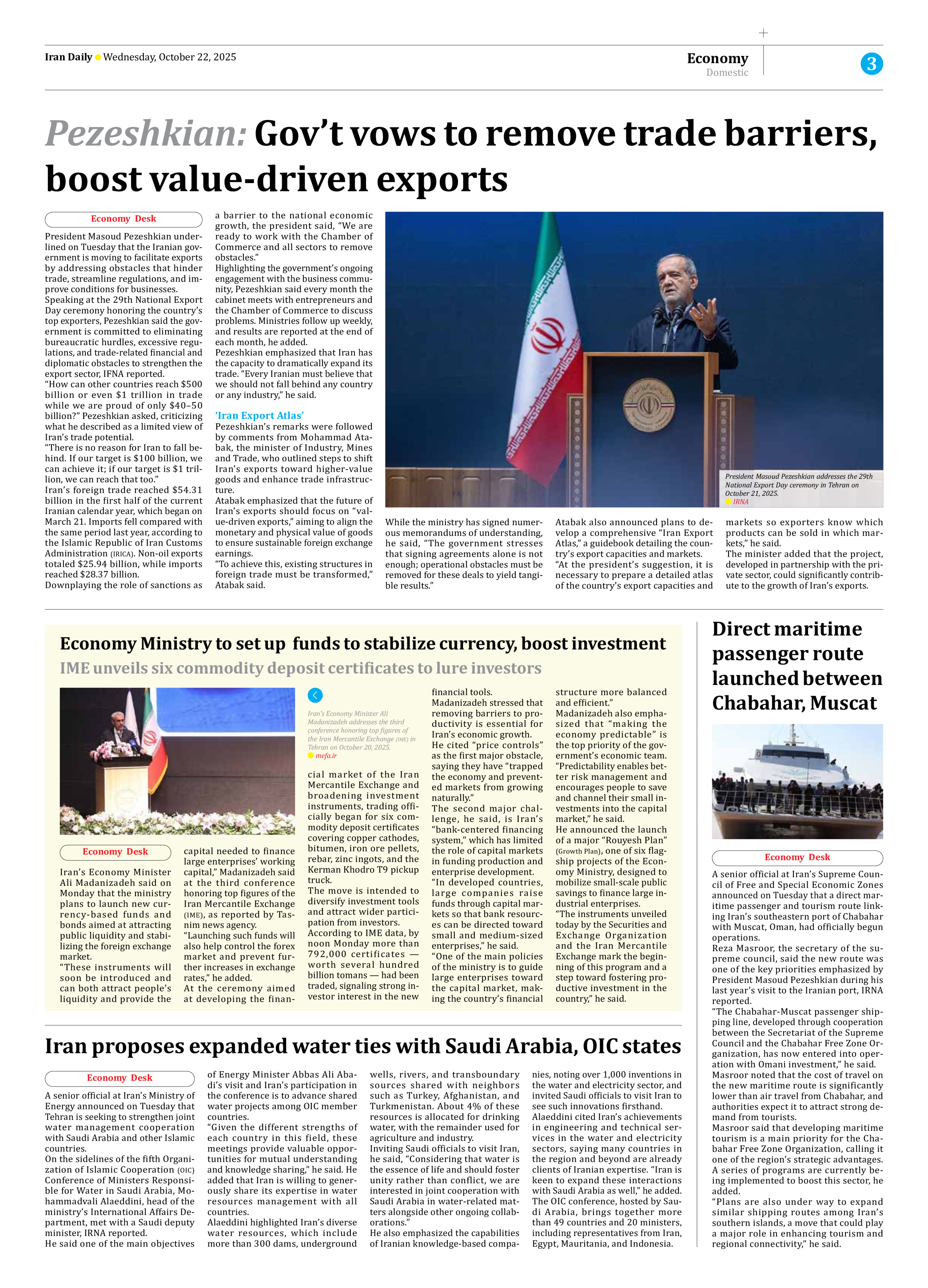


Pezeshkian: Gov’t vows to remove trade barriers, boost value-driven exports
President Masoud Pezeshkian underlined on Tuesday that the Iranian government is moving to facilitate exports by addressing obstacles that hinder trade, streamline regulations, and improve conditions for businesses.
Speaking at the 29th National Export Day ceremony honoring the country’s top exporters, Pezeshkian said the government is committed to eliminating bureaucratic hurdles, excessive regulations, and trade-related financial and diplomatic obstacles to strengthen the export sector, IFNA reported.
“How can other countries reach $500 billion or even $1 trillion in trade while we are proud of only $40–50 billion?” Pezeshkian asked, criticizing what he described as a limited view of Iran’s trade potential.
“There is no reason for Iran to fall behind. If our target is $100 billion, we can achieve it; if our target is $1 trillion, we can reach that too.”
Iran’s foreign trade reached $54.31 billion in the first half of the current Iranian calendar year, which began on March 21. Imports fell compared with the same period last year, according to the Islamic Republic of Iran Customs Administration (IRICA). Non-oil exports totaled $25.94 billion, while imports reached $28.37 billion.
Downplaying the role of sanctions as a barrier to the national economic growth, the president said, “We are ready to work with the Chamber of Commerce and all sectors to remove obstacles.”
Highlighting the government’s ongoing engagement with the business community, Pezeshkian said every month the cabinet meets with entrepreneurs and the Chamber of Commerce to discuss problems. Ministries follow up weekly, and results are reported at the end of each month, he added.
Pezeshkian emphasized that Iran has the capacity to dramatically expand its trade. “Every Iranian must believe that we should not fall behind any country or any industry,” he said.
‘Iran Export Atlas’
Pezeshkian’s remarks were followed by comments from Mohammad Atabak, the minister of Industry, Mines and Trade, who outlined steps to shift Iran’s exports toward higher-value goods and enhance trade infrastructure.
Atabak emphasized that the future of Iran’s exports should focus on “value-driven exports,” aiming to align the monetary and physical value of goods to ensure sustainable foreign exchange earnings.
“To achieve this, existing structures in foreign trade must be transformed,” Atabak said.
While the ministry has signed numerous memorandums of understanding, he said, “The government stresses that signing agreements alone is not enough; operational obstacles must be removed for these deals to yield tangible results.”
Atabak also announced plans to develop a comprehensive “Iran Export Atlas,” a guidebook detailing the country’s export capacities and markets.
“At the president’s suggestion, it is necessary to prepare a detailed atlas of the country’s export capacities and markets so exporters know which products can be sold in which markets,” he said.
The minister added that the project, developed in partnership with the private sector, could significantly contribute to the growth of Iran’s exports.