





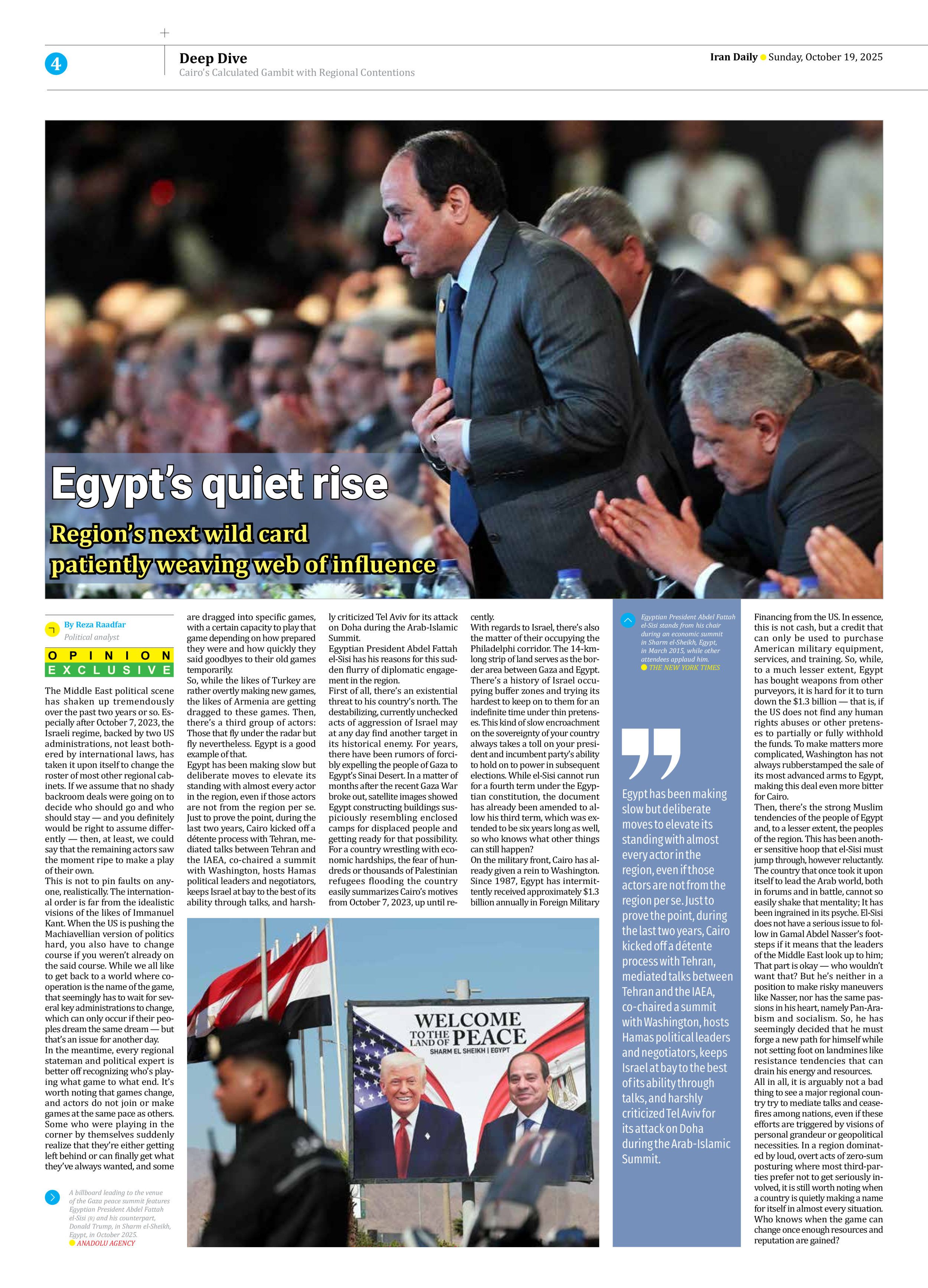


Egypt’s quiet rise
Region’s next wild card patiently weaving web of influence
By Reza Raadfar
Political analyst
The Middle East political scene has shaken up tremendously over the past two years or so. Especially after October 7, 2023, the Israeli regime, backed by two US administrations, not least bothered by international laws, has taken it upon itself to change the roster of most other regional cabinets. If we assume that no shady backroom deals were going on to decide who should go and who should stay — and you definitely would be right to assume differently — then, at least, we could say that the remaining actors saw the moment ripe to make a play of their own.
This is not to pin faults on anyone, realistically. The international order is far from the idealistic visions of the likes of Immanuel Kant. When the US is pushing the Machiavellian version of politics hard, you also have to change course if you weren’t already on the said course. While we all like to get back to a world where cooperation is the name of the game, that seemingly has to wait for several key administrations to change, which can only occur if their peoples dream the same dream — but that’s an issue for another day.
In the meantime, every regional stateman and political expert is better off recognizing who’s playing what game to what end. It’s worth noting that games change, and actors do not join or make games at the same pace as others. Some who were playing in the corner by themselves suddenly realize that they’re either getting left behind or can finally get what they’ve always wanted, and some are dragged into specific games, with a certain capacity to play that game depending on how prepared they were and how quickly they said goodbyes to their old games temporarily.
So, while the likes of Turkey are rather overtly making new games, the likes of Armenia are getting dragged to these games. Then, there’s a third group of actors: Those that fly under the radar but fly nevertheless. Egypt is a good example of that.
Egypt has been making slow but deliberate moves to elevate its standing with almost every actor in the region, even if those actors are not from the region per se. Just to prove the point, during the last two years, Cairo kicked off a détente process with Tehran, mediated talks between Tehran and the IAEA, co-chaired a summit with Washington, hosts Hamas political leaders and negotiators, keeps Israel at bay to the best of its ability through talks, and harshly criticized Tel Aviv for its attack on Doha during the Arab-Islamic Summit.
Egyptian President Abdel Fattah el-Sisi has his reasons for this sudden flurry of diplomatic engagement in the region.
First of all, there’s an existential threat to his country’s north. The destabilizing, currently unchecked acts of aggression of Israel may at any day find another target in its historical enemy. For years, there have been rumors of forcibly expelling the people of Gaza to Egypt’s Sinai Desert. In a matter of months after the recent Gaza War broke out, satellite images showed Egypt constructing buildings suspiciously resembling enclosed camps for displaced people and getting ready for that possibility. For a country wrestling with economic hardships, the fear of hundreds or thousands of Palestinian refugees flooding the country easily summarizes Cairo’s motives from October 7, 2023, up until recently.
With regards to Israel, there’s also the matter of their occupying the Philadelphi corridor. The 14-km-long strip of land serves as the border area between Gaza and Egypt. There’s a history of Israel occupying buffer zones and trying its hardest to keep on to them for an indefinite time under thin pretenses. This kind of slow encroachment on the sovereignty of your country always takes a toll on your president and incumbent party’s ability to hold on to power in subsequent elections. While el-Sisi cannot run for a fourth term under the Egyptian constitution, the document has already been amended to allow his third term, which was extended to be six years long as well, so who knows what other things can still happen?
On the military front, Cairo has already given a rein to Washington. Since 1987, Egypt has intermittently received approximately $1.3 billion annually in Foreign Military Financing from the US. In essence, this is not cash, but a credit that can only be used to purchase American military equipment, services, and training. So, while, to a much lesser extent, Egypt has bought weapons from other purveyors, it is hard for it to turn down the $1.3 billion — that is, if the US does not find any human rights abuses or other pretenses to partially or fully withhold the funds. To make matters more complicated, Washington has not always rubberstamped the sale of its most advanced arms to Egypt, making this deal even more bitter for Cairo.
Then, there’s the strong Muslim tendencies of the people of Egypt and, to a lesser extent, the peoples of the region. This has been another sensitive hoop that el-Sisi must jump through, however reluctantly. The country that once took it upon itself to lead the Arab world, both in forums and in battle, cannot so easily shake that mentality; It has been ingrained in its psyche. El-Sisi does not have a serious issue to follow in Gamal Abdel Nasser’s footsteps if it means that the leaders of the Middle East look up to him; That part is okay — who wouldn’t want that? But he’s neither in a position to make risky maneuvers like Nasser, nor has the same passions in his heart, namely Pan-Arabism and socialism. So, he has seemingly decided that he must forge a new path for himself while not setting foot on landmines like resistance tendencies that can drain his energy and resources.
All in all, it is arguably not a bad thing to see a major regional country try to mediate talks and cease-fires among nations, even if these efforts are triggered by visions of personal grandeur or geopolitical necessities. In a region dominated by loud, overt acts of zero-sum posturing where most third-parties prefer not to get seriously involved, it is still worth noting when a country is quietly making a name for itself in almost every situation. Who knows when the game can change once enough resources and reputation are gained?