







Farshchian Museum turns 23
Sacred toil of miniature art
By Saeideh Ehsani Rad
Staff writer
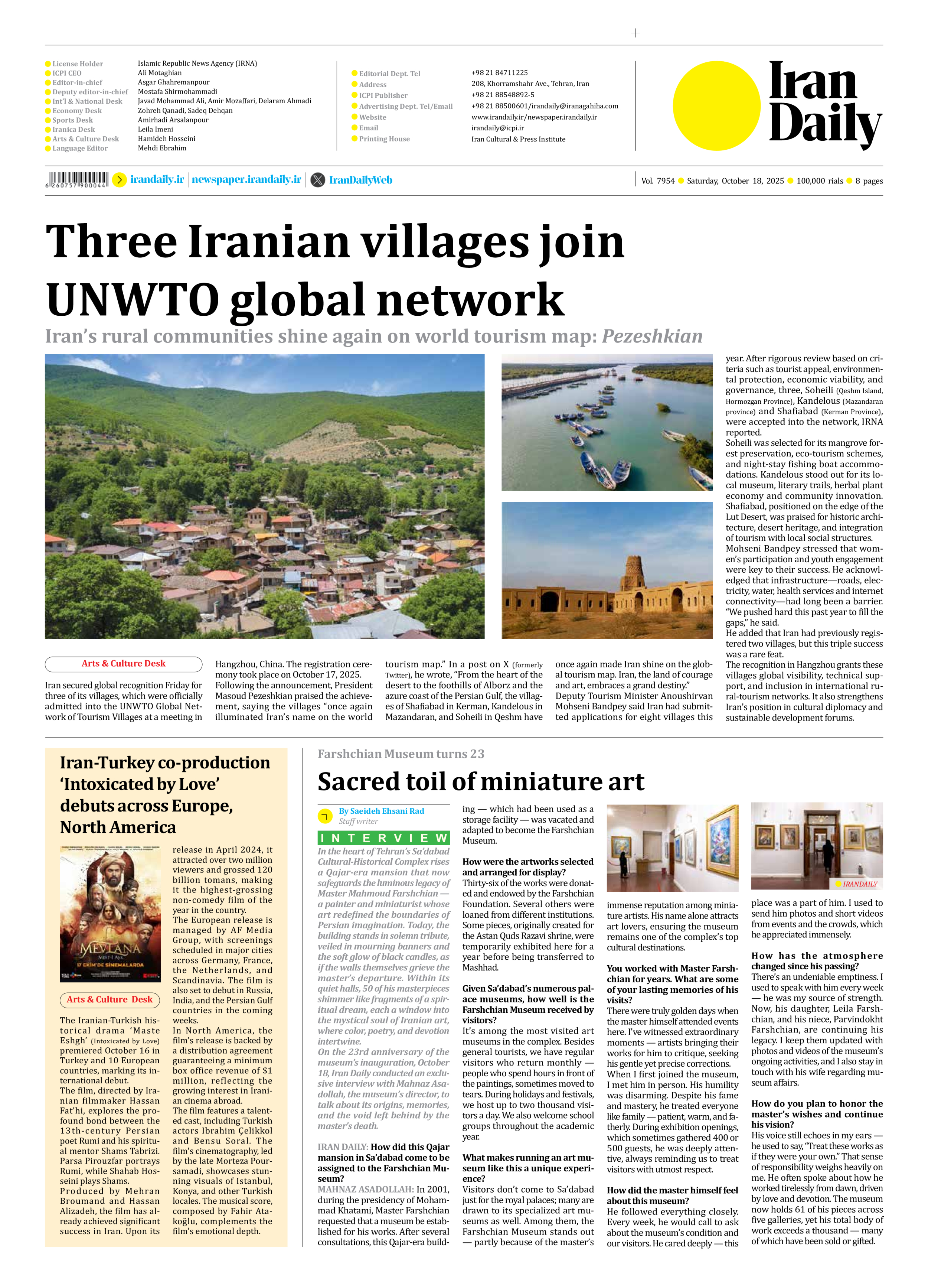
In the heart of Tehran’s Sa’dabad Cultural-Historical Complex rises a Qajar-era mansion that now safeguards the luminous legacy of Master Mahmoud Farshchian — a painter and miniaturist whose art redefined the boundaries of Persian imagination. Today, the building stands in solemn tribute, veiled in mourning banners and the soft glow of black candles, as if the walls themselves grieve the master’s departure. Within its quiet halls, 50 of his masterpieces shimmer like fragments of a spiritual dream, each a window into the mystical soul of Iranian art, where color, poetry, and devotion intertwine.
On the 23rd anniversary of the museum’s inauguration, October 18, Iran Daily conducted an exclusive interview with Mahnaz Asadollah, the museum’s director, to talk about its origins, memories, and the void left behind by the master’s death.
IRAN DAILY: How did this Qajar mansion in Sa’dabad come to be assigned to the Farshchian Museum?
MAHNAZ ASADOLLAH: In 2001, during the presidency of Mohammad Khatami, Master Farshchian requested that a museum be established for his works. After several consultations, this Qajar-era building — which had been used as a storage facility — was vacated and adapted to become the Farshchian Museum.
How were the artworks selected and arranged for display?
Thirty-six of the works were donated and endowed by the Farshchian Foundation. Several others were loaned from different institutions. Some pieces, originally created for the Astan Quds Razavi shrine, were temporarily exhibited here for a year before being transferred to Mashhad.
Given Sa’dabad’s numerous palace museums, how well is the Farshchian Museum received by visitors?
It’s among the most visited art museums in the complex. Besides general tourists, we have regular visitors who return monthly — people who spend hours in front of the paintings, sometimes moved to tears. During holidays and festivals, we host up to two thousand visitors a day. We also welcome school groups throughout the academic year.
What makes running an art museum like this a unique experience?
Visitors don’t come to Sa’dabad just for the royal palaces; many are drawn to its specialized art museums as well. Among them, the Farshchian Museum stands out — partly because of the master’s immense reputation among miniature artists. His name alone attracts art lovers, ensuring the museum remains one of the complex’s top cultural destinations.
You worked with Master Farshchian for years. What are some of your lasting memories of his visits?
There were truly golden days when the master himself attended events here. I’ve witnessed extraordinary moments — artists bringing their works for him to critique, seeking his gentle yet precise corrections.
When I first joined the museum, I met him in person. His humility was disarming. Despite his fame and mastery, he treated everyone like family — patient, warm, and fatherly. During exhibition openings, which sometimes gathered 400 or 500 guests, he was deeply attentive, always reminding us to treat visitors with utmost respect.
How did the master himself feel about this museum?
He followed everything closely. Every week, he would call to ask about the museum’s condition and our visitors. He cared deeply — this place was a part of him. I used to send him photos and short videos from events and the crowds, which he appreciated immensely.
How has the atmosphere changed since his passing?
There’s an undeniable emptiness. I used to speak with him every week — he was my source of strength. Now, his daughter, Leila Farshchian, and his niece, Parvindokht Farshchian, are continuing his legacy. I keep them updated with photos and videos of the museum’s ongoing activities, and I also stay in touch with his wife regarding museum affairs.
How do you plan to honor the master’s wishes and continue his vision?
His voice still echoes in my ears — he used to say, “Treat these works as if they were your own.” That sense of responsibility weighs heavily on me. He often spoke about how he worked tirelessly from dawn, driven by love and devotion. The museum now holds 61 of his pieces across five galleries, yet his total body of work exceeds a thousand — many of which have been sold or gifted.