







Copy in clipboard...
Russia: JCPOA to ‘pass into history’ as Resolution 2231 expires
Remaining UN restrictions on Iran will ‘formally expire on Oct. 18’
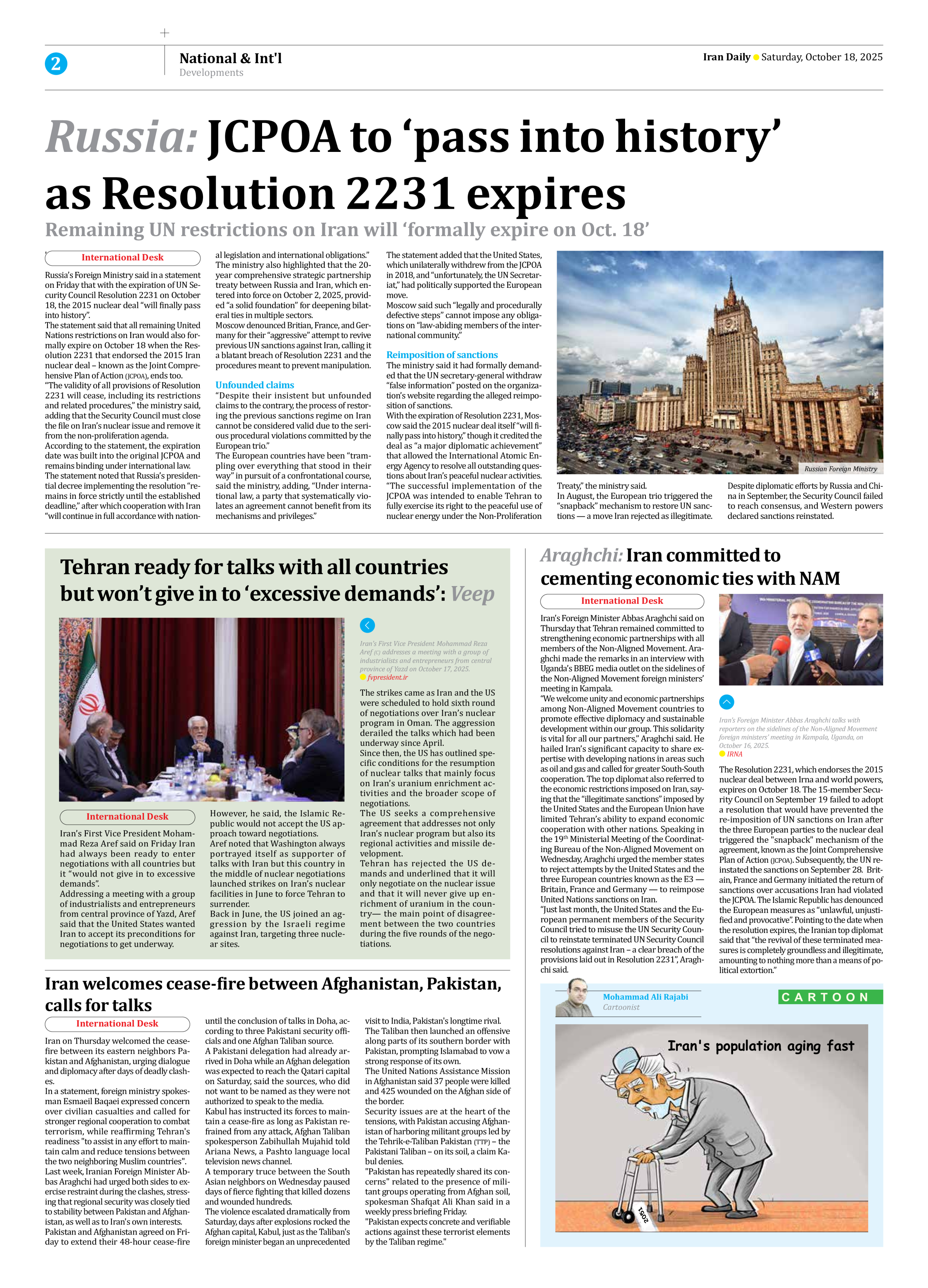
Russia’s Foreign Ministry said in a statement on Friday that with the expiration of UN Security Council Resolution 2231 on October 18, the 2015 nuclear deal “will finally pass into history”.
The statement said that all remaining United Nations restrictions on Iran would also formally expire on October 18 when the Resolution 2231 that endorsed the 2015 Iran nuclear deal – known as the Joint Comprehensive Plan of Action (JCPOA), ends too.
“The validity of all provisions of Resolution 2231 will cease, including its restrictions and related procedures,” the ministry said, adding that the Security Council must close the file on Iran’s nuclear issue and remove it from the non-proliferation agenda.
According to the statement, the expiration date was built into the original JCPOA and remains binding under international law.
The statement noted that Russia’s presidential decree implementing the resolution “remains in force strictly until the established deadline,” after which cooperation with Iran “will continue in full accordance with national legislation and international obligations.”
The ministry also highlighted that the 20-year comprehensive strategic partnership treaty between Russia and Iran, which entered into force on October 2, 2025, provided “a solid foundation” for deepening bilateral ties in multiple sectors.
Moscow denounced Britian, France, and Germany for their “aggressive” attempt to revive previous UN sanctions against Iran, calling it a blatant breach of Resolution 2231 and the procedures meant to prevent manipulation.
Unfounded claims
“Despite their insistent but unfounded claims to the contrary, the process of restoring the previous sanctions regime on Iran cannot be considered valid due to the serious procedural violations committed by the European trio.”
The European countries have been “trampling over everything that stood in their way” in pursuit of a confrontational course, said the ministry, adding, “Under international law, a party that systematically violates an agreement cannot benefit from its mechanisms and privileges.”
The statement added that the United States, which unilaterally withdrew from the JCPOA in 2018, and “unfortunately, the UN Secretariat,” had politically supported the European move.
Moscow said such “legally and procedurally defective steps” cannot impose any obligations on “law-abiding members of the international community.”
Reimposition of sanctions
The ministry said it had formally demanded that the UN secretary-general withdraw “false information” posted on the organization’s website regarding the alleged reimposition of sanctions.
With the expiration of Resolution 2231, Moscow said the 2015 nuclear deal itself “will finally pass into history,” though it credited the deal as “a major diplomatic achievement” that allowed the International Atomic Energy Agency to resolve all outstanding questions about Iran’s peaceful nuclear activities.
“The successful implementation of the JCPOA was intended to enable Tehran to fully exercise its right to the peaceful use of nuclear energy under the Non-Proliferation Treaty,” the ministry said.
In August, the European trio triggered the “snapback” mechanism to restore UN sanctions — a move Iran rejected as illegitimate.
Despite diplomatic efforts by Russia and China in September, the Security Council failed to reach consensus, and Western powers declared sanctions reinstated.