







Copy in clipboard...
Nasser Taghvai leaves his story in every frame
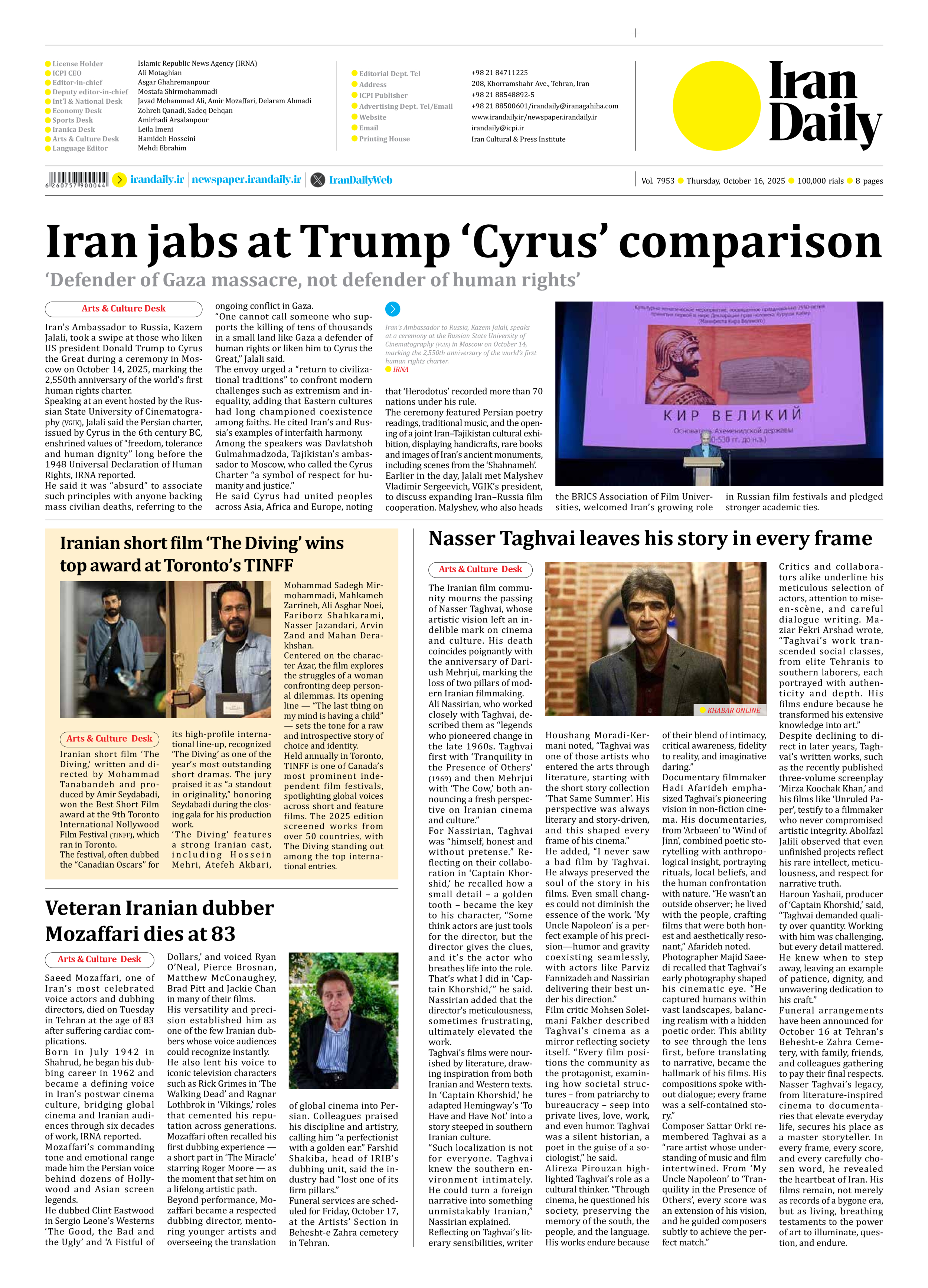
The Iranian film community mourns the passing of Nasser Taghvai, whose artistic vision left an indelible mark on cinema and culture. His death coincides poignantly with the anniversary of Dariush Mehrjui, marking the loss of two pillars of modern Iranian filmmaking.
Ali Nassirian, who worked closely with Taghvai, described them as “legends who pioneered change in the late 1960s. Taghvai first with ‘Tranquility in the Presence of Others’ (1969) and then Mehrjui with ‘The Cow,’ both announcing a fresh perspective on Iranian cinema and culture.”
For Nassirian, Taghvai was “himself, honest and without pretense.” Reflecting on their collaboration in ‘Captain Khorshid,’ he recalled how a small detail – a golden tooth – became the key to his character, “Some think actors are just tools for the director, but the director gives the clues, and it’s the actor who breathes life into the role. That’s what I did in ‘Captain Khorshid,’” he said. Nassirian added that the director’s meticulousness, sometimes frustrating, ultimately elevated the work.
Taghvai’s films were nourished by literature, drawing inspiration from both Iranian and Western texts. In ‘Captain Khorshid,’ he adapted Hemingway’s ‘To Have and Have Not’ into a story steeped in southern Iranian culture.
“Such localization is not for everyone. Taghvai knew the southern environment intimately. He could turn a foreign narrative into something unmistakably Iranian,” Nassirian explained.
Reflecting on Taghvai’s literary sensibilities, writer Houshang Moradi-Kermani noted, “Taghvai was one of those artists who entered the arts through literature, starting with the short story collection ‘That Same Summer’. His perspective was always literary and story-driven, and this shaped every frame of his cinema.”
He added, “I never saw a bad film by Taghvai. He always preserved the soul of the story in his films. Even small changes could not diminish the essence of the work. ‘My Uncle Napoleon’ is a perfect example of his precision—humor and gravity coexisting seamlessly, with actors like Parviz Fannizadeh and Nassirian delivering their best under his direction.”
Film critic Mohsen Soleimani Fakher described Taghvai’s cinema as a mirror reflecting society itself. “Every film positions the community as the protagonist, examining how societal structures – from patriarchy to bureaucracy – seep into private lives, love, work, and even humor. Taghvai was a silent historian, a poet in the guise of a sociologist,” he said.
Alireza Pirouzan highlighted Taghvai’s role as a cultural thinker. “Through cinema, he questioned his society, preserving the memory of the south, the people, and the language. His works endure because of their blend of intimacy, critical awareness, fidelity to reality, and imaginative daring.”
Documentary filmmaker Hadi Afarideh emphasized Taghvai’s pioneering vision in non-fiction cinema. His documentaries, from ‘Arbaeen’ to ‘Wind of Jinn’, combined poetic storytelling with anthropological insight, portraying rituals, local beliefs, and the human confrontation with nature. “He wasn’t an outside observer; he lived with the people, crafting films that were both honest and aesthetically resonant,” Afarideh noted.
Photographer Majid Saeedi recalled that Taghvai’s early photography shaped his cinematic eye. “He captured humans within vast landscapes, balancing realism with a hidden poetic order. This ability to see through the lens first, before translating to narrative, became the hallmark of his films. His compositions spoke without dialogue; every frame was a self-contained story.”
Composer Sattar Orki remembered Taghvai as a “rare artist whose understanding of music and film intertwined. From ‘My Uncle Napoleon’ to ‘Tranquility in the Presence of Others’, every score was an extension of his vision, and he guided composers subtly to achieve the perfect match.”
Critics and collaborators alike underline his meticulous selection of actors, attention to mise-en-scène, and careful dialogue writing. Maziar Fekri Arshad wrote, “Taghvai’s work transcended social classes, from elite Tehranis to southern laborers, each portrayed with authenticity and depth. His films endure because he transformed his extensive knowledge into art.”
Despite declining to direct in later years, Taghvai’s written works, such as the recently published three-volume screenplay ‘Mirza Koochak Khan,’ and his films like ‘Unruled Paper’, testify to a filmmaker who never compromised artistic integrity. Abolfazl Jalili observed that even unfinished projects reflect his rare intellect, meticulousness, and respect for narrative truth.
Haroun Yashaii, producer of ‘Captain Khorshid,’ said, “Taghvai demanded quality over quantity. Working with him was challenging, but every detail mattered. He knew when to step away, leaving an example of patience, dignity, and unwavering dedication to his craft.”
Funeral arrangements have been announced for October 16 at Tehran’s Behesht-e Zahra Cemetery, with family, friends, and colleagues gathering to pay their final respects.
Nasser Taghvai’s legacy, from literature-inspired cinema to documentaries that elevate everyday life, secures his place as a master storyteller. In every frame, every score, and every carefully chosen word, he revealed the heartbeat of Iran. His films remain, not merely as records of a bygone era, but as living, breathing testaments to the power of art to illuminate, question, and endure.