







Gaza war costs each US taxpayer $165, counting
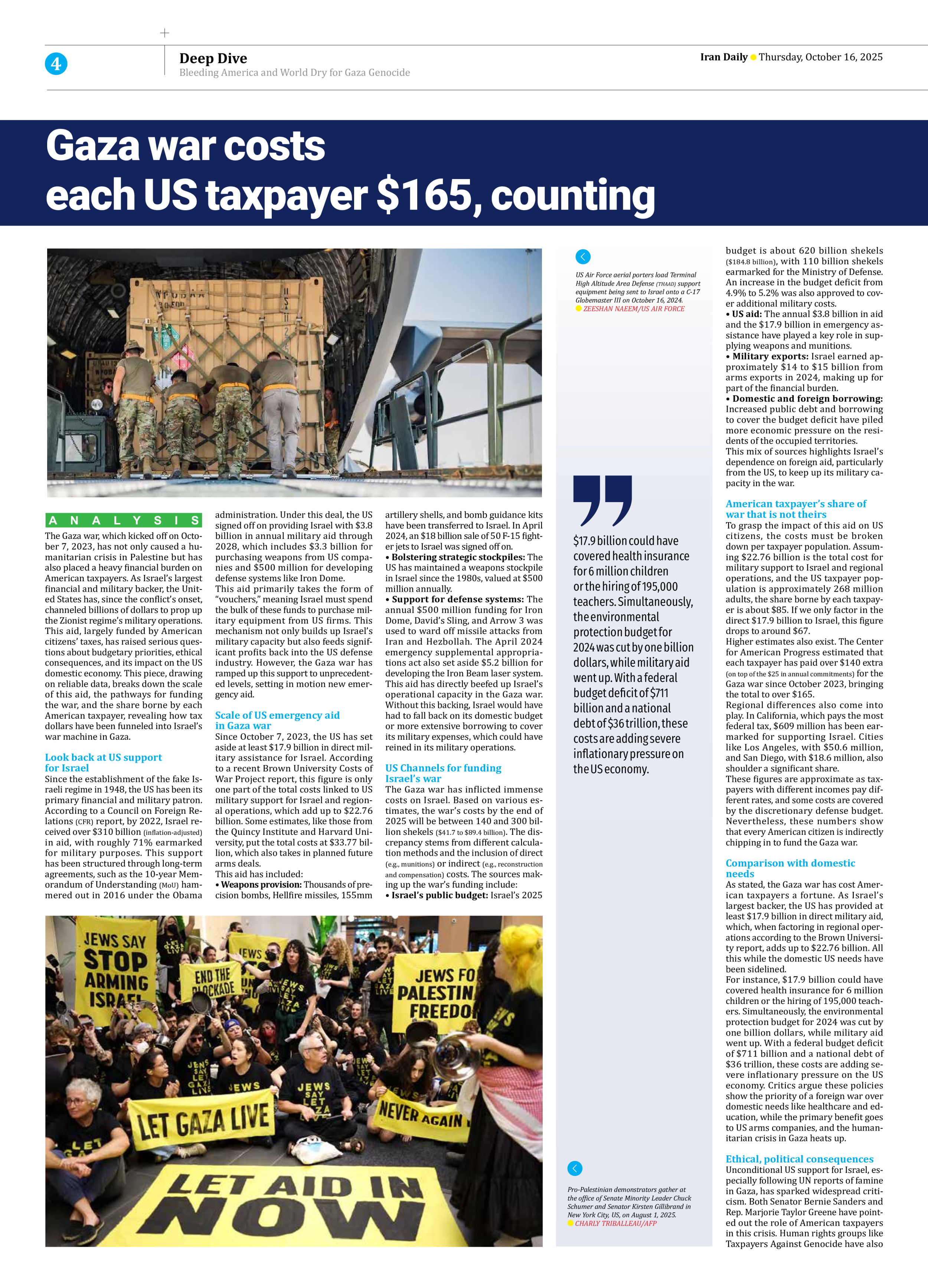
The Gaza war, which kicked off on October 7, 2023, has not only caused a humanitarian crisis in Palestine but has also placed a heavy financial burden on American taxpayers. As Israel’s largest financial and military backer, the United States has, since the conflict’s onset, channeled billions of dollars to prop up the Zionist regime’s military operations.
This aid, largely funded by American citizens’ taxes, has raised serious questions about budgetary priorities, ethical consequences, and its impact on the US domestic economy. This piece, drawing on reliable data, breaks down the scale of this aid, the pathways for funding the war, and the share borne by each American taxpayer, revealing how tax dollars have been funneled into Israel’s war machine in Gaza.
Look back at US support
for Israel
Since the establishment of the fake Israeli regime in 1948, the US has been its primary financial and military patron. According to a Council on Foreign Relations (CFR) report, by 2022, Israel received over $310 billion (inflation-adjusted) in aid, with roughly 71% earmarked for military purposes. This support has been structured through long-term agreements, such as the 10-year Memorandum of Understanding (MoU) hammered out in 2016 under the Obama administration. Under this deal, the US signed off on providing Israel with $3.8 billion in annual military aid through 2028, which includes $3.3 billion for purchasing weapons from US companies and $500 million for developing defense systems like Iron Dome.
This aid primarily takes the form of “vouchers,” meaning Israel must spend the bulk of these funds to purchase military equipment from US firms. This mechanism not only builds up Israel’s military capacity but also feeds significant profits back into the US defense industry. However, the Gaza war has ramped up this support to unprecedented levels, setting in motion new emergency aid.
Scale of US emergency aid
in Gaza war
Since October 7, 2023, the US has set aside at least $17.9 billion in direct military assistance for Israel. According to a recent Brown University Costs of War Project report, this figure is only one part of the total costs linked to US military support for Israel and regional operations, which add up to $22.76 billion. Some estimates, like those from the Quincy Institute and Harvard University, put the total costs at $33.77 billion, which also takes in planned future arms deals.
This aid has included:
• Weapons provision: Thousands of precision bombs, Hellfire missiles, 155mm artillery shells, and bomb guidance kits have been transferred to Israel. In April 2024, an $18 billion sale of 50 F-15 fighter jets to Israel was signed off on.
• Bolstering strategic stockpiles: The US has maintained a weapons stockpile in Israel since the 1980s, valued at $500 million annually.
• Support for defense systems: The annual $500 million funding for Iron Dome, David’s Sling, and Arrow 3 was used to ward off missile attacks from Iran and Hezbollah. The April 2024 emergency supplemental appropriations act also set aside $5.2 billion for developing the Iron Beam laser system.
This aid has directly beefed up Israel’s operational capacity in the Gaza war. Without this backing, Israel would have had to fall back on its domestic budget or more extensive borrowing to cover its military expenses, which could have reined in its military operations.
US Channels for funding
Israel’s war
The Gaza war has inflicted immense costs on Israel. Based on various estimates, the war’s costs by the end of 2025 will be between 140 and 300 billion shekels ($41.7 to $89.4 billion). The discrepancy stems from different calculation methods and the inclusion of direct (e.g., munitions) or indirect (e.g., reconstruction and compensation) costs. The sources making up the war’s funding include:
• Israel’s public budget: Israel’s 2025 budget is about 620 billion shekels ($184.8 billion), with 110 billion shekels earmarked for the Ministry of Defense. An increase in the budget deficit from 4.9% to 5.2% was also approved to cover additional military costs.
• US aid: The annual $3.8 billion in aid and the $17.9 billion in emergency assistance have played a key role in supplying weapons and munitions.
• Military exports: Israel earned approximately $14 to $15 billion from arms exports in 2024, making up for part of the financial burden.
• Domestic and foreign borrowing: Increased public debt and borrowing to cover the budget deficit have piled more economic pressure on the residents of the occupied territories.
This mix of sources highlights Israel’s dependence on foreign aid, particularly from the US, to keep up its military capacity in the war.
American taxpayer’s share of war that is not theirs
To grasp the impact of this aid on US citizens, the costs must be broken down per taxpayer population. Assuming $22.76 billion is the total cost for military support to Israel and regional operations, and the US taxpayer population is approximately 268 million adults, the share borne by each taxpayer is about $85. If we only factor in the direct $17.9 billion to Israel, this figure drops to around $67.
Higher estimates also exist. The Center for American Progress estimated that each taxpayer has paid over $140 extra (on top of the $25 in annual commitments) for the Gaza war since October 2023, bringing the total to over $165.
Regional differences also come into play. In California, which pays the most federal tax, $609 million has been earmarked for supporting Israel. Cities like Los Angeles, with $50.6 million, and San Diego, with $18.6 million, also shoulder a significant share.
These figures are approximate as taxpayers with different incomes pay different rates, and some costs are covered by the discretionary defense budget. Nevertheless, these numbers show that every American citizen is indirectly chipping in to fund the Gaza war.
Comparison with domestic needs
As stated, the Gaza war has cost American taxpayers a fortune. As Israel’s largest backer, the US has provided at least $17.9 billion in direct military aid, which, when factoring in regional operations according to the Brown University report, adds up to $22.76 billion. All this while the domestic US needs have been sidelined.
For instance, $17.9 billion could have covered health insurance for 6 million children or the hiring of 195,000 teachers. Simultaneously, the environmental protection budget for 2024 was cut by one billion dollars, while military aid went up. With a federal budget deficit of $711 billion and a national debt of $36 trillion, these costs are adding severe inflationary pressure on the US economy. Critics argue these policies show the priority of a foreign war over domestic needs like healthcare and education, while the primary benefit goes to US arms companies, and the humanitarian crisis in Gaza heats up.
Ethical, political consequences
Unconditional US support for Israel, especially following UN reports of famine in Gaza, has sparked widespread criticism. Both Senator Bernie Sanders and Rep. Marjorie Taylor Greene have pointed out the role of American taxpayers in this crisis. Human rights groups like Taxpayers Against Genocide have also accused the US government of complicity in human rights violations.
Polls indicate a sea change in public opinion, particularly among the youth. According to a Pew Research Center poll from March 2024, 51% of those aged 18–29 oppose military aid to Israel. Even among American Jews, 4 out of 10 believe Israel has committed genocide. This public pressure may, in the future, lead to a reassessment of military aid agreements.
Challenges, prospects of future US support
As the end of the 2019–2028 MoU draws near, negotiations for a new agreement will kick off. Proposals such as replacing direct aid with security pacts or tying aid to human rights compliance have been put forward. Analysts like Steven Cook believe Israel should cut its dependence on foreign aid. However, powerful lobbies like AIPAC and bipartisan support in Congress make scaling back aid difficult. At the same time, public pressure and campus protests may push policymakers to re-evaluate their priorities.
The article first appeared in Persian on IRNA.