







A new Afghan war?
By Sushant Sareen
Senior fellow at Observer Research Foundation
Reports coming in from Afghanistan claim an aerial attack Saturday night on a few places in Kabul and some other parts of Eastern Afghanistan along the border with Pakistan.
There is speculation about possible United States (US) involvement in the attacks. If indeed the Americans were involved, was it at the technical level, or was it to the extent of intelligence sharing, or did it involve kinetic action remains in the realm of speculation. The target of the attacks is believed to be the Tehrik-e-Taliban Pakistan (TTP) emir, Noor Wali Mehsud. However, an audio clip purportedly of Mehsud surfaced soon after the attack, claiming that he is in the tribal districts of Pakistan, not Afghanistan.
This is not the first time that Pakistanis have used air power against alleged terrorist targets in Afghanistan. However, past attacks were generally limited to border areas, which were remote and inaccessible. This is the first time that Pakistan has decided to strike at the heart of Afghanistan. The repercussions of such an audacious attack will be far-reaching.
Earlier attacks were downplayed by the Taliban and not made much of an issue, at least not to a point where it would have led to a major break with Pakistan. A strike on Kabul will, however, be difficult, if not impossible, to brush under the carpet. Although the initial reaction from the official spokesman of the Taliban, Zabiullah Mujahid, and the Kabul police chief has been measured, the Taliban will have to take a strong stand on the Pakistani attack on the capital city. To not do so will seriously dent the legitimacy of the Taliban regime and raise questions or even challenge their authority.
While the Taliban are not in a position to respond to Pakistan in kind as they lack an air force and an effective air defence system, they do have other ways to hit back. Broadly, there are four options available to the Taliban.
The first is to do nothing. Make a bit of noise and then move on. But such restraint will raise serious questions about their legitimacy as the Taliban would appear fearful of Pakistan or being compromised by their long association with Pakistan. Even if the senior leadership prefers not to escalate, the foot soldiers will want to take revenge.
The second option is to speak softly but ramp up the attacks. This will mean lifting the restraints imposed on Taliban cadres to not joining the ranks of TTP and desisting from participating in attacks inside Pakistan.
The third option is to declare war on Pakistan and unleash guerrilla forces to exact retribution.
Finally, there is a remote possibility that the Pakistani attacks will have a salutary impact on the Taliban and force them to either expel or curb the activities of TTP inside Afghanistan.
Regardless of the option that is picked, as long as the TTP continues to bleed Pakistan, there is no solution to the problem. The fact that the TTP attacks have increased in intensity, ferocity, and even geography — with recent claims by the anti-Pakistan jihadist alliance Ittehadul Mujahideen Pakistan of carrying out attacks even in Jammu and Kashmir — means that it will not be easy to eliminate them.
The TTP and other groups claim that they are now operating from inside Pakistan. The Taliban authorities in Afghanistan also insist that this is Pakistan’s problem and that Afghanistan is being made a scapegoat. But Pakistan insists that not just the Islamist jihadists but also Baloch freedom fighters are operating from bases inside Afghanistan.
The issue for Pakistan is that bombing targets in Afghanistan won’t solve the problem. All it will do is satisfy public opinion, especially in Punjab, where an anti-Pashtun sentiment is simmering. But kinetic military action has its limitations. If anything, attacks on Afghanistan will only lead to Afghans, even those who are against the Taliban, closing ranks against Pakistan. Recent reports suggest that the Interior Minister Sirajuddin Haqqani was being sidelined by the Kandahar clique that calls the shots. But the Haqqanis won’t be caught dead siding with Pakistan against the Taliban Emir. Interestingly, the Pakistani attacks have been criticised by some senior military officials of the erstwhile Islamic Republic of Afghanistan.
The other option for Pakistan is to unleash another round of destabilisation in Afghanistan. The instruments for this will be sections of the erstwhile republic who are carrying out a low-level insurgency against the Taliban, and using the Daesh-affiliated terror outfit in Afghanistan as a proxy to wage a dirty war in Afghanistan as a tit-for-tat. The Taliban have already accused Pakistan of giving bases to the outfit in Balochistan, and there are some reports that some insurgent militants could also be deployed against the Taliban and TTP.
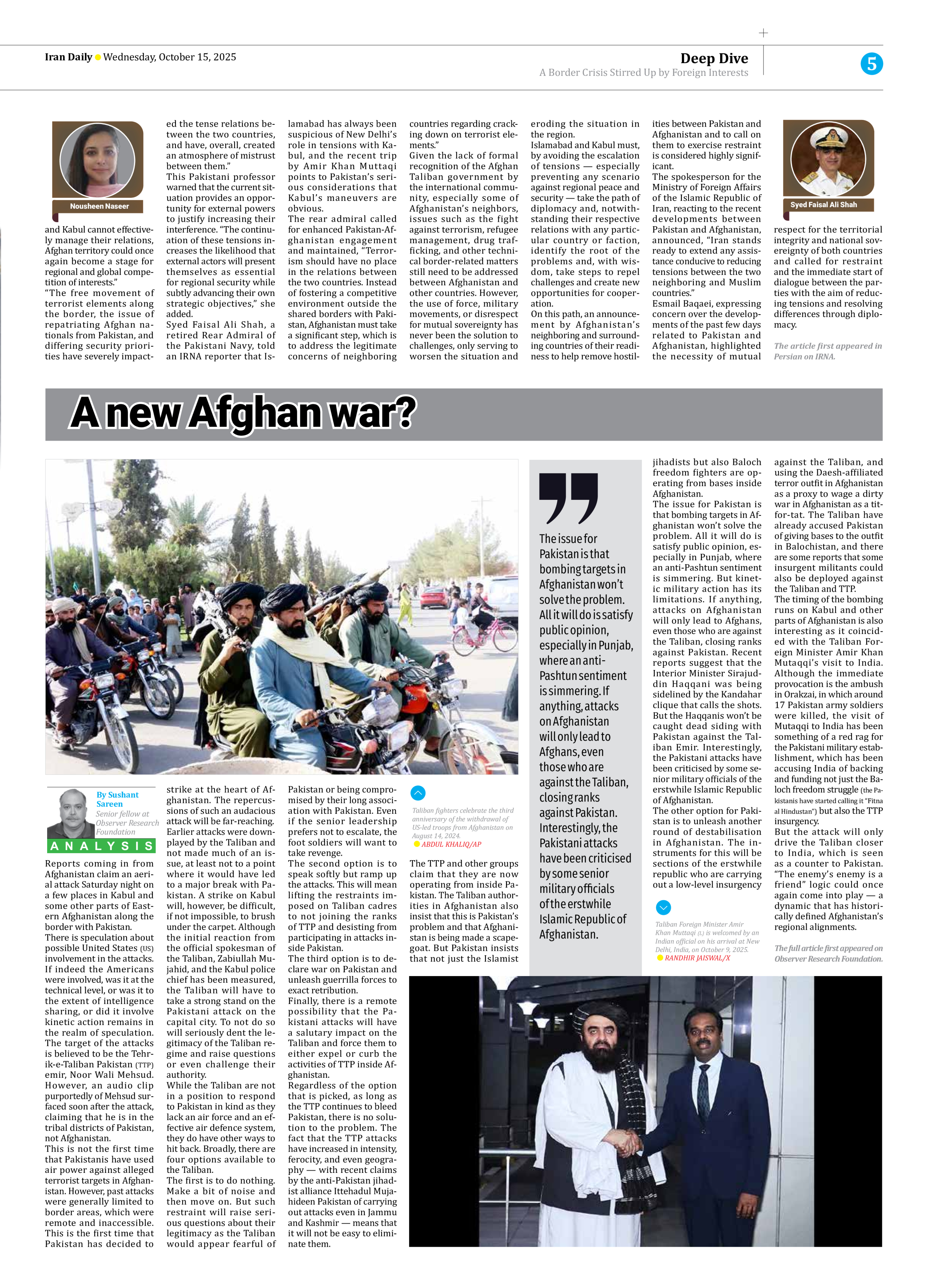
The timing of the bombing runs on Kabul and other parts of Afghanistan is also interesting as it coincided with the Taliban Foreign Minister Amir Khan Mutaqqi’s visit to India. Although the immediate provocation is the ambush in Orakzai, in which around 17 Pakistan army soldiers were killed, the visit of Mutaqqi to India has been something of a red rag for the Pakistani military establishment, which has been accusing India of backing and funding not just the Baloch freedom struggle (the Pakistanis have started calling it “Fitna al Hindustan”) but also the TTP insurgency.
But the attack will only drive the Taliban closer to India, which is seen as a counter to Pakistan. “The enemy’s enemy is a friend” logic could once again come into play — a dynamic that has historically defined Afghanistan’s regional alignments.
The full article first appeared on Observer Research Foundation.