





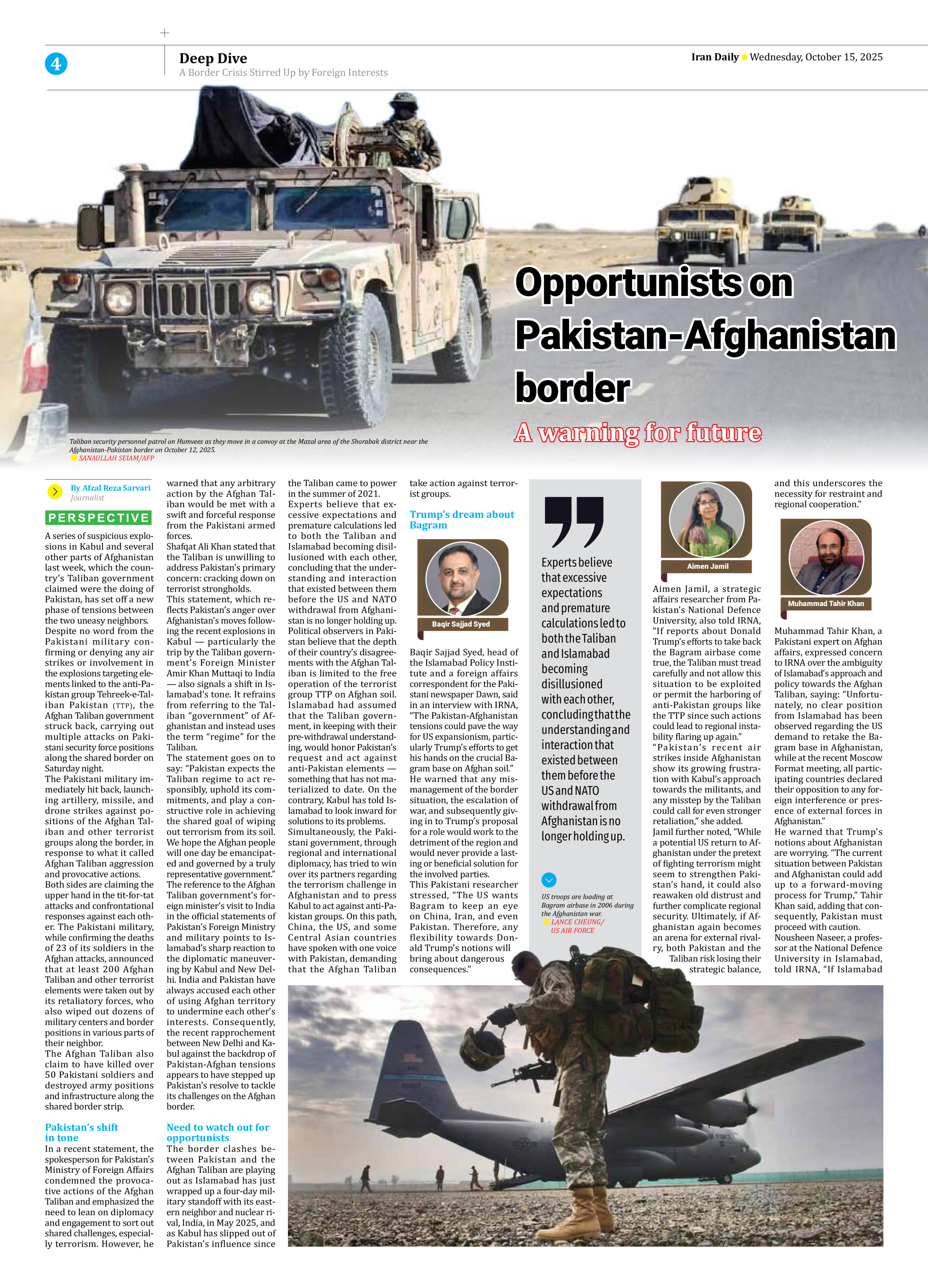


Opportunists on Pakistan-Afghanistan border
A warning for future
By Afzal Reza Sarvari
Journalist
A series of suspicious explosions in Kabul and several other parts of Afghanistan last week, which the country’s Taliban government claimed were the doing of Pakistan, has set off a new phase of tensions between the two uneasy neighbors.
Despite no word from the Pakistani military confirming or denying any air strikes or involvement in the explosions targeting elements linked to the anti-Pakistan group Tehreek-e-Taliban Pakistan (TTP), the Afghan Taliban government struck back, carrying out multiple attacks on Pakistani security force positions along the shared border on Saturday night.
The Pakistani military immediately hit back, launching artillery, missile, and drone strikes against positions of the Afghan Taliban and other terrorist groups along the border, in response to what it called Afghan Taliban aggression and provocative actions.
Both sides are claiming the upper hand in the tit-for-tat attacks and confrontational responses against each other. The Pakistani military, while confirming the deaths of 23 of its soldiers in the Afghan attacks, announced that at least 200 Afghan Taliban and other terrorist elements were taken out by its retaliatory forces, who also wiped out dozens of military centers and border positions in various parts of their neighbor.
The Afghan Taliban also claim to have killed over 50 Pakistani soldiers and destroyed army positions and infrastructure along the shared border strip.
Pakistan’s shift
in tone
In a recent statement, the spokesperson for Pakistan’s Ministry of Foreign Affairs condemned the provocative actions of the Afghan Taliban and emphasized the need to lean on diplomacy and engagement to sort out shared challenges, especially terrorism. However, he warned that any arbitrary action by the Afghan Taliban would be met with a swift and forceful response from the Pakistani armed forces.
Shafqat Ali Khan stated that the Taliban is unwilling to address Pakistan’s primary concern: cracking down on terrorist strongholds.
This statement, which reflects Pakistan’s anger over Afghanistan’s moves following the recent explosions in Kabul — particularly the trip by the Taliban government’s Foreign Minister Amir Khan Muttaqi to India — also signals a shift in Islamabad’s tone. It refrains from referring to the Taliban “government” of Afghanistan and instead uses the term “regime” for the Taliban.
The statement goes on to say: “Pakistan expects the Taliban regime to act responsibly, uphold its commitments, and play a constructive role in achieving the shared goal of wiping out terrorism from its soil. We hope the Afghan people will one day be emancipated and governed by a truly representative government.”
The reference to the Afghan Taliban government’s foreign minister’s visit to India in the official statements of Pakistan’s Foreign Ministry and military points to Islamabad’s sharp reaction to the diplomatic maneuvering by Kabul and New Delhi. India and Pakistan have always accused each other of using Afghan territory to undermine each other’s interests. Consequently, the recent rapprochement between New Delhi and Kabul against the backdrop of Pakistan-Afghan tensions appears to have stepped up Pakistan’s resolve to tackle its challenges on the Afghan border.
Need to watch out for opportunists
The border clashes between Pakistan and the Afghan Taliban are playing out as Islamabad has just wrapped up a four-day military standoff with its eastern neighbor and nuclear rival, India, in May 2025, and as Kabul has slipped out of Pakistan’s influence since the Taliban came to power in the summer of 2021.
Experts believe that excessive expectations and premature calculations led to both the Taliban and Islamabad becoming disillusioned with each other, concluding that the understanding and interaction that existed between them before the US and NATO withdrawal from Afghanistan is no longer holding up.
Political observers in Pakistan believe that the depth of their country’s disagreements with the Afghan Taliban is limited to the free operation of the terrorist group TTP on Afghan soil. Islamabad had assumed that the Taliban government, in keeping with their pre-withdrawal understanding, would honor Pakistan’s request and act against anti-Pakistan elements — something that has not materialized to date. On the contrary, Kabul has told Islamabad to look inward for solutions to its problems.
Simultaneously, the Pakistani government, through regional and international diplomacy, has tried to win over its partners regarding the terrorism challenge in Afghanistan and to press Kabul to act against anti-Pakistan groups. On this path, China, the US, and some Central Asian countries have spoken with one voice with Pakistan, demanding that the Afghan Taliban take action against terrorist groups.
Trump’s dream about Bagram
Baqir Sajjad Syed, head of the Islamabad Policy Institute and a foreign affairs correspondent for the Pakistani newspaper Dawn, said in an interview with IRNA, “The Pakistan-Afghanistan tensions could pave the way for US expansionism, particularly Trump’s efforts to get his hands on the crucial Bagram base on Afghan soil.”
He warned that any mismanagement of the border situation, the escalation of war, and subsequently giving in to Trump’s proposal for a role would work to the detriment of the region and would never provide a lasting or beneficial solution for the involved parties.
This Pakistani researcher stressed, “The US wants Bagram to keep an eye on China, Iran, and even Pakistan. Therefore, any flexibility towards Donald Trump’s notions will bring about dangerous consequences.”
Aimen Jamil, a strategic affairs researcher from Pakistan’s National Defence University, also told IRNA, “If reports about Donald Trump’s efforts to take back the Bagram airbase come true, the Taliban must tread carefully and not allow this situation to be exploited or permit the harboring of anti-Pakistan groups like the TTP since such actions could lead to regional instability flaring up again.”
“Pakistan’s recent air strikes inside Afghanistan show its growing frustration with Kabul’s approach towards the militants, and any misstep by the Taliban could call for even stronger retaliation,” she added.
Jamil further noted, “While a potential US return to Afghanistan under the pretext of fighting terrorism might seem to strengthen Pakistan’s hand, it could also reawaken old distrust and further complicate regional security. Ultimately, if Afghanistan again becomes an arena for external rivalry, both Pakistan and the Taliban risk losing their strategic balance, and this underscores the necessity for restraint and regional cooperation.”
Muhammad Tahir Khan, a Pakistani expert on Afghan affairs, expressed concern to IRNA over the ambiguity of Islamabad’s approach and policy towards the Afghan Taliban, saying: “Unfortunately, no clear position from Islamabad has been observed regarding the US demand to retake the Bagram base in Afghanistan, while at the recent Moscow Format meeting, all participating countries declared their opposition to any foreign interference or presence of external forces in Afghanistan.”
He warned that Trump’s notions about Afghanistan are worrying. “The current situation between Pakistan and Afghanistan could add up to a forward-moving process for Trump,” Tahir Khan said, adding that consequently, Pakistan must proceed with caution.
Nousheen Naseer, a professor at the National Defence University in Islamabad, told IRNA, “If Islamabad and Kabul cannot effectively manage their relations, Afghan territory could once again become a stage for regional and global competition of interests.”
“The free movement of terrorist elements along the border, the issue of repatriating Afghan nationals from Pakistan, and differing security priorities have severely impacted the tense relations between the two countries, and have, overall, created an atmosphere of mistrust between them.”
This Pakistani professor warned that the current situation provides an opportunity for external powers to justify increasing their interference. “The continuation of these tensions increases the likelihood that external actors will present themselves as essential for regional security while subtly advancing their own strategic objectives,” she added.
Syed Faisal Ali Shah, a retired Rear Admiral of the Pakistani Navy, told an IRNA reporter that Islamabad has always been suspicious of New Delhi’s role in tensions with Kabul, and the recent trip by Amir Khan Muttaqi points to Pakistan’s serious considerations that Kabul’s maneuvers are obvious.
The rear admiral called for enhanced Pakistan-Afghanistan engagement and maintained, “Terrorism should have no place in the relations between the two countries. Instead of fostering a competitive environment outside the shared borders with Pakistan, Afghanistan must take a significant step, which is to address the legitimate concerns of neighboring countries regarding cracking down on terrorist elements.”
Given the lack of formal recognition of the Afghan Taliban government by the international community, especially some of Afghanistan’s neighbors, issues such as the fight against terrorism, refugee management, drug trafficking, and other technical border-related matters still need to be addressed between Afghanistan and other countries. However, the use of force, military movements, or disrespect for mutual sovereignty has never been the solution to challenges, only serving to worsen the situation and eroding the situation in the region.
Islamabad and Kabul must, by avoiding the escalation of tensions — especially preventing any scenario against regional peace and security — take the path of diplomacy and, notwithstanding their respective relations with any particular country or faction, identify the root of the problems and, with wisdom, take steps to repel challenges and create new opportunities for cooperation.
On this path, an announcement by Afghanistan’s neighboring and surrounding countries of their readiness to help remove hostilities between Pakistan and Afghanistan and to call on them to exercise restraint is considered highly significant.
The spokesperson for the Ministry of Foreign Affairs of the Islamic Republic of Iran, reacting to the recent developments between Pakistan and Afghanistan, announced, “Iran stands ready to extend any assistance conducive to reducing tensions between the two neighboring and Muslim countries.”
Esmail Baqaei, expressing concern over the developments of the past few days related to Pakistan and Afghanistan, highlighted the necessity of mutual respect for the territorial integrity and national sovereignty of both countries and called for restraint and the immediate start of dialogue between the parties with the aim of reducing tensions and resolving differences through diplomacy.
The article first appeared in
Persian on IRNA.