







Eight historic mosques from East Azarbaijan nominated for UNESCO world heritage listing
From stone sanctuaries to wooden marvels, Iran’s NW preserves centuries of faith, art
By Sadeq Dehqan
Staff writer
From the turquoise domes of Tabriz to the carved stone columns of rural Asnagh, the mosques of East Azarbaijan stand as living testaments to centuries of Iranian art, faith, and craftsmanship.
Nestled along ancient trade routes that once linked Persia to the Caucasus and Anatolia, the province is home to some of the country’s most architecturally diverse houses of worship—many built of stone, wood, and glazed tile in styles that evolved through successive Islamic dynasties.
Now, eight of these historic mosques have been nominated for inclusion in Iran’s new UNESCO World Heritage dossier, highlighting the enduring spiritual and cultural legacy of northwestern Iran.
The deputy director of the East Azarbaijan Province Cultural Heritage and Tourism Department announced that eight historic mosques in East Azarbaijan have been selected in the final shortlist of the province’s nominations for inclusion in Iran’s UNESCO World Heritage dossier for mosques.
In a conversation with Iran Daily, Vahid Navadad explained that over the past few days, evaluators from the ministry’s world-heritage mosque dossier team visited these mosques across the province to study their historical and architectural features up close.
He said that preparations for inscribing Iranian mosques on the UNESCO World Heritage list began about two years ago, during which more than a thousand mosques throughout the country were evaluated. Through successive rounds of screening, officials from the ministry narrowed the field to 32 mosques across 14 provinces. These mosques date from as early as the 8th century AH through the Qajar era.
Navadad noted that the process includes the removal of later additions and obstacles within the precincts and buffer zones of the mosques, alongside necessary restoration work—tasks overseen by the ministry’s evaluators in support of the global nomination.
He added that under the umbrella of the Iranian Mosques World Heritage dossier, selected mosques from across the country are under review. Once the dossier is fully drafted, it will be submitted to UNESCO. Initially, the East Azarbaijan heritage office put forward fifteen candidate mosques, but subsequent evaluation and consolidation reduced that number to eight.
Referring to the list of East Azarbaijan mosques in the UNESCO dossier, he named the following, Blue Mosque (Tabriz), Sheikh Shahab al-Din Ahari Mosque (Ahar), Jameh Mosque of Sarab, historic village mosque of Asnagh, Stone Mosque of Tark in Miyaneh, Molla Rostam Mosque (Maragheh), Mehrabad Mosque (Bonab), Jameh Mosque of Tasuj.
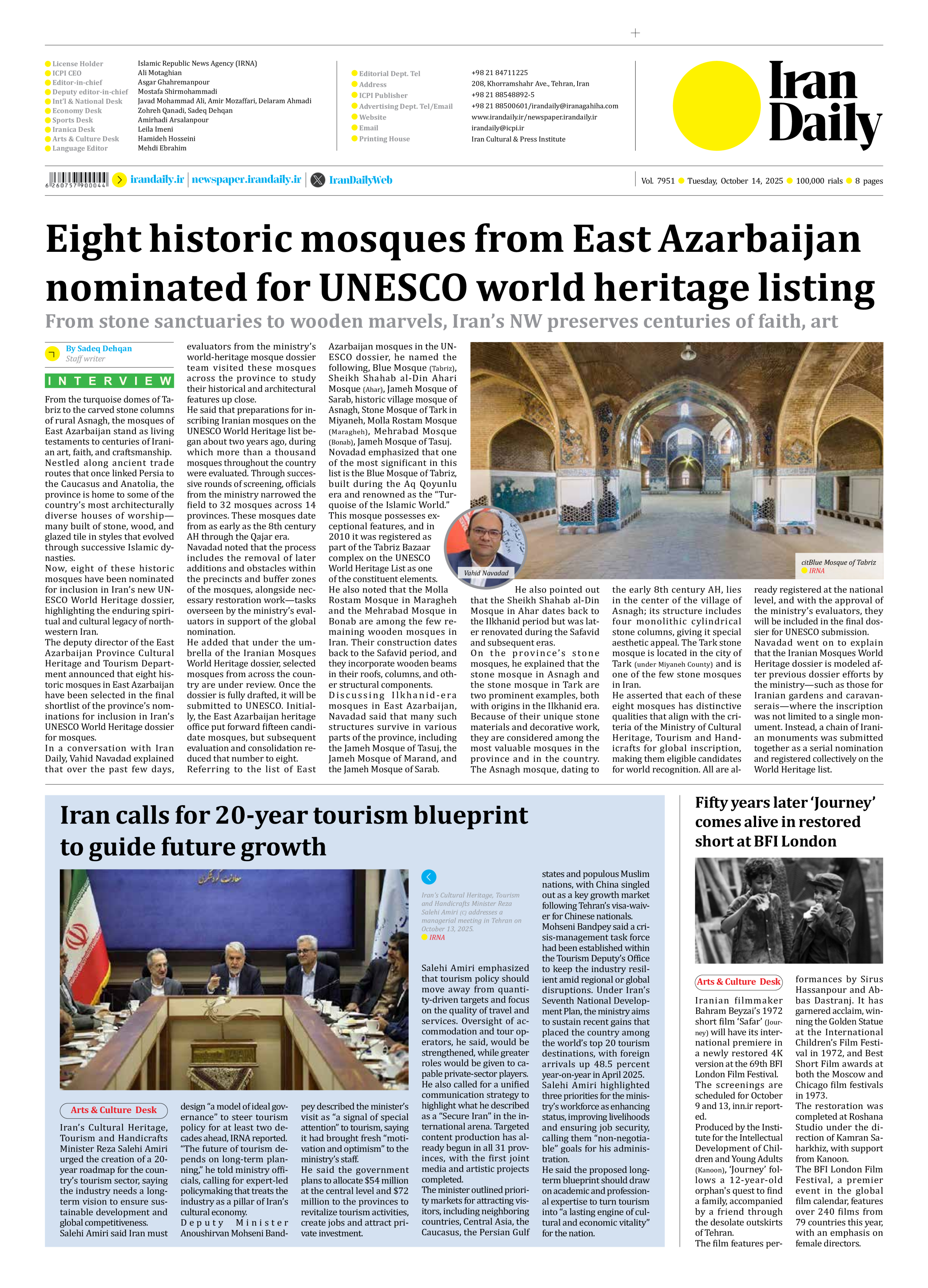
Novadad emphasized that one of the most significant in this list is the Blue Mosque of Tabriz, built during the Aq Qoyunlu era and renowned as the “Turquoise of the Islamic World.” This mosque possesses exceptional features, and in 2010 it was registered as part of the Tabriz Bazaar complex on the UNESCO World Heritage List as one of the constituent elements.
He also noted that the Molla Rostam Mosque in Maragheh and the Mehrabad Mosque in Bonab are among the few remaining wooden mosques in Iran. Their construction dates back to the Safavid period, and they incorporate wooden beams in their roofs, columns, and other structural components.
Discussing Ilkhanid-era mosques in East Azarbaijan, Navadad said that many such structures survive in various parts of the province, including the Jameh Mosque of Tasuj, the Jameh Mosque of Marand, and the Jameh Mosque of Sarab.
He also pointed out that the Sheikh Shahab al-Din Mosque in Ahar dates back to the Ilkhanid period but was later renovated during the Safavid and subsequent eras.
On the province’s stone mosques, he explained that the stone mosque in Asnagh and the stone mosque in Tark are two prominent examples, both with origins in the Ilkhanid era. Because of their unique stone materials and decorative work, they are considered among the most valuable mosques in the province and in the country. The Asnagh mosque, dating to the early 8th century AH, lies in the center of the village of Asnagh; its structure includes four monolithic cylindrical stone columns, giving it special aesthetic appeal. The Tark stone mosque is located in the city of Tark (under Miyaneh County) and is one of the few stone mosques in Iran.
He asserted that each of these eight mosques has distinctive qualities that align with the criteria of the Ministry of Cultural Heritage, Tourism and Handicrafts for global inscription, making them eligible candidates for world recognition. All are already registered at the national level, and with the approval of the ministry’s evaluators, they will be included in the final dossier for UNESCO submission.
Navadad went on to explain that the Iranian Mosques World Heritage dossier is modeled after previous dossier efforts by the ministry—such as those for Iranian gardens and caravanserais—where the inscription was not limited to a single monument. Instead, a chain of Iranian monuments was submitted together as a serial nomination and registered collectively on the World Heritage list.